Towards optimal morphology in organic solar cells?
Oskar J Sandberg, Ronald Österbacka

Abstract
Genes, proteins, chemicals, diseases, species, mutations and cell lines named across the full text — each resolved to its canonical identifier and authoritative record.
Click any figure to enlarge with its caption.
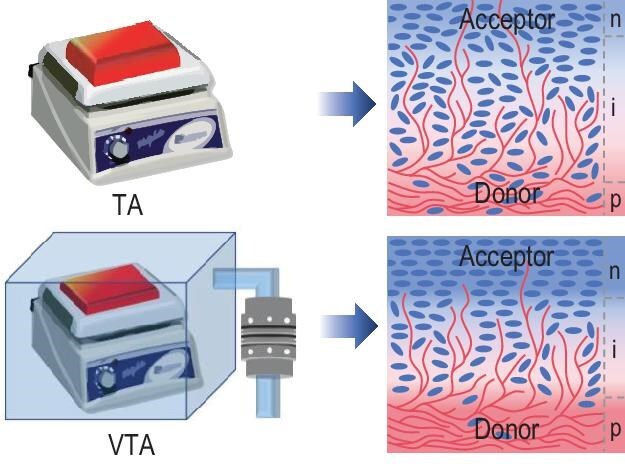 Figure 1
Peer Reviews
No public reviews on file for this paper yet. If you reviewed it on a platform where reviews are public (OpenReview, ICLR, NeurIPS, ICML), you can paste yours below so the community can read it here.
Videos
No videos yet. Explain this paper in a talk, walkthrough, or lecture? Add one.
Taxonomy
TopicsOrganic Electronics and Photovoltaics · Advanced Memory and Neural Computing · Chemical and Physical Properties of Materials
Organic solar cells (OSCs) show great promise within the renewable energy sector, as sustainable and cost-effective alternatives comprising lightweight and flexible solar cells manufactured using low-cost methods such as printing [1]. However, in contrast to other solar cell technologies, OSCs are inherently excitonic, meaning that the photon absorption produces strongly bound excitons rather than free charge carriers. To overcome this, OSCs based on bulk heterojunction (BHJ) blends of two different organic semiconductor components—a donor (D) and an acceptor (A)—are commonly used. Excitons are efficiently dissociated at the D–A interfaces, ultimately generating free electrons (holes) in the acceptor (donor) phase. The free electrons (holes) are subsequently transported in the acceptor (donor) phase to the cathode (anode) where they are collected [2]. The phase separation in the BHJ needs to be optimized to maximize the exciton dissociation, while simultaneously ensuring percolating, continuous transport pathways for charge extraction. As such, controlling the morphology in OSCs is of utmost importance, complicated by the fact that the morphology in state-of-the-art BHJs is generally not stable, leading to poor overall stability [3].
The stability can, in principle, be increased using a planar heterojunction (PHJ) where a donor and acceptor layer is stacked one upon the other. While PHJs facilitate selective charge extraction, the exciton dissociation is limited to one exciton diffusion length (typically around 10 nm) from the D–A interface, resulting in a substantial loss in photocurrent. An alternative approach that combines the advantages of BHJs and PHJs is to use a pseudo-BHJ (p-BHJ) structure (see Fig. 1, right). The p-BHJ is constructed by sequential deposition of donor and acceptor, intermixing and forming continuous transport pathways through vertical compositional gradients. Ideally, the p-BHJ forms a p-i-n-like structure, with donor- and acceptor-rich domains at the anode and cathode, and a gradually more intermixed morphology in between [4]. However, achieving an ideal morphology has remained challenging.
To improve the morphology of OSCs, post treatments such as thermal annealing (TA) are commonly employed. In the paper by Cheng and co-workers, they introduce a post-treatment based on vacuum-assisted TA (VTA) that combines vacuum and thermal annealing (see Fig. 1) [5]. The VTA treatment was applied to p-BHJ OSCs, showing superior performance and stability compared to standard TA. VTA-treated p-BHJs based on D18:L8-BO and PM6:L8-BO reached impressive power conversion efficiencies of 20.5% and 20.0%, respectively. The enhancements were underpinned by increases in short-circuit current densities, fill factors and open-circuit voltages, consistent with improved charge carrier generation, extraction and selectivity.
VTA accelerates solvent evaporation, enhances acceptor crystallization at the top surface, and reduces excessive intermixing of donor and acceptor materials. As a result, a more stratified configuration, resembling an optimal p-i-n-like morphology, is obtained. Techniques probing the morphology further revealed enhanced crystallinity and molecular packing in VTA-treated films. The VTA treatment was also found to significantly reduce the burn-in effect, resulting in enhanced operational stability of the OSCs. VTA-treated OSCs exhibited T80 lifetimes exceeding 3900 h under ISOS-L-1 conditions and 5400 h when using a device structure with stable contacts. Furthermore, VTA-treated OSCs showed improved resilience against thermal, light and moisture stresses, as evidenced by T80 lifetimes of over 1200 h achieved under accelerated ISOS-L-3 conditions.
In summary, VTA post-treatment of p-BHJs appears to form the optimal morphology in OSCs, leading to higher efficiencies and improved stability due to better crystallization and suppressed intermixing, ultimately advancing OSC technology.
The reference list from the paper itself. Each links out to its DOI / PubMed record.
- 1Kippelen B, Brédas JL. Energy Environ Sci 2009; 2: 251–61.10.1039/b 812502 n · doi ↗
- 2Armin A, Li W, Sandberg OJ et al. Adv Energy Mater 2021; 11: 2003570.10.1002/aenm.202003570 · doi ↗
- 3Jee MH, Ryu HS, Lee D et al. Adv Sci 2022; 9: 2201876.10.1002/advs.202201876 PMC 944347035794317 · doi ↗ · pubmed ↗
- 4Li D, Kay AM, Riley DB. Adv Energy Mater 2025; 15: 2500816.10.1002/aenm.202500816 · doi ↗
- 5Cheng J, Wang L, Wang T et al. Natl Sci Rev 2025; 12: nwaf 440.10.1093/nsr/nwaf 44041311642 PMC 12648560 · doi ↗ · pubmed ↗