Sarcoidosis-like cutaneous lesions in paracoccidioidomycosis: four case reports and review of the literature
Jaqueline Santos Ribeiro, Rafael Fantelli Stelini, Renata Ferreira Magalhães, Paulo Eduardo Neves Ferreira Velho, Andrea Fernandes Eloy da Costa França

Abstract
Genes, proteins, chemicals, diseases, species, mutations and cell lines named across the full text — each resolved to its canonical identifier and authoritative record.
Click any figure to enlarge with its caption.
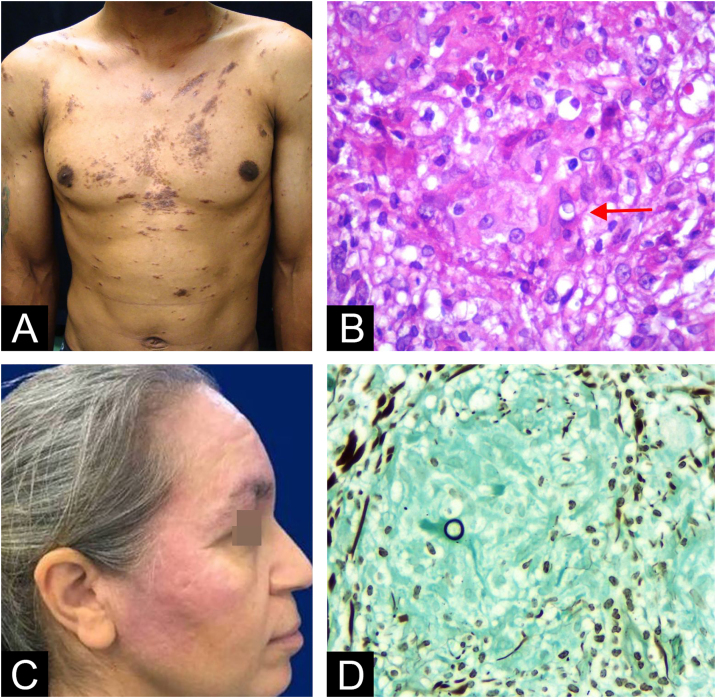 Figure 1
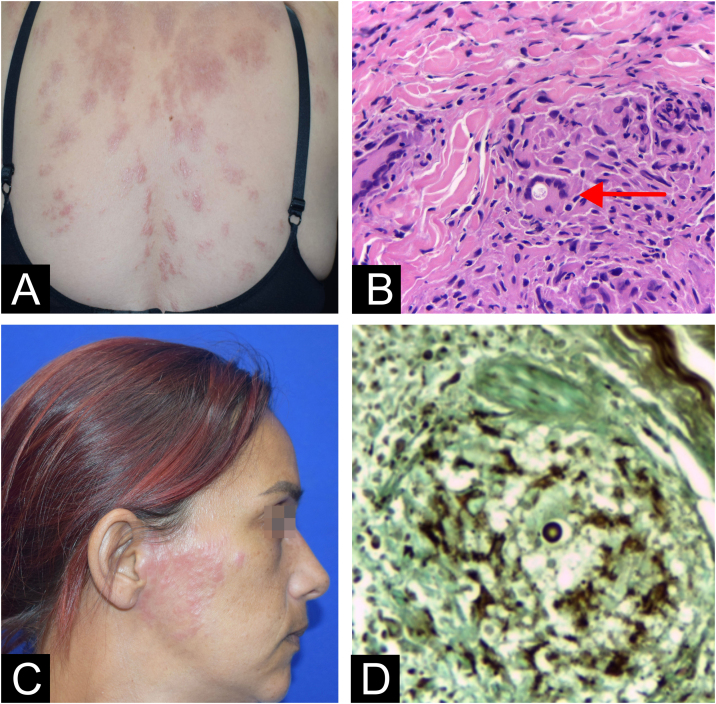 Figure 2
Peer Reviews
No public reviews on file for this paper yet. If you reviewed it on a platform where reviews are public (OpenReview, ICLR, NeurIPS, ICML), you can paste yours below so the community can read it here.
Videos
No videos yet. Explain this paper in a talk, walkthrough, or lecture? Add one.
Taxonomy
TopicsFungal Infections and Studies · Sarcoidosis and Beryllium Toxicity Research · Nail Diseases and Treatments
Dear Editor,
Paracoccidioidomycosis (PCM) is a deep mycosis caused by the thermo-dimorphic fungi Paracoccidioides brasiliensis complex and Paracoccidioides lutzii. Although common in Latin America, its true prevalence is underestimated due to the lack of mandatory reporting. The clinical manifestations often develop many years after inhalation of conidia from soil due to the reactivation of endogenous latent foci.1
PCM can involve any organ, but its clinical presentation is typically classified into acute/subacute and chronic forms.1 Skin involvement occurs in up to 30% of patients with chronic PCM. The oral mucosa typically presents with ulcers featuring hemorrhagic dots (moriform stomatitis), whereas cutaneous lesions are polymorphic, predominantly ulcerative.1, 2
We describe four Brazilian patients with sarcoidosis-like skin lesions caused by PCM (Fig. 1, Fig. 2) and discuss the relevant literature. The female-to-male ratio was 3:1, with ages ranging from 25 to 51-years (average age of 38). The duration of skin lesions before diagnosis varied from 4-months to 4-years, and the most common misdiagnosis was leprosy (in 2 patients). The face was the first site involved in all patients, with systemic manifestations observed in the lungs (1 patient) and lymph nodes (2 patients). Skin biopsies showed granulomas with very few yeast elements, none exhibiting multi-sporulating characteristics. Culture and serology for Paracoccidioides sp. were positive in only one patient. All patients responded well to treatment with itraconazole or trimethoprim-sulfamethoxazole.Fig. 1. Patient 1 (A) Brownish plaques on the trunk and (B) A rare non-sporulating yeast element with thick wall in the dermis (arrow) at hematoxylin and eosin stain. Patient 2 (C) Red plaques on face and (D) Unique birefringent fungal structure within a dermal granuloma at Grocott stain.Fig. 1. Fig. 2Patient 3 (A) Red plaques disseminated on the trunk and (B) Yeast inside giant cell (arrow) at hematoxylin eosin stain. Patient 4 (A) Pre-auricular red plaque and (D) Dermal granulomas showing an isolated yeast element at Grocott stain.Fig. 2
A literature search using the MeSH terms “paracoccidioidomycosis” AND “sarcoidosis” and “paracoccidioidomycosis” AND “sarcoid” in the PubMed and SciELO databases (August–September 2024) identified 12 articles describing sarcoidosis-like skin lesions in PCM. All publications were case reports or case series, dating from 2008 to 2024 (Table 1). A total of 13 patients were reported, primarily from the Southeast, South, and Central-West regions of Brazil.3, 4, 5, 6, 7, 8, 9, 10, 11, 12, 13, 14Table 1. Summary of narrative review cases.Table 1Total of patients13Sex Women6 Men7Age (average, in years)33Affected sites (%) Head100% Trunk30.8% Limbs7.7%Diagnostic delay (average, in years)2.8Lung involvement Positive0 Negative10 Unknown3PCM serology Positive4 Negative3 Unknown6Previous wrong diagnosis (%) Granulomatous rosácea5 (38%) Leprosy4 (30%) Sarcoidosis1 (7.6%) Lupus erythematosus1 (7.6%)Treatment Itraconazole7 Trimethoprim sulfamethoxazole5 Amphotericin B2 Unknown2
Sarcoidosis-like cutaneous lesions in PCM present as brownish or reddish papules and plaques, which may or may not be infiltrated. The balance between immune defense and fungal infection determines the lesions' morphology and distribution, with the sarcoid-like form of PCM being associated with a predominant Th1 immune response. This presentation is typically paucifungal and classically resistant to the pathogen.5, 15 It seems that this immune response pattern is species independent.10, 11
Marques et al. analyzed 152 PCM patients treated at a Brazilian tertiary hospital and found that ulcerative and vegetative/verrucous lesions accounted for 50.1% of cases, whereas infiltrative lesions (including sarcoidosis-like forms) comprised 26.6% of cases. Although classic PCM lesions predominantly affect the cephalic region due to their contiguity with mucosal involvement, sarcoidosis-like PCM lesions also primarily affect this area, as observed in all cases from our study.2 The increased vascular perfusion in this region may further predispose to cephalic involvement.
Our review found that sarcoidosis-like PCM cases are more common in women, unlike the typical male predominance in other PCM forms. Estrogen receptors in Paracoccidioides spp. may inhibit the conversion of mycelium or conidia into the infectious yeast form, leading to fewer skin lesions and pulmonary involvement.1, 5 However, an extensive laboratory and imaging workup is recommended in all sarcoidosis-like PCM.14
Histologically, sarcoidosis-like PCM lesions are characterized by epithelioid granulomas with multinucleated giant cells, often containing few or no detectable fungal elements. This can lead to frequent misdiagnosis, as documented in 84% of the patients in our literature review. Sarcoidosis is the primary differential diagnosis, given its potential pulmonary and lymphatic involvement, as well as its cutaneous manifestations, which occur in 35% of cases.
Cutaneous sarcoidosis most commonly affects white women of working age, with papules and plaques frequently appearing on the face (61%) and often preceding systemic manifestations.
Leprosy, an endemic disease in Brazil, can histologically resemble PCM in its tuberculoid form. In ambiguous clinical presentations, histological findings may lead to misdiagnosis, resulting in inappropriate treatment and delayed correct diagnosis.3, 6, 7 To improve diagnostic accuracy, culture and serological testing ‒ preferably combining two modalities such as immunoblotting and immunodiffusion ‒ are recommended to rule out infectious causes.
Sarcoidosis-like PCM responds well to standard antifungal therapy, with rapid improvement of skin lesions. Nevertheless, treatment should be maintained for at least nine months. In cases where serologic tests are initially positive, they can be useful for monitoring treatment response.
ORCID IDs
Jaqueline Santos Ribeiro: 0009-0009-4278-285X
Rafael Fantelli Stelini: 0000-0003-0618-1693
Renata Ferreira Magalhães: 0000-0001-9170-932X
Paulo Eduardo Neves Ferreira Velho: 0000-0001-7901-2351
Authors' contributions
Jaqueline Santos Ribeiro: Writing of the manuscript; data collection.
Rafael Fantelli Stelini: Manuscript critical review; effective participation in the propaedeutics/therapeutics; final approval of the final version of the manuscript.
Renata Ferreira Magalhães: Manuscript critical review; final approval of the final version of the manuscript.
Paulo Eduardo Neves Ferreira Velho: Manuscript critical review; effective participation in the propaedeutics/therapeutics; final approval of the final version of the manuscript.
Andrea Fernandes Eloy da Costa França: Writing of the manuscript; effective participation in the research guidance; final approval of the final version of the manuscript.
Financial support
This research did not receive any specific grant from funding agencies in the public, comercial, or not-for-profit sectors.
Research data availability
Does not apply.
Declaration of competing interest
None declared.
The reference list from the paper itself. Each links out to its DOI / PubMed record.
- 1Shikanai-Yasuda M.A.Mendes R.P.Colombo A.L.Queiroz-Telles F.Kono A.S.G.Paniago A.M.M.Brazilian guidelines for the clinical management of paracoccidioidomycosis Rev Soc Bras Med Trop 5020177157402874657010.1590/0037-8682-0230-2017 · doi ↗ · pubmed ↗
- 2Marques S.A.Cortez D.B.Lastória J.C.Camargo R.M.P.Marques M.E.A.paracoccidioidomycosis: frequency, morphology, and pathogenesis of tegumentary lesions An Bras Dermatol 822007411417
- 3Marques S.A.Lastória J.C.Putinatti M.S.Camargo R.M.Marques M.E.Paracoccidioidomycosis: infiltrated, sarcoid-like cutaneous lesions misinterpreted as tuberculoid leprosy Rev Inst Med Trop Sao Paulo 50200847501832748710.1590/s 0036-46652008000100010 · doi ↗ · pubmed ↗
- 4Nascimento C.R.Delanina W.F.Soares C.T.Paracoccidioidomycosis: sarcoid-like form in childhood An Bras Dermatol 8720124864872271477210.1590/s 0365-05962012000300025 · doi ↗ · pubmed ↗
- 5Medeiros V.L.Arruda L.Sarcoid-like lesions in paracoccidioidomycosis: immunological factors An Bras Dermatol 88201311311610.1590/S 0365-05962013000100017 PMC 369993623539015 · doi ↗ · pubmed ↗
- 6Müller S.F.Miranda M.F.Sarcoid-like paracoccidioidomycosis presenting with perineural granuloma An Bras Dermatol 8820139949952447411610.1590/abd 1806-4841.20132309 PMC 3900358 · doi ↗ · pubmed ↗
- 7Abreu M.A.M.M.Lastória J.C.Mattos A.L.A.Alchorne M.M.A.Paracoccidioidomycosis with sarcoid-like lesions: a diagnostic challenge Rev Soc Bras Med Trop 5020172732762856277010.1590/0037-8682-0246-2016 · doi ↗ · pubmed ↗
- 8Fernandes N.C.Côrtes J.G.Akitti T.Quintella D.C.Cuzzi T.Sarcoid-like cutaneous lesions in chronic adult paracoccidioidomycosis: report of two cases Rev Inst Med Trop Sao Paulo 592017 e 362859126410.1590/S 1678-9946201759036 PMC 5459543 · doi ↗ · pubmed ↗