Selective 7‑Azaindole Modulators Targeting Fyn and GSK-3β for Dual-Target Neuromodulation
Haofeng Shi, Yinlong Li, Steven H. Liang

TL;DR
Researchers developed a new compound that targets two brain-related enzymes, Fyn and GSK-3β, to potentially treat neurodegenerative diseases.
Contribution
A novel dual-target compound with nanomolar selectivity for Fyn and GSK-3β is proposed for neuroregenerative therapy.
Findings
A lead compound was identified with nanomolar potency against Fyn and GSK-3β.
The compound shows neuroprotective and modulatory properties in preclinical models.
Structure–activity relationship optimization guided the development of multitarget inhibitors.
Abstract
Fyn proto-oncogene kinase (Fyn) and glycogen synthase kinase-3β (GSK-3β) belong to distinct branches of the protein kinase (PK) superfamily. Fyn is a member of the Src family of tyrosine kinases, whereas GSK-3β is classified within the CMGC group of serine/threonine kinases. Both play critical roles in neurodegenerative processes, and their dysregulation has been implicated in disease progression. The development of Fyn and GSK-3β inhibitors has attracted increasing research attention. The design of multitarget inhibitors represents a promising, though underexplored, therapeutic strategy. A recent study reported a series of dual selective nanomolar inhibitors based on structure–activity relationship (SAR) optimization. In-depth profiling of the lead compound’s neuroprotective and modulatory properties establishes a foundation for the development of next-generation neuroregenerative…
Genes, proteins, chemicals, diseases, species, mutations and cell lines named across the full text — each resolved to its canonical identifier and authoritative record.
Click any figure to enlarge with its caption.
 1
1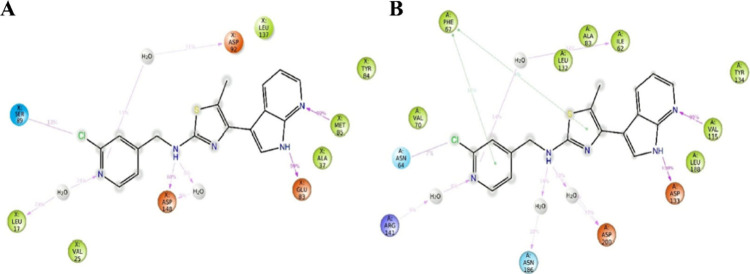 2
2- —National Institutes of Health10.13039/100000002
Peer Reviews
No public reviews on file for this paper yet. If you reviewed it on a platform where reviews are public (OpenReview, ICLR, NeurIPS, ICML), you can paste yours below so the community can read it here.
Videos
No videos yet. Explain this paper in a talk, walkthrough, or lecture? Add one.
Taxonomy
TopicsWnt/β-catenin signaling in development and cancer · Nerve injury and regeneration · Nicotinic Acetylcholine Receptors Study
Introduction
Protein kinases (PKs) catalyze protein phosphorylation that regulate cellular signaling through reversible protein modifications. ?,? Dysregulation of kinase activity is closely associated with the onset and progression of numerous human diseases. ?,? Based on catalytic domain homology, the human kinome is classified into eight major families.? Among these, Fyn proto-oncogene kinase (Fyn), belonging to the Src subfamily of the tyrosine kinase (TK) family,? and glycogen synthase kinase 3β (GSK-3β), a member of the CMGC family,? are central regulators of cytoskeletal dynamics,? metabolic homeostasis, ?,? and neuroplasticity? via tyrosine phosphorylation? and serine/threonine phosphorylation, ?,? respectively. Aberrant activation of Fyn and GSK-3β plays a pivotal role in neurodegenerative diseases such as Alzheimer’s disease (AD) and Parkinson’s disease (PD), ?,? establishing both kinases as key therapeutic targets for dual-modulation strategies. ?,?
Fyn is widely expressed in the brain and participates in T-cell receptor signaling, brain function regulation, adhesion-related signaling, and cell survival. ?,? GSK-3β, predominantly expressed in the central nervous system (CNS), regulates cell division, proliferation, differentiation, and adhesion. ?,? Moreover, GSK-3β is closely associated with neuronal apoptosis, synaptic plasticity, axon formation, and neurogenesis. ?−? ? ? Given the multifactorial etiology and progressive nature of neurodegenerative diseases,? current treatments primarily alleviate symptoms without altering disease progression.? Research has shifted from single-target approaches ?,? toward multitarget intervention strategies that simultaneously suppress neuroinflammation and promote neuroregeneration. ?,? Within this framework, dual regulation of Fyn and GSK-3β represents a promising therapeutic avenue.?
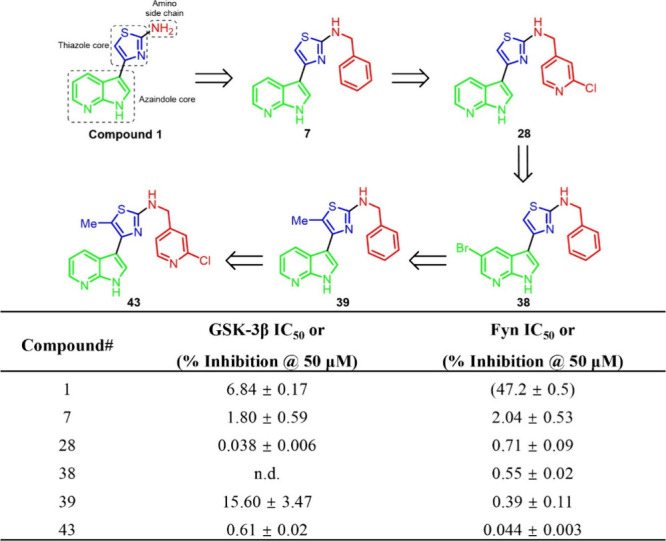
Previous work on 7-azaindole-based molecules yielded potent Rho kinase (ROCK) and ROCK2 inhibitors with high inhibitory activity and favorable lipophilic ligand efficiency (LLE). ?,? Recent study revealed that derivatives of this scaffold exhibit moderate inhibitory effects against FYN and GSK-3β. Guided by systematic structural optimization of three key regions (Figure),? modifications to the amino side chain were explored to enhance inhibitory activity through the incorporation of side chains with varying lengths and functional groups (e.g., aliphatic amines, aromatic amides). Among these analogs, compound 7, featuring an N-benzyl substitution, exhibited improved inhibitory activity against Fyn and GSK-3β. Subsequent exploration involving substitutions on the phenyl ring or its replacement with N-heterocycles revealed that introduction of a 3-chloro-4-pyridyl moiety (compound 28) yielded the first dual inhibitor with double-digit nanomolar potency (GSK-3β IC_50_ = 0.038 ± 0.006 μM; Fyn IC_50_ = 0.71 ± 0.09 μM). The modification of azaindole core was investigated via removal, substitution, or masking of either nitrogen atom, as well as introduction of other substituents onto the core scaffold. These results suggested the introduction of bromine atom at C-5 position markedly enhanced both selectivity and inhibitory potency toward Fyn (compound 38, Fyn IC_50_ = 0.55 ± 0.02 μM). The following modification of thiazole core revealed introduction of a methyl group on the thiazole ring redirected the inhibitory profile toward Fyn (compound 39, GSK-3β IC_50_ = 15.60 ± 3.47 μM; Fyn IC_50_ = 0.39 ± 0.11 μM). Integration of the most favorable structural fragments from each region yielded an optimized scaffold, compound 43, with substantial improvements in potency and selectivity (GSK-3β IC_50_ = 0.61 ± 0.02 μM; Fyn IC_50_ = 0.044 ± 0.003 μM). This compound represents a promising dual-target inhibitor and a candidate for further neuroprotective and neuroregenerative investigation (Figure).
SAR optimization of Compound 1. a Data are mean ± SD from ≥ 3 independent experiments, with IC50 values determined from dose–response curves for promising compounds. The data was adapted from ref . Copyright 2025 American Chemical Society.
Computational results revealed mechanistic insights into the binding interaction of compound 43 with Fyn and GSK-3β (Figure). For Fyn, compound 43 adopted a stable, fixed conformation within the binding pocket. The 5-methyl group of the thiazole ring was optimally positioned in a hydrophobic cavity, while the 7-azaindole moiety further stabilized the complex through hydrogen bonding with the backbone NH of Ser89. In contrast, when bound to GSK-3β, the 5-methyl group of the thiazole ring was sterically hindered by the Leu132 side chain, causing a slight displacement of the ligand from the binding pocket and attenuating halogen bonding and π–π interactions. This adverse spatial effect was partially compensated by a hydrogen bond between the pyridine ring of compound 43 and Arg141, which maintained its submicromolar inhibitory activity against GSK-3β.
Bidimensional interaction profiles over time calculated on the last 50 ns of molecular dynamics simulation of 43 within Fyn (A) and GSK-3β (B). Green arrows are p–p interactions, red arrows are p–cation interactions, magenta lines are halogen bonds, and magenta arrow are H-bond interactions. The data was adapted from ref. Copyright 2025 American Chemical Society.
Biological evaluation demonstrated that compound 43 possesses multidimensional neuroactive properties and favorable drug-like characteristics. In primary rat cerebellar granule neuron (CGN) model, it showed no neurotoxicity at concentrations of 5–25 μM and slightly enhanced cell viability relative to the control. In the serum/potassium deprivation-induced neuronal senescence model, compound 43 completely reversed cell death and rescued neuronal viability, demonstrating a potent neuroprotective effect. In the mouse subventricular zone (SVZ) neurosphere model, drug concentrations of 0.1–5 μM failed to significantly promote neurosphere proliferation or maturation, in contrast to compounds with high GSK-3β inhibitory activity. However, in the neurosphere differentiation model, treatment with compound 43 at 1 μM selectively promoted astrocyte differentiation. In LPS-stimulated N9 microglia, compound 43 (2.5–5 μM) significantly downregulated the pro-inflammatory enzyme iNOS without altering anti-inflammatory TREM2 expression or microglial phagocytosis, supporting neuroinflammation alleviation via M1/M2 phenotypic switching. For blood-brain barrier (BBB) permeability, compound 43 exhibited an apparent permeability coefficient (Papp = 32 ± 5.38 × 10^–6^ cm/s) higher than positive controls (e.g., antipyrine, donepezil) and did not disrupt endothelial integrity at 100 μM, confirming favorable CNS penetration. Kinase profiling further demonstrated potent inhibition of Fyn (IC_50_ = 0.044 ± 0.003 μM) and GSK-3β (IC_50_ = 0.61 ± 0.02 μM), along with modulation of neurotoxic kinases Lyn/LOK/Abl, while engaging anti-inflammatory off-target kinases in a potentially synergistic manner.
Future Outlook
Building on the promising findings of this study regarding 7-azaindole-based Fyn/GSK-3β inhibitors, compound 43 has emerged as the lead compound from a series of Fyn/GSK-3β inhibitors following an extensive SAR screening. Future studies should prioritize in vivo validation and pharmacokinetic/pharmacodynamic (PK/PD) optimization. Behavioral and neuropathological assessments in animal models of neurodegenerative diseases (e.g., AD transgenic mouse models) will be essential to confirm its efficacy in ameliorating cognitive impairments, reducing neurofibrillary tangles (NFTs), and restoring neuronal function. In parallel, the development of positron emission tomography (PET) ?,? tracers targeting Frn or GSK-3β separately is warranted to enable noninvasive evaluation of target engagement and dose–response relationships in living subjects.? These studies will collectively advance the translational potential of dual Fyn/GSK-3β inhibition as a strategy for neuroprotective and neuroregenerative therapy.
The reference list from the paper itself. Each links out to its DOI / PubMed record.
- 1Attwood M. M.Fabbro D.Sokolov A. V.Knapp S.Schiöth H. B.Trends in Kinase Drug Discovery: Targets, Indications and Inhibitor Design Nat. Rev. Drug Discov.2021201183986110.1038/s 41573-021-00252-y 34354255 · doi ↗ · pubmed ↗
- 2Krahn A. I.Wells C.Drewry D. H.Beitel L. K.Durcan T. M.Axtman A. D.Defining the Neural Kinome: Strategies and Opportunities for Small Molecule Drug Discovery to Target Neurodegenerative Diseases ACS Chem. Neurosci.202011131871188610.1021/acschemneuro.0c 0017632464049 · doi ↗ · pubmed ↗
- 3Pardridge W. M.Blood-Brain Barrier Delivery Drug Discov.Today 2007121546110.1016/j.drudis.2006.10.01317198973 · doi ↗ · pubmed ↗
- 4Xiang H.Zhang J.Lin C.Zhang L.Liu B.Ouyang L.Targeting Autophagy-Related Protein Kinases for Potential Therapeutic Purpose Acta Pharm. Sin. B 202010456958110.1016/j.apsb.2019.10.00332322463 PMC 7161711 · doi ↗ · pubmed ↗
- 5Manning G.Whyte D. B.Martinez R.Hunter T.Sudarsanam S.The Protein Kinase Complement of the Human Genome Science 200229856001912193410.1126/science.107576212471243 · doi ↗ · pubmed ↗
- 6Tang X.Feng Y.Ye K.Src-Family Tyrosine Kinase Fyn Phosphorylates Phosphatidylinositol 3-Kinase Enhancer-Activating Akt, Preventing its Apoptotic Cleavage and Promoting Cell Survival Cell Death Differ.200714236837710.1038/sj.cdd.440201116841086 · doi ↗ · pubmed ↗
- 7Rippin I.Eldar-Finkelman H.Mechanisms and Therapeutic Implications of GSK-3 in Treating Neurodegeneration Cells 202110226210.3390/cells 1002026233572709 PMC 7911291 · doi ↗ · pubmed ↗
- 8Klein C.Krämer E.-M.Cardine A.-M.Schraven B.Brandt R.Trotter J.Process Outgrowth of Oligodendrocytes is Promoted by Interaction of Fyn Kinase with the Cytoskeletal Protein Tau J. Neurosci.200222369870710.1523/JNEUROSCI.22-03-00698.200211826099 PMC 6758498 · doi ↗ · pubmed ↗