[Corrigendum] CXCR6 predicts poor prognosis in gastric cancer and promotes tumor metastasis through epithelial-mesenchymal transition
Jie-Jie Jin, Fa-Xiang Dai, Zi-Wen Long, Hong Cai, Xiao-Wen Liu, Ye Zhou, Qi Hong, Qiong-Zhu Dong, Ya-Nong Wang, Hua Huang

Abstract
Genes, proteins, chemicals, diseases, species, mutations and cell lines named across the full text — each resolved to its canonical identifier and authoritative record.
Click any figure to enlarge with its caption.
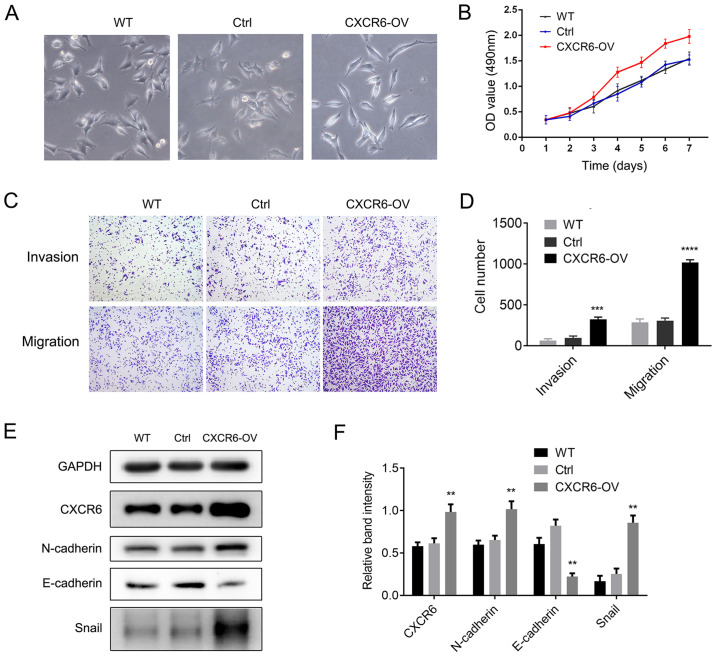 Figure 1
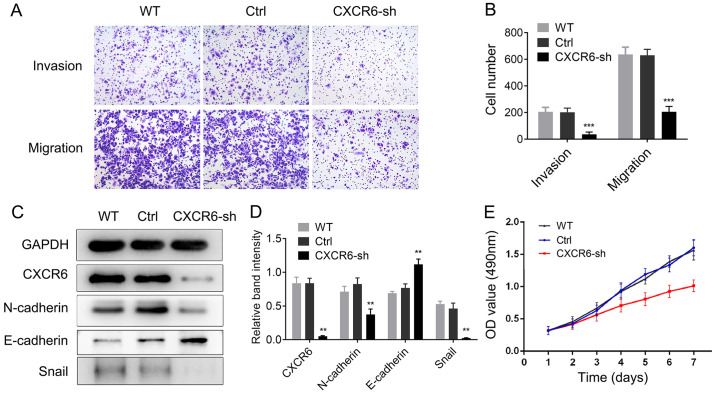 Figure 2
Peer Reviews
No public reviews on file for this paper yet. If you reviewed it on a platform where reviews are public (OpenReview, ICLR, NeurIPS, ICML), you can paste yours below so the community can read it here.
Videos
No videos yet. Explain this paper in a talk, walkthrough, or lecture? Add one.
Taxonomy
TopicsChemokine receptors and signaling · Cancer Cells and Metastasis · Cancer Mechanisms and Therapy
Oncol Rep 37: 3279–3286, 2017; DOI: 10.3892/or.2017.5598
Subsequently to the publication of the above paper, an interested reader drew to the authors' attention that, concerning the cell migration and invasion assay experiments shown in Figs. 3 and 4, the ‘WT/Migration’ and ‘Ctrl/Invasion’ panels in Fig. 3C contained an overlapping section of data, and the ‘WT/Invasion’ and ‘CXCR-sh/Migration’ panels in Fig. 4A were duplicates, such that data which were intended to show the results from differently performed experiments had apparently been derived from the same original sources. Upon examining the data independently in the Editorial Office, it also came to light that the E-cadherin western blot in Fig. 3E was strikingly similar to the N-cadherin western blot shown in Fig. 4A.
However, the authors were able to consult their original data, and recognized that these data had inadvertently been included in these two figures incorrectly. Revised and corrected versions of Figs. 3 and 4, now showing the correct data for the E-cadherin blot in Fig. 3E and the ‘Ctrl/Invasion’ experiment in Fig. 3C, and the ‘CXCR-sh/Migration’ panel in Fig. 4A, are shown on the next page. The authors regret the errors that were made during the compilation of the original figures, and are grateful to the editor of Oncology Reports for allowing them the opportunity to publish this Corrigendum. Note that these errors did not have a significant impact on the conclusions reached in this study. All the authors agree with the publication of this corrigendum; furthermore, they apologize to the readership for any inconvenience caused.