P-1763. Disease burden of carbapenem-resistant Enterobacterales (CRE) infections in Korea
Chan Mi Lee, Eunyoung Lee, Shinwon Lee, Sun Young Cho, Pyoeng Gyun Choe, Raeseok Lee, Jiwon Jung, Nam Su Ku, Young Keun Kim, Hee Jung Choi, Jeong-Han Kim, Chung-Jong Kim, Yee Gyung Kwak, Kyung-Hwa Park, Sung un Shin, Yeon Sook Kim, Shinhye Cheon, Se Yoon Park, Jeonghoon Ahn

TL;DR
This study estimates the health and economic impact of carbapenem-resistant Enterobacterales infections in Korea, finding high mortality and significant costs.
Contribution
The study provides the first comprehensive assessment of CRE infection burden in Korea using a predictive model and real-world data.
Findings
CRE infections accounted for 22.4% of reported cases, with high mortality rates and significant medical costs.
Klebsiella pneumoniae was the most common CRE pathogen, and carbapenemase-producing strains dominated.
The estimated economic burden of CRE infections in 2022 was over $517 million in Korea.
Abstract
Carbapenem-resistant Enterobacterales (CRE) pose a significant public health threat. While CRE isolation from clinical specimens is a mandatory national notifiable event in Korea, current surveillance systems do not differentiate between colonization and infection, hindering accurate estimation of the disease burden. This study aimed to assess the clinical and socio-economic burden of CRE infections in Korea. A retrospective study was conducted across fifteen geographically diverse medical institutions. Medical records from all cases with CRE-positive clinical specimens in 2022 were reviewed and classified as “CRE-infected” or “colonized.” For the “CRE-infected” cohort, clinical data and medical costs were collected. A predictive logistic regression model was developed using sex, age, presence of bacteremia, and bacterial species to estimate the nationwide CRE infections. For cases of…
Genes, proteins, chemicals, diseases, species, mutations and cell lines named across the full text — each resolved to its canonical identifier and authoritative record.
Click any figure to enlarge with its caption.
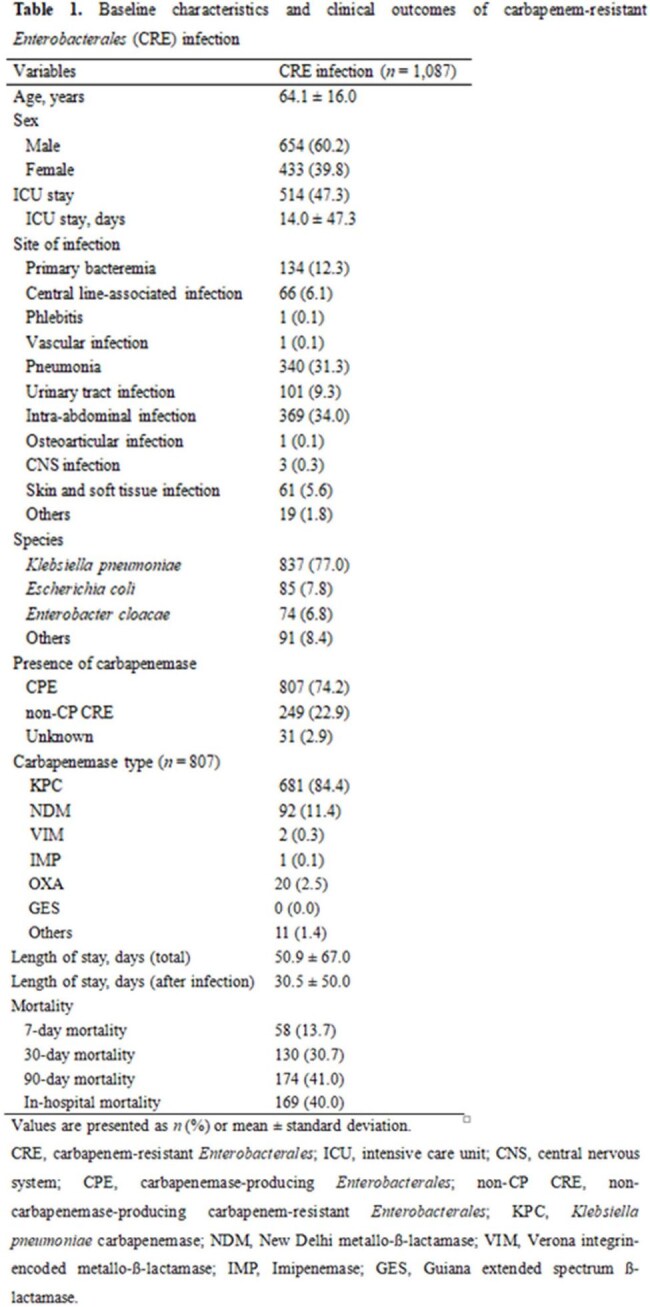 Figure 1
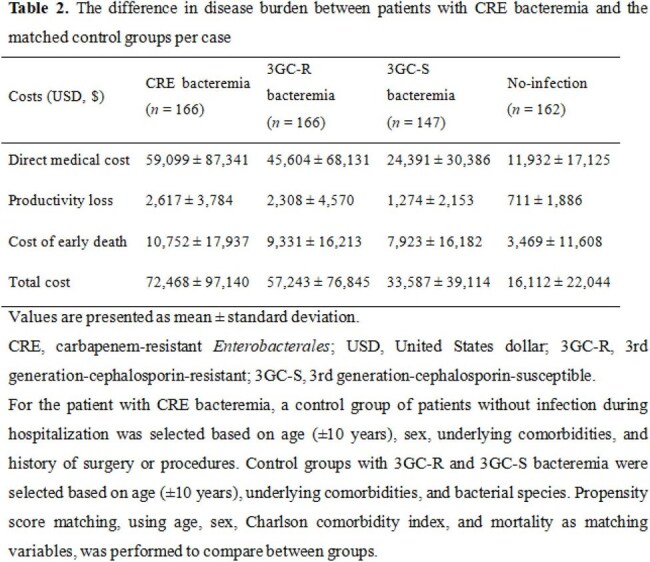 Figure 2
Peer Reviews
No public reviews on file for this paper yet. If you reviewed it on a platform where reviews are public (OpenReview, ICLR, NeurIPS, ICML), you can paste yours below so the community can read it here.
Videos
No videos yet. Explain this paper in a talk, walkthrough, or lecture? Add one.
Taxonomy
TopicsAntibiotic Resistance in Bacteria · Enterobacteriaceae and Cronobacter Research · Antibiotics Pharmacokinetics and Efficacy