P-2181. Post-Exposure Prophylaxis (PEP) of Respiratory Syncytial Virus (RSV) Infection After High-Inoculum RSV Human Challenge: Analysis of a Randomized Double-Blind, Placebo-Controlled Trial of EDP-323, an Oral, Non-Nucleoside Polymerase Inhibitor Antiviral
John DeVincenzo, Alaa Ahmad, Shijie Chen, Scott T Rottinghaus

TL;DR
A new oral antiviral drug, EDP-323, effectively prevents RSV infection when taken up to five days after exposure in a clinical trial.
Contribution
EDP-323 is the first oral non-nucleoside polymerase inhibitor shown to prevent RSV infection after high-dose exposure in humans.
Findings
0% of EDP-323 recipients became infected with RSV compared to 26% of placebo recipients.
Both low and high doses of EDP-323 were statistically significant in preventing RSV infection.
EDP-323 was well-tolerated with no serious adverse events reported.
Abstract
RSV causes high secondary transmission rates in families, hospitals, nursing homes and other settings. Breakthrough RSV infections occur despite RSV vaccination or monoclonal antibody injection. Certain patients at great risk of severe RSV do not respond to RSV vaccination. No effective RSV treatments exist. EDP-323, a first in class, potent, oral, non-nucleoside small molecule RSV polymerase (L-protein) inhibitor rapidly reduces viral load and disease severity when treatment is started after an active RSV infection is identified1. The efficacy of RSV antivirals used for post-exposure prophylaxis (PEP) is unknown. A randomized, double-blind, placebo (PBO)-controlled study (NCT06170242) evaluated the efficacy, antiviral activity and safety, of EDP-323. Healthy volunteers received large intranasal exposures of a low-passage clinical strain of RSV-A (Memphis-37, 4 Log10 plaque forming…
Genes, proteins, chemicals, diseases, species, mutations and cell lines named across the full text — each resolved to its canonical identifier and authoritative record.
Click any figure to enlarge with its caption.
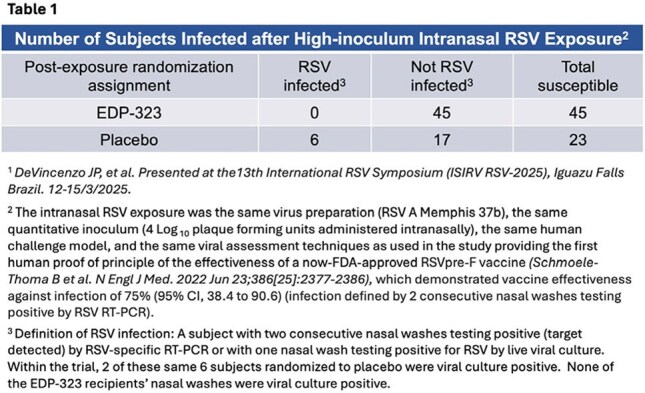 Figure 1
Peer Reviews
No public reviews on file for this paper yet. If you reviewed it on a platform where reviews are public (OpenReview, ICLR, NeurIPS, ICML), you can paste yours below so the community can read it here.
Videos
No videos yet. Explain this paper in a talk, walkthrough, or lecture? Add one.
Taxonomy
TopicsRespiratory viral infections research · Cystic Fibrosis Research Advances · Neonatal Respiratory Health Research