P-1982. Negative Predictive Value of Methods to Identify Underlying Medical Conditions with and without Use of a Lookback Period among Adults with a Healthcare Encounter for Acute Respiratory Illness, September 2023 – August 2024
Amber Kautz, Morgan Najdowski, Kristin K Dascomb, Sara Y Tartof, Karthik Natarajan, Stephanie Irving, Nicola P Klein, Shaun J Grannis, Toan Ong, Sarah W Ball, Malini B DeSilva, Jennifer DeCuir, Ruth Link-Gelles, Ryan E Wiegand, Amanda B Payne

TL;DR
This study evaluates how well a single healthcare encounter captures underlying medical conditions compared to a 1-year lookback period, finding significant differences that could affect vaccine effectiveness estimates.
Contribution
The study introduces a novel comparison of medical condition capture using a single encounter versus a lookback period, highlighting misclassification risks in vaccine effectiveness research.
Findings
NPV was <80% for common UMC categories like cardiovascular and endocrine/metabolic in younger adults.
Median prevalence differences reached up to 30 percentage points in younger adults and 52 in older adults.
UMC categories with low prevalence had NPV >90%, indicating better capture accuracy.
Abstract
Vaccine effectiveness (VE) studies are necessary to understand how well vaccines work in the real world. Many VE studies rely on health records to capture underlying medical conditions (UMCs) from a single acute respiratory illness- (ARI) associated encounter, which may bias VE if UMCs are not fully captured. We assessed capture of UMCs from a single acute encounter and a lookback period. Data were used from MarketScan® Treatment Pathways, a healthcare claims dataset, between September 1, 2023 – August 31, 2024. We included beneficiaries aged ≥18+ years with ≥1 inpatient or emergency department (ED) claim containing an ICD-10 code for ARI who had 3 years of continuous enrollment in a participating insurance plan prior to the date of their first ARI claim (i.e., index encounter). The prevalence of UMCs was calculated using ICD-10 codes from 1) the index encounter, and 2) the 1-year…
Genes, proteins, chemicals, diseases, species, mutations and cell lines named across the full text — each resolved to its canonical identifier and authoritative record.
Click any figure to enlarge with its caption.
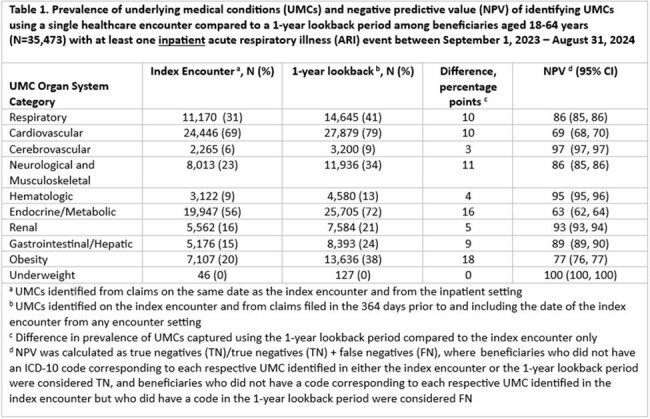 Figure 1
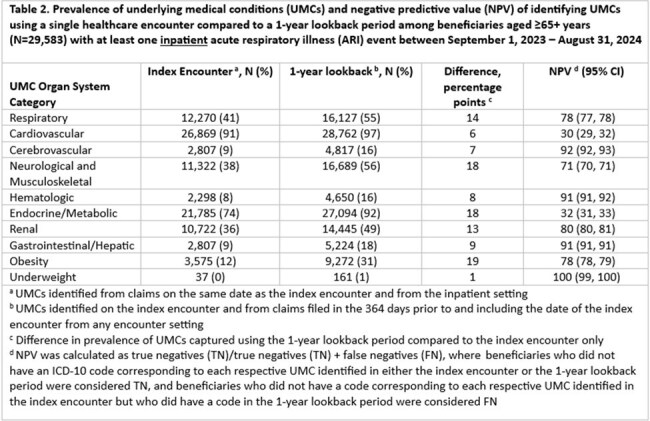 Figure 2
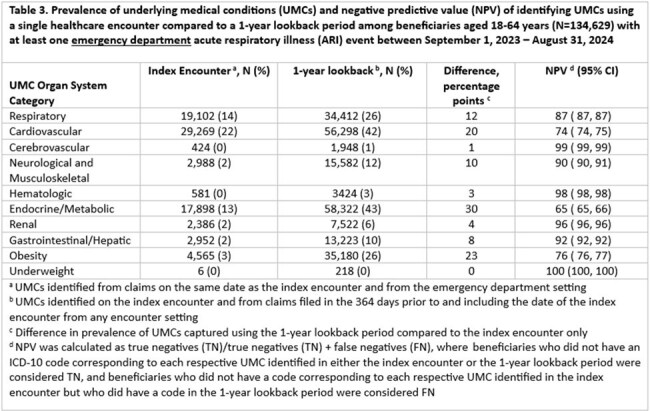 Figure 3
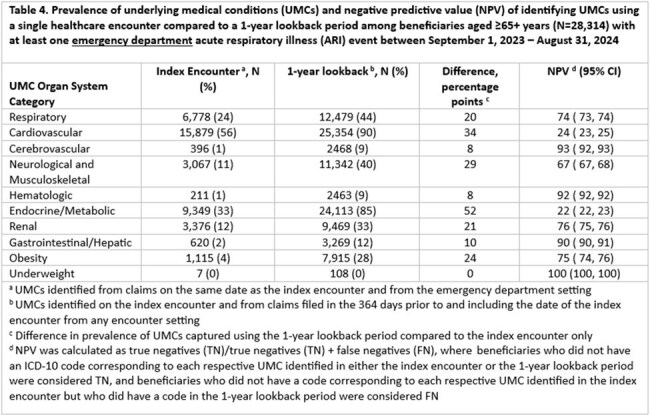 Figure 4
Peer Reviews
No public reviews on file for this paper yet. If you reviewed it on a platform where reviews are public (OpenReview, ICLR, NeurIPS, ICML), you can paste yours below so the community can read it here.
Videos
No videos yet. Explain this paper in a talk, walkthrough, or lecture? Add one.
Taxonomy
TopicsImmune responses and vaccinations · Data-Driven Disease Surveillance · Vaccine Coverage and Hesitancy