P-2151. Incidence of Breakthrough HSV in Adult Allogeneic Hematopoietic Cell Transplant Recipients on Standardized Antiviral Prophylaxis
Ria Mohan, Christine Johnston, Amanda Phipps, Chris Davis, Agnes Ho, Michael J Boeckh, Emily Ford, Denise McCulloch, Ted Gooley, Frank P Tverdek, Steven A Pergam, Molly D Fischer

TL;DR
This study examines how often herpes simplex virus (HSV) reactivates in adult patients who received blood cell transplants, even when they are on standard antiviral treatment.
Contribution
The study provides updated data on HSV recurrence rates in the modern era of standardized antiviral prophylaxis after allogeneic hematopoietic cell transplants.
Findings
HSV recurrence occurred in 0.8% of adult allogeneic hematopoietic cell transplant recipients within the first 100 days.
Most HSV recurrences were HSV-1, and nearly half of the cases were resistant to acyclovir.
Patients with acyclovir-resistant HSV required significantly longer treatment durations compared to those with susceptible infections.
Abstract
Reactivations of herpes simplex viruses (HSV) can occur in the early post-allogeneic hematopoietic cell transplant (aHCT) period despite universal antiviral prophylaxis. Few studies have assessed HSV recurrence in the era of standardized antiviral prophylaxis, in which val/acyclovir is recommended for up to 1 year post aHCT. We evaluated the incidence and management of HSV during the first 100 days post-HCT over two decades.Figure 1:Time from transplant to first positive HSV test and development of symptoms Time from transplant to first positive HSV test and development of symptoms All first aHCT recipients at Fred Hutchinson Cancer Center between 2002-2022 were reviewed to determine the incidence of HSV within the first 100 days on prophylaxis (acyclovir 800 mg or valacyclovir 500 mg twice daily). HSV cases were identified via viral culture, polymerase chain reaction, and/or direct…
Genes, proteins, chemicals, diseases, species, mutations and cell lines named across the full text — each resolved to its canonical identifier and authoritative record.
Click any figure to enlarge with its caption.
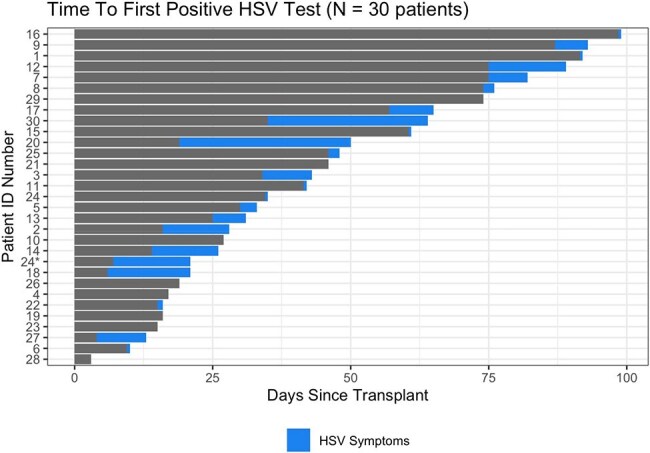 Figure 1
Peer Reviews
No public reviews on file for this paper yet. If you reviewed it on a platform where reviews are public (OpenReview, ICLR, NeurIPS, ICML), you can paste yours below so the community can read it here.
Videos
No videos yet. Explain this paper in a talk, walkthrough, or lecture? Add one.
Taxonomy
TopicsHerpesvirus Infections and Treatments · Cytomegalovirus and herpesvirus research · Virus-based gene therapy research