P-2032. Monitoring the laboratory frequency for musculoskeletal infections at a tertiary care Children's Hospital: a diagnostic stewardship QI project
Kedar Tilak, Christine A Symes, Douglas S Swanson, Rana E El Feghaly, Alaina N Burns, Ann Wirtz

TL;DR
This study aimed to improve lab test frequency for musculoskeletal infections in children by implementing quality improvement strategies.
Contribution
The paper introduces a quality improvement project to standardize lab monitoring for musculoskeletal infections in pediatric patients.
Findings
The frequency of ESR testing improved from 27% to 68% after implementing QI strategies.
Process measures increased from 0% to 60%, but CBC and CRP frequencies did not show significant improvement.
No change was observed in hospital readmission rates for patients with musculoskeletal infections.
Abstract
Patients with musculoskeletal infections (MSKI) undergo several laboratory tests. To promote laboratory stewardship, our Infectious diseases (ID) division recommended the following frequencies for labs: 1) C-reactive protein (CRP) every 2-3 days until >50% reduction while >3mg/dL, otherwise weekly until normal, 2) Sedimentation rate (ESR) at the start of therapy and end if > 20mm/hr initially, 3) Complete blood cell count (CBC) at the start of therapy and when transitioning to oral therapy if WBC is initially elevated. Baseline data showed that of 42 children evaluated between July 2023-May 2024, only 15 (35.7%) had a CBC and 13 (30.95%) had a CRP and ESR obtained at the recommended frequency. Our aim was to increase appropriately ordered monitoring labs to 65% by October 2025.Cause and effect analysisPICK chart Cause and effect analysis PICK chart We formed a quality improvement…
Click any figure to enlarge with its caption.
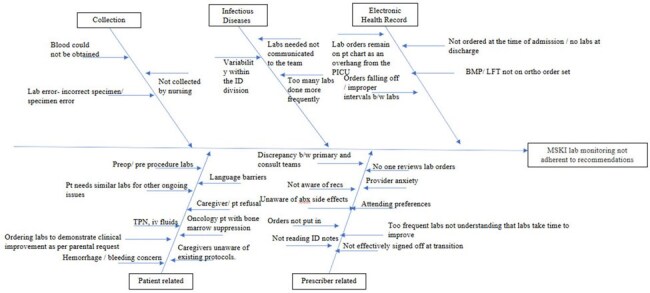 Figure 1
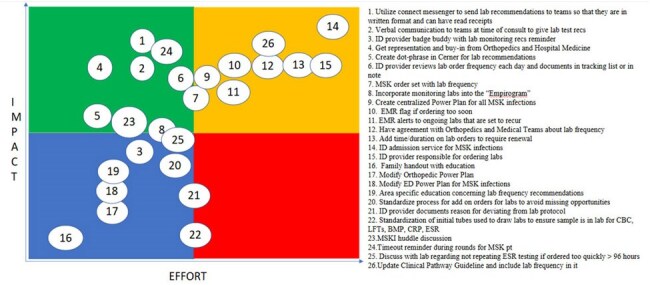 Figure 2
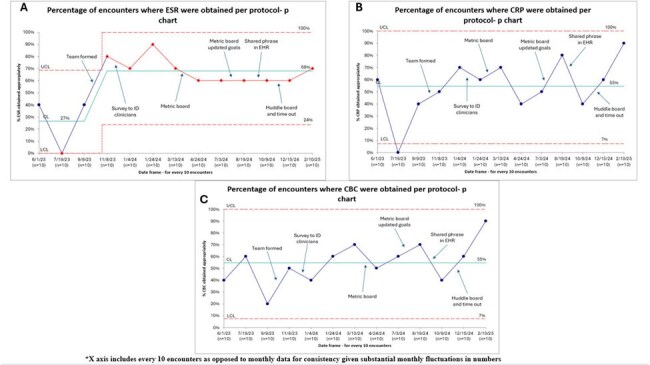 Figure 3
Peer Reviews
No public reviews on file for this paper yet. If you reviewed it on a platform where reviews are public (OpenReview, ICLR, NeurIPS, ICML), you can paste yours below so the community can read it here.
Videos
No videos yet. Explain this paper in a talk, walkthrough, or lecture? Add one.
Taxonomy
TopicsOrthopedic Infections and Treatments · Bacterial Identification and Susceptibility Testing · Antibiotic Use and Resistance