P-1755. Developing Host-based Signatures of Gram-negative Infection to Guide Empiric Antibiotics for Sepsis
Alyse Wheelock, Elizabeth Chiyka, Te Vantha, George Oduro, Yasith Ros, Vannsay Yin, Chris Oppong, Yaw Agyekum Boaitey, Alex Owusu-Ofori, Nehkonti Adams, Deborah Striegel, Patrick Blair, Joshua Chenoweth, Danielle Clark

TL;DR
This study explores using host-based biomarkers to identify Gram-negative infections in sepsis patients, aiming to improve antibiotic use and patient outcomes in resource-limited settings.
Contribution
The study introduces a novel host-based transcriptomic and proteomic signature for detecting Gram-negative infections in sepsis.
Findings
A transcriptomic signature (SMARCD3, EIF4G1, IER5) achieved an AUROC of 0.891 for detecting Gram-negative infections.
A protein-based signature (IL17A, IL1RA, MMP8) had an AUROC of 0.795 for the same purpose.
The method shows potential for a rapid diagnostic test to guide antibiotic use in sepsis.
Abstract
Mounting evidence indicates that broad-spectrum antibiotic overuse is widespread in the management of suspected sepsis and leads to harms. Clinicians lack timely diagnostic tools to guide when broad empiric gram-negative (GN) coverage is needed. To address this gap, we aimed to identify a host-based signature of GN infection as a proof-of-concept for development of a future rapid diagnostic assay.Table 1.Participant and pathogen characteristics in classified discovery/cross-validation dataseta. “Systemic infections” refers to processes without a primary anatomic site of infection, such as dengue, but not to cases where bacteremia complicated a primary site of infection. b. Participants who presented with suspected sepsis and met enrollment criteria but were ultimately adjudicated as having a confirmed non-infectious disease, e.g. congestive heart failure or diabetic ketoacidosis. c. All…
Genes, proteins, chemicals, diseases, species, mutations and cell lines named across the full text — each resolved to its canonical identifier and authoritative record.
Click any figure to enlarge with its caption.
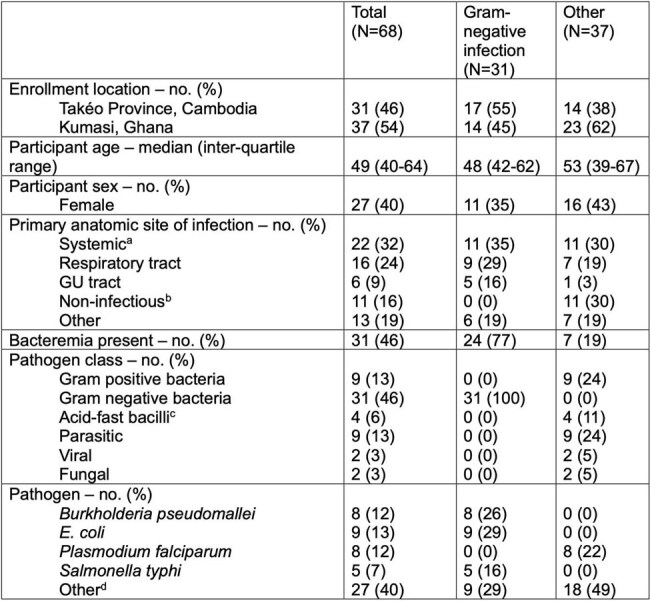 Figure 1
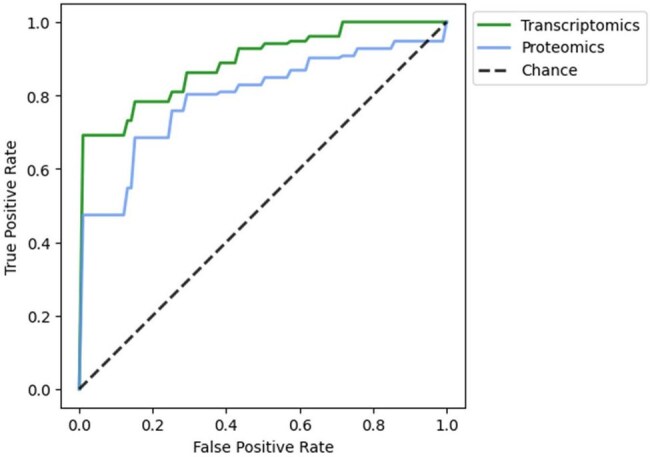 Figure 2
Peer Reviews
No public reviews on file for this paper yet. If you reviewed it on a platform where reviews are public (OpenReview, ICLR, NeurIPS, ICML), you can paste yours below so the community can read it here.
Videos
No videos yet. Explain this paper in a talk, walkthrough, or lecture? Add one.
Taxonomy
TopicsBacterial Identification and Susceptibility Testing · Sepsis Diagnosis and Treatment · Neonatal and Maternal Infections