P-1960. Desirability of Outcome Ranking (DOOR) Analysis of Isavuconazole Relative to Voriconazole for the Treatment of Invasive Mold Disease (IMD)
Thomas L Holland, David R Walker, Jun Liu, Yana Labinov, Thomas Lodise

TL;DR
This study compares isavuconazole and voriconazole for treating invasive mold disease, finding that isavuconazole may offer better outcomes in terms of effectiveness and safety.
Contribution
The study introduces a novel within-patient ranking analysis (DOOR) to compare treatment benefits and harms in invasive mold disease.
Findings
Isavuconazole showed a 53.4% probability of better Composite DOOR outcomes compared to voriconazole.
Safety DOOR outcomes favored isavuconazole with a 54.5% probability of being more favorable.
Isavuconazole had a 56.2% probability of better safety outcomes for moderate/severe treatment-related adverse events.
Abstract
In SECURE, a randomized, Phase 3, double-blind trial, isavuconazole was non-inferior to voriconazole for primary treatment of suspected IMD. To better understand the association between treatment benefits and harms, a within-patient analysis using DOOR was performed. Patients in SECURE with proven or probable IMD as determined by the data review committee were analyzed. Patients were assigned a mutually exclusive DOOR rank, from 1 (most desirable) to 7 (least desirable) (Table 1). Two DOOR ranking systems served as primary endpoints: Composite DOOR and Safety DOOR. The DOOR distribution for each outcome was compared between treatment groups using the Wilcoxon Mann–Whitney U statistic; DOOR probability >50% indicates a more favorable outcome with isavuconazole vs voriconazole. DOOR distributions were also compared between treatments in pre-specified subgroups of age and sex. The…
Genes, proteins, chemicals, diseases, species, mutations and cell lines named across the full text — each resolved to its canonical identifier and authoritative record.
Click any figure to enlarge with its caption.
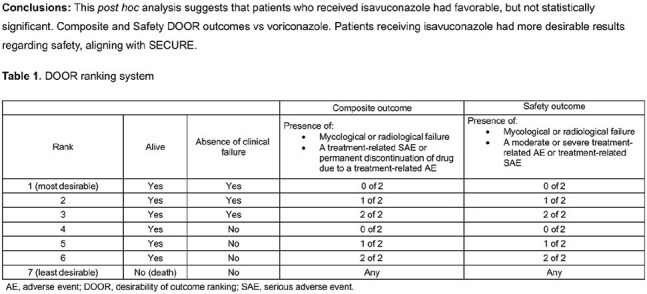 Figure 1
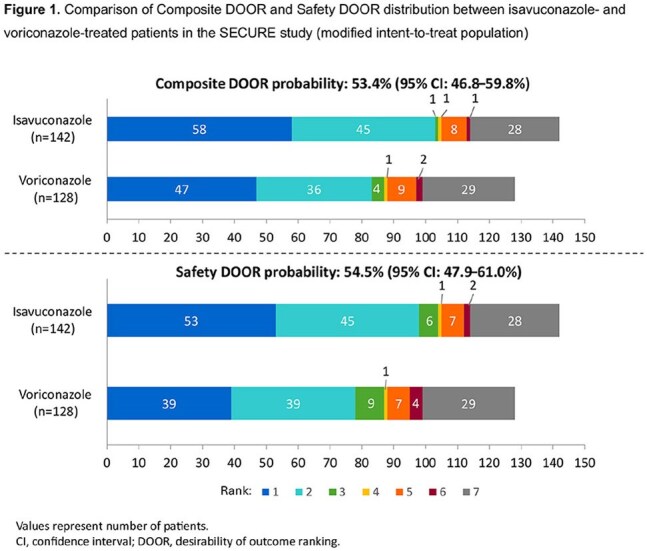 Figure 2
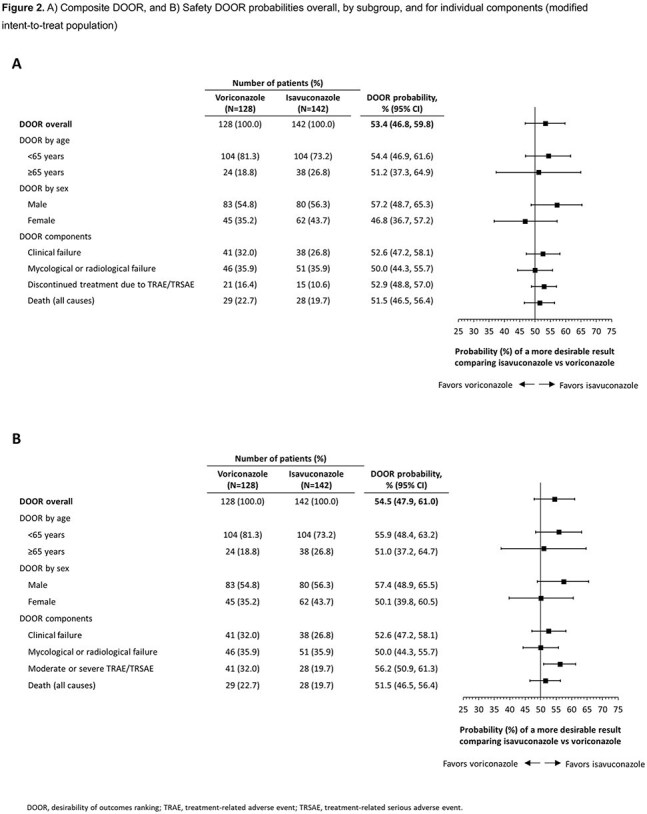 Figure 3
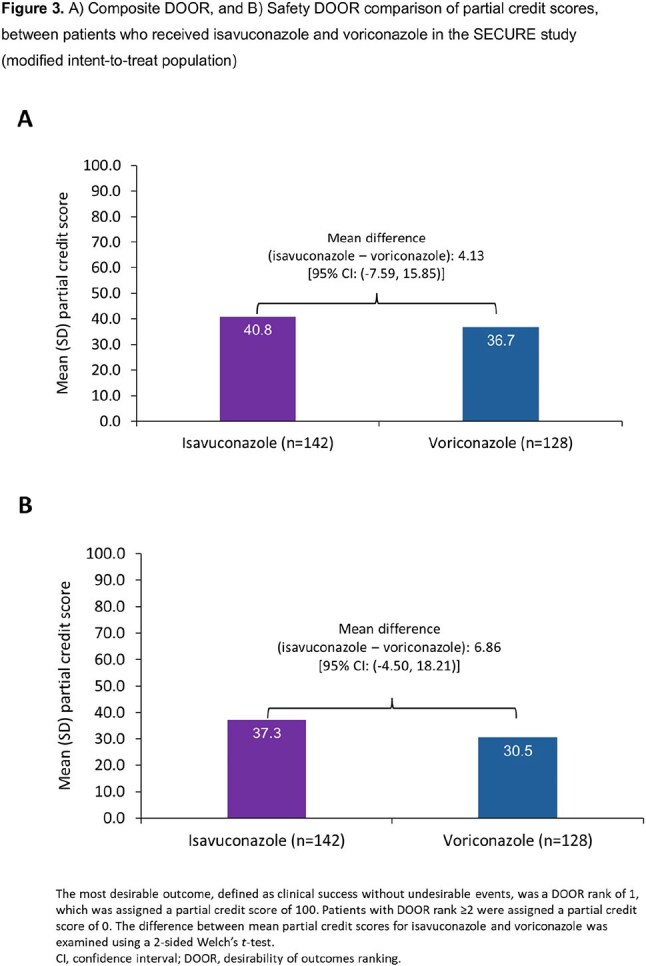 Figure 4
Peer Reviews
No public reviews on file for this paper yet. If you reviewed it on a platform where reviews are public (OpenReview, ICLR, NeurIPS, ICML), you can paste yours below so the community can read it here.
Videos
No videos yet. Explain this paper in a talk, walkthrough, or lecture? Add one.
Taxonomy
TopicsAntifungal resistance and susceptibility · Fungal Infections and Studies · Legionella and Acanthamoeba research