P-1941. Risk Factors for Developing Candidemia after Gastrointestinal Perforation and/or Ischemia and Its Outcomes: A Matched Case-Control Study
Myeongji Kim, Nischal Ranganath, Sofia Molina Garcia, Kemar O Barrett, Ryan W W Stevens, Allison LeMahieu, Veljko Strajina, Aditya Shah

TL;DR
This study identifies risk factors for developing candidemia after gastrointestinal injuries and finds that certain conditions significantly increase the risk and worsen outcomes.
Contribution
The study identifies specific medical and surgical risk factors for candidemia in patients with GI perforation or ischemia using a matched case-control design.
Findings
Shock requiring vasopressor and respiratory failure are medical risk factors for candidemia.
Upper GI tract perforation is strongly associated with candidemia, while lower GI tract perforation is less likely to lead to it.
Diffuse intraabdominal contamination increases the risk of candidemia compared to no or contained contamination.
Abstract
Candidemia can occur as a consequence of gastrointestinal (GI) injury. The mortality of candidemia is high, ranging 30-60%, even with treatment with antifungal agents. In this retrospective matched case-control study, we aimed to elucidate the medical and surgical risk factors of developing candidemia in patients who received emergency surgery for GI ischemia and/or perforation, and compare clinical outcomes in these patients with or without candidemia. All patients ≥ 18 years of age who had emergency GI surgery at Mayo Clinic Rochester, MN, for the indication of GI ischemia and/or perforation between 01/01/2018 to 07/31/2024 were included. Cases were defined as patients who developed candidemia during index admission and had no alternative sources of candidemia. Controls and cases were matched 4:1 on age (± 5 years), Charlson Comorbidity Index (± 3), and year of surgery (± 2 years).…
Genes, proteins, chemicals, diseases, species, mutations and cell lines named across the full text — each resolved to its canonical identifier and authoritative record.
Click any figure to enlarge with its caption.
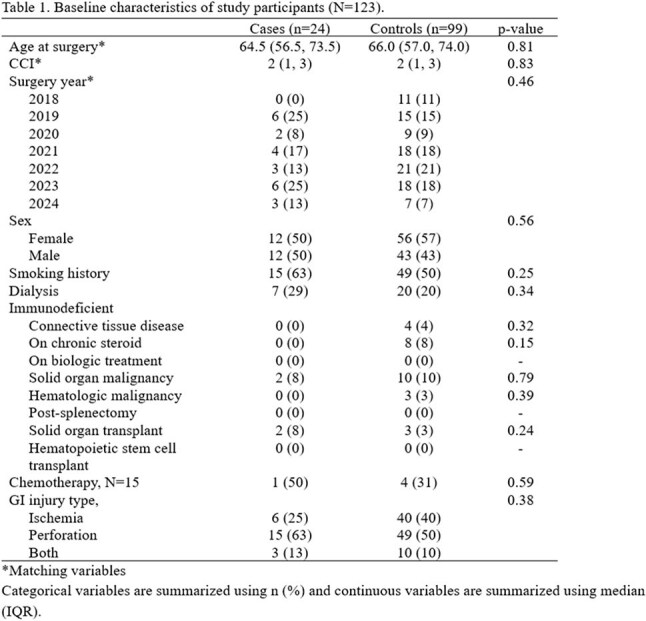 Figure 1
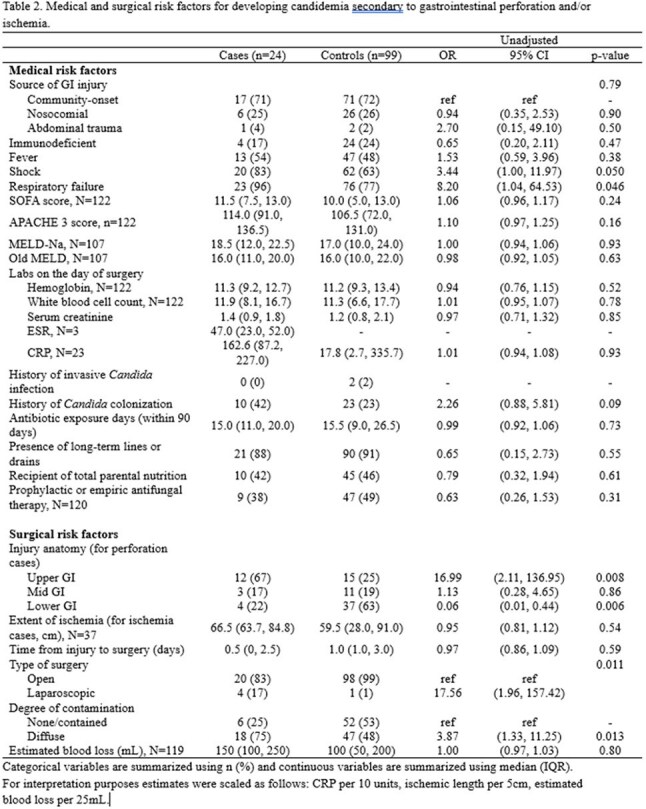 Figure 2
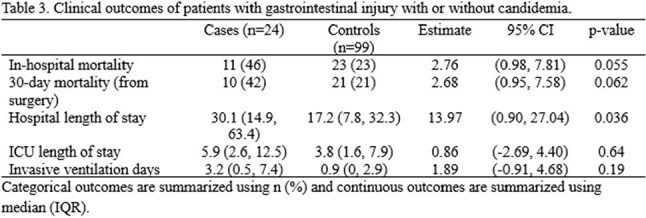 Figure 3
Peer Reviews
No public reviews on file for this paper yet. If you reviewed it on a platform where reviews are public (OpenReview, ICLR, NeurIPS, ICML), you can paste yours below so the community can read it here.
Videos
No videos yet. Explain this paper in a talk, walkthrough, or lecture? Add one.
Taxonomy
TopicsCardiac, Anesthesia and Surgical Outcomes · Enhanced Recovery After Surgery · Surgical site infection prevention