P-2010. The Impact of Staff-Performed Reminder Call Timing on Appointment Attendance in an Infectious Diseases Clinic
Angelica M Chan, Mery Deeb, Hadeel Zainah

TL;DR
Changing the timing of staff reminder calls for clinic appointments from one day to two to three days before did not significantly reduce no-show rates.
Contribution
This study evaluates the impact of altering the timing of staff-performed appointment reminders in an infectious diseases clinic.
Findings
No-show rates increased slightly after changing reminder calls to 2-3 days prior, though not statistically significant.
Most no-show patients had commercial insurance, and the primary reason for missed appointments was inability to deliver the reminder call.
Abstract
Appointment attendance is an ongoing problem in many outpatient clinics. Despite adding staff-performed calls to automated calls in our Infectious Diseases (ID) clinic, we did not see benefit when staff-performed calls were done 1 day prior to appointments. We aimed to evaluate the effect of changing staff-performed calls to 2-3 days prior to the visit. This retrospective quality improvement project occurred in an ID clinic at a 359-bed Rhode Island community hospital. The clinic had 2 providers who see non-HIV patients. The staff performed reminder calls to patients who did not confirm appointments through the automated reminder calls. The timing of the reminder call was changed from 1 day to 2-3 days prior to appointment date to provide patients with more notice. The change started on May 26th, 2023. Data from a 6-month period before the change (November 1st, 2021-May 31st, 2022)…
Click any figure to enlarge with its caption.
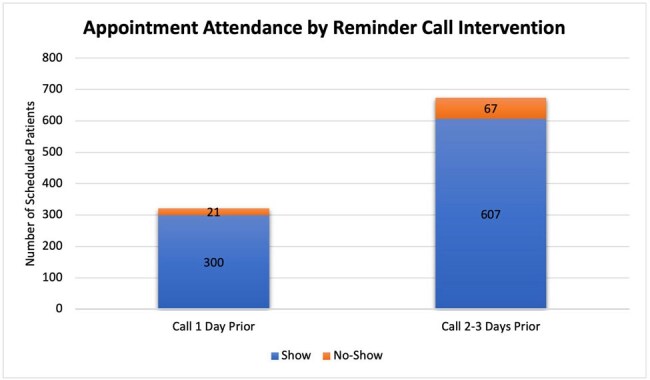 Figure 1
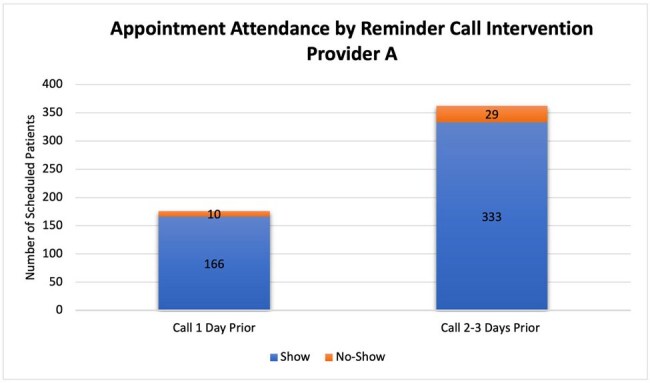 Figure 2
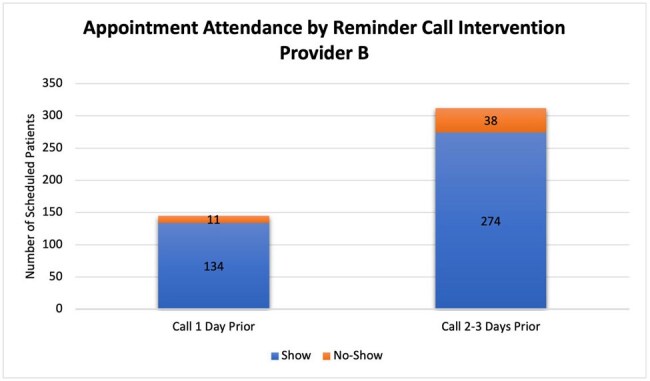 Figure 3
Peer Reviews
No public reviews on file for this paper yet. If you reviewed it on a platform where reviews are public (OpenReview, ICLR, NeurIPS, ICML), you can paste yours below so the community can read it here.
Videos
No videos yet. Explain this paper in a talk, walkthrough, or lecture? Add one.
Taxonomy
TopicsHealthcare Operations and Scheduling Optimization · Emergency and Acute Care Studies · Infection Control in Healthcare