P-2197. Impact of ventilation on transmission risk and reproduction number of viruses in South India: implications for climate change and pandemic preparedness
Palak Shah, Brady Sack, Abdul Basith, Madolyn Dauphinais, Komal Jain, Maria Florencia Martins, Sierra Wallace, Subitha Lakshminarayanan, Chelsie Cintron, Sadhana Subramanian, Apratim Sahay, Kobto Koura, Ralph P Brooks, Sheela Shenoi, Pranay Sinha, Palanivel Chinnakali

TL;DR
This study shows that poor ventilation, especially in air-conditioned spaces in South India, increases the risk of spreading respiratory viruses like SARS-CoV-2 and influenza.
Contribution
The study provides empirical evidence on how ventilation affects virus transmission risk and R0 in tropical indoor settings.
Findings
High transmission risk of SARS-CoV-2 and influenza occurs in poorly ventilated and air-conditioned spaces.
R0 for both viruses exceeds 1 in closed and AC conditions for high virus shedders.
Ventilation significantly reduces transmission risk for both viruses.
Abstract
Rising global temperatures are predicted to increase the time individuals spend in under-ventilated indoor spaces, especially in tropical and subtropical regions, and to enhance the transmission risk of respiratory pathogens. We studied the impact of ventilation on the transmission risk and basic reproductive number (R0) of common respiratory viruses that have pandemic potential, namely SARS-CoV-2 and influenza, in Puducherry, India.Transmission risk and basic reproductive number (R0) of SARS-CoV-2 under different ventilation conditions and viral shedding potentials.1A) Box plots of transmission risk using base estimate of q= 28.0 for high viral shedding potential and q= 4.0 for low viral shedding potential, across three ventilation conditions tested. Solid line at top denotes Wilcoxon rank sum test comparing closed and open conditions for each viral shedding potential; M denotes mean,…
Genes, proteins, chemicals, diseases, species, mutations and cell lines named across the full text — each resolved to its canonical identifier and authoritative record.
Click any figure to enlarge with its caption.
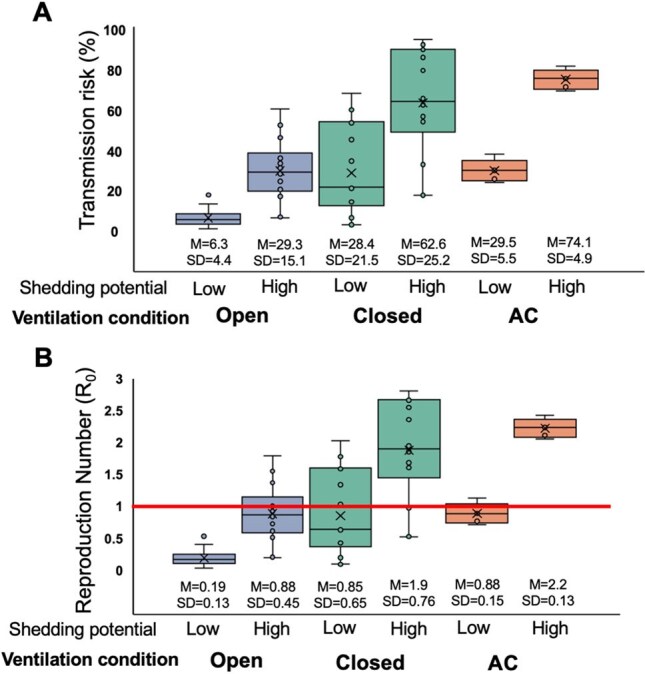 Figure 1
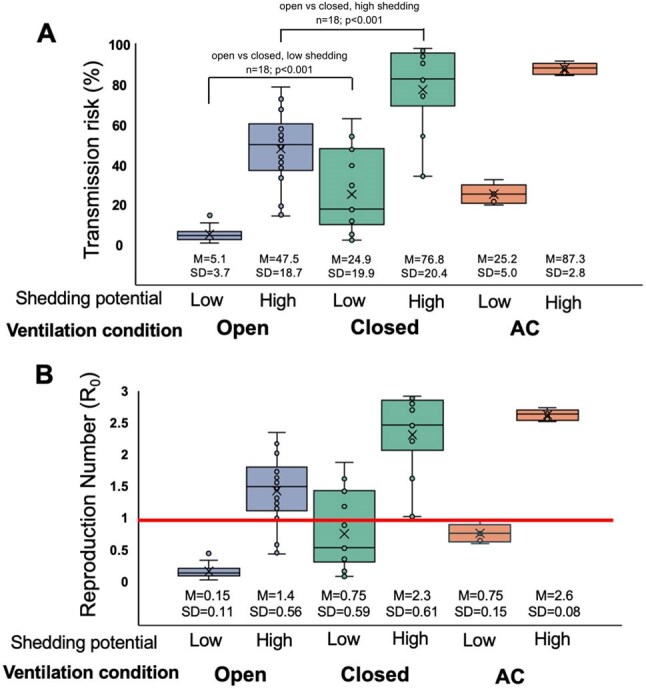 Figure 2
Peer Reviews
No public reviews on file for this paper yet. If you reviewed it on a platform where reviews are public (OpenReview, ICLR, NeurIPS, ICML), you can paste yours below so the community can read it here.
Videos
No videos yet. Explain this paper in a talk, walkthrough, or lecture? Add one.
Taxonomy
TopicsInfection Control and Ventilation · COVID-19 epidemiological studies · COVID-19 Impact on Reproduction