P-2038. Less Is More: A Targeted Blood Culture Protocol Reduces Harm and Cost in Pediatric Febrile Neutropenia
Muayad Alali

TL;DR
A new protocol limits repeat blood cultures in children with febrile neutropenia, reducing costs and harm without compromising safety.
Contribution
Implementation and evaluation of a restrictive blood culture protocol in pediatric febrile neutropenia.
Findings
Only 0.62% of repeat blood cultures beyond 48 hours identified new true pathogens.
The protocol reduced antibiotic days, culture sets, and contamination rates significantly.
Estimated cost savings of $1.5 million over two years were achieved through reduced resource use.
Abstract
Limited evidence guides the use of repeat blood cultures beyond 48 hours in pediatric febrile neutropenia (FN), contributing to inconsistent practices. To address this gap, we implemented a protocol at Riley Hospital for Children in January 2023, limiting repeat cultures to cases of hemodynamic instability or recurrent fever (≥72 hours after defervescence). Limited evidence guides the use of repeat blood cultures beyond 48 hours in pediatric febrile neutropenia (FN), contributing to inconsistent practices. To address this gap, we implemented a protocol at Riley Hospital for Children in January 2023, limiting repeat cultures to cases of hemodynamic instability or recurrent fever (≥72 hours after defervescence). Of 2,313 FN episodes screened, 1,285 met inclusion criteria (834 pre- and 451 post-implementation). Among episodes with negative cultures in the first 48 hours, only 8 (0.62%)…
Click any figure to enlarge with its caption.
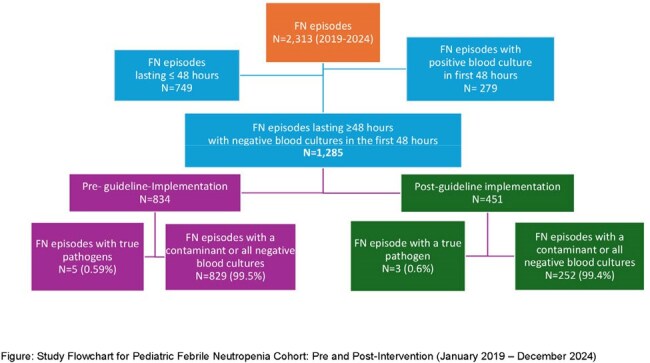 Figure 1
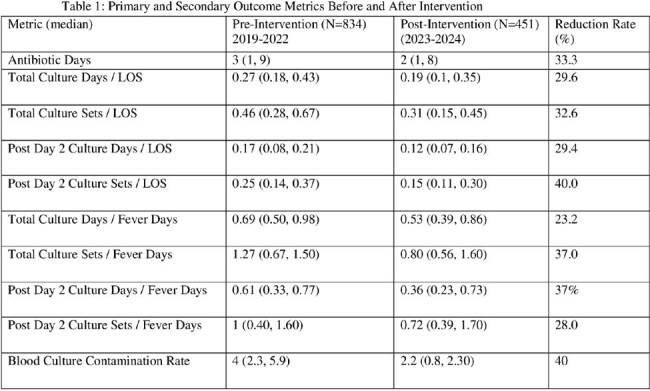 Figure 2
Peer Reviews
No public reviews on file for this paper yet. If you reviewed it on a platform where reviews are public (OpenReview, ICLR, NeurIPS, ICML), you can paste yours below so the community can read it here.
Videos
No videos yet. Explain this paper in a talk, walkthrough, or lecture? Add one.
Taxonomy
TopicsNeutropenia and Cancer Infections · Bacterial Identification and Susceptibility Testing · Blood disorders and treatments