P-2143. Colonization with Fluoroquinolone-Resistant Streptococcus mitis-oralis Group Prior to Hematopoietic Cell Transplantation and Subsequent Streptococcal Bacteremia
Lee Gottesdiener, Supram Hosuru Subramanya, Jamie Marino, Juliet Barker, Tsiporah Shore, Rosemary Soave, Markus Plate, John Lee, Barry N Kreiswirth, Cazer Casey, Lars Westblade, Michael J Satlin

TL;DR
This study shows that patients colonized with fluoroquinolone-resistant Streptococcus mitis-oralis group before a blood stem cell transplant are more likely to develop bloodstream infections despite antibiotic prophylaxis.
Contribution
The study identifies pre-transplant colonization with fluoroquinolone-resistant SMOG as a risk factor for subsequent VGS bacteremia during neutropenia.
Findings
71% of patients were colonized with fluoroquinolone-resistant SMOG prior to hematopoietic cell transplantation.
15% of colonized patients developed VGS bacteremia, all caused by SMOG, while none of the non-colonized patients did.
Colonized patients with bacteremia had longer neutropenia and more tooth loss compared to colonized patients without bacteremia.
Abstract
Bacteremia due to viridans group streptococci (VGS), particularly Streptococcus mitis-oralis group (SMOG), is common in neutropenic patients after hematopoietic cell transplantation (HCT) despite use of fluoroquinolone (FQ) prophylaxis. VGS bloodstream isolates in patients receiving FQ prophylaxis are typically FQ-resistant (FQ-R). This study assessed the prevalence of colonization with FQ-R SMOG prior to HCT and the risk of VGS bacteremia during neutropenia.Table 1.Baseline characteristics of patients, with stratification by colonization with FQ-R SMOG at enrollment*Patients may have more than one malignancy, therefore totals may exceed 100%.Abbreviations: CML, Chronic myeloid leukemia; IQR, Interquartile Range; MDS, Myelodysplastic syndrome; MPN, Myeloproliferative neoplasm; FQ-R SMOG, Fluoroquinolone-resistant Streptococcus mitis-oralis group.Figure 1.Proportion of patients…
Genes, proteins, chemicals, diseases, species, mutations and cell lines named across the full text — each resolved to its canonical identifier and authoritative record.
Click any figure to enlarge with its caption.
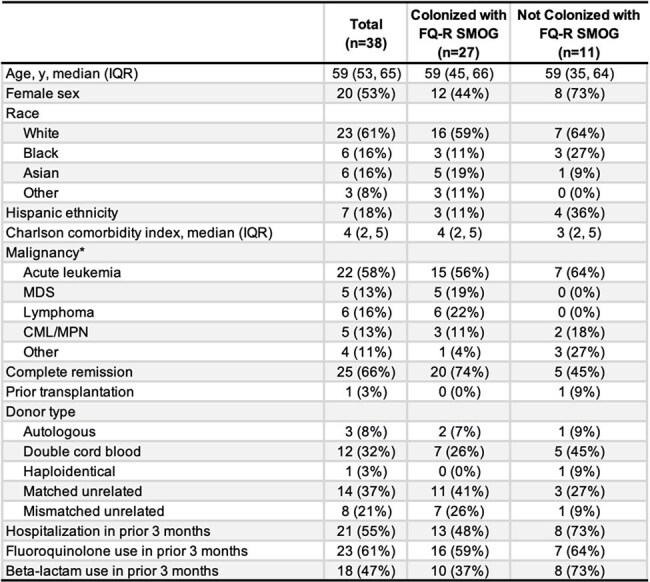 Figure 1
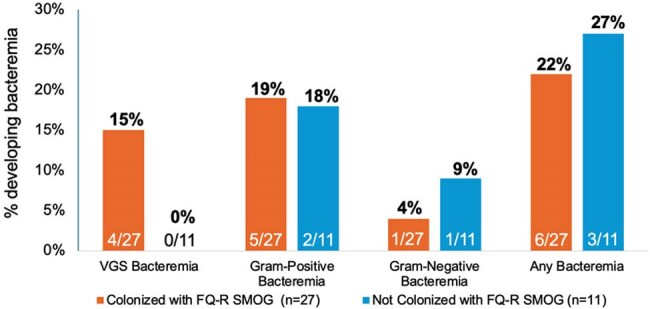 Figure 2
Peer Reviews
No public reviews on file for this paper yet. If you reviewed it on a platform where reviews are public (OpenReview, ICLR, NeurIPS, ICML), you can paste yours below so the community can read it here.
Videos
No videos yet. Explain this paper in a talk, walkthrough, or lecture? Add one.
Taxonomy
TopicsNeutropenia and Cancer Infections · Blood disorders and treatments · Neonatal and Maternal Infections