P-2166. Fusariosis in Hematologic Malignancies in the Era of Antifungal Prophylaxis
Paulina Vega, Pooja Bhattacharyya, Thomas M Kuczmarski, Regina Lengermann, Lisa So, Leah H Yoke, Hayden Z Smith, Joshua Lieberman, David Fredricks, Steven A Pergam

TL;DR
Invasive fusariosis remains a deadly infection in patients with blood cancers, even when they receive antifungal prophylaxis.
Contribution
A 10-year retrospective study characterizes the epidemiology and outcomes of invasive fusariosis in hematologic malignancy patients during the mold-active triazole prophylaxis era.
Findings
Twenty-two cases of invasive fusariosis were identified, with high mortality (45%) despite antifungal prophylaxis.
F. fujikuroi species complex was the most common species identified, and serum galactomannan testing was negative in all cases.
Most patients transitioned from initial monotherapy to dual or triple antifungal regimens within 7 days.
Abstract
Patients receiving myelosuppressive chemotherapy or undergoing hematopoietic cell transplant (HCT) for hematologic malignancies (HM), are disproportionately affected by invasive fusariosis (IF). We performed a 10-year retrospective review to characterize the epidemiology of IF in the era of mold-active triazole (MAT) prophylaxis. To be included, patients had to be ≥18 years of age and diagnosed with IF at our tertiary cancer center between July 2015 and June 2024. All cases met international definitions for proven/probable fusarium infections including positive microbiologic or molecular testing. Demographics, presenting symptoms, diagnosis, treatments and outcomes were evaluated by 2 independent reviewers.This graph depicts antifungal therapy type (monotherapy, dual, triple) at day 1, 7, 14, 21, 30, 45 , 60 and 90. Yellow circles show cases in which death was attributable to invasive…
Genes, proteins, chemicals, diseases, species, mutations and cell lines named across the full text — each resolved to its canonical identifier and authoritative record.
Click any figure to enlarge with its caption.
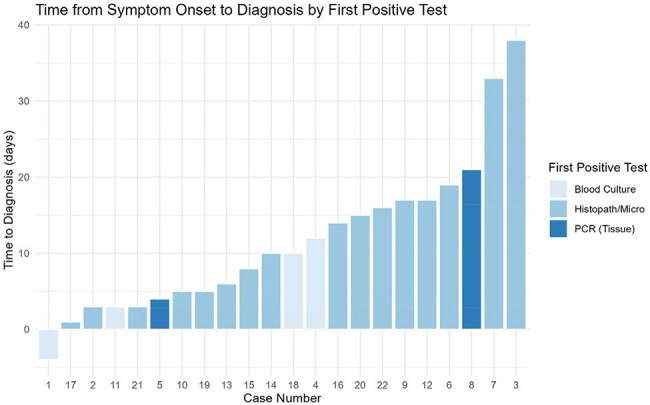 Figure 1
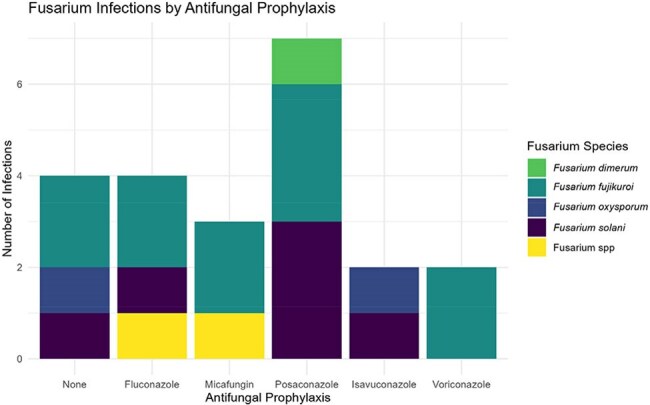 Figure 2
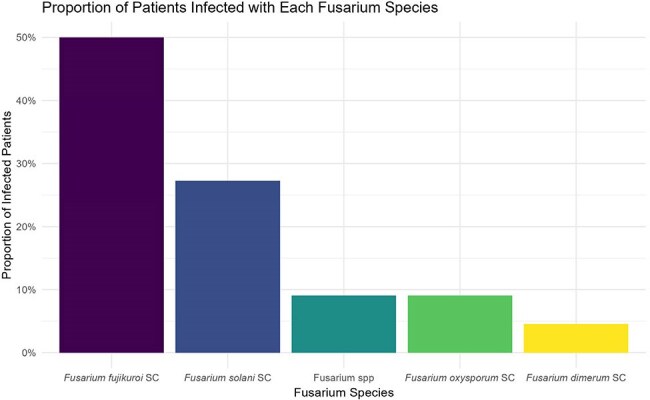 Figure 3
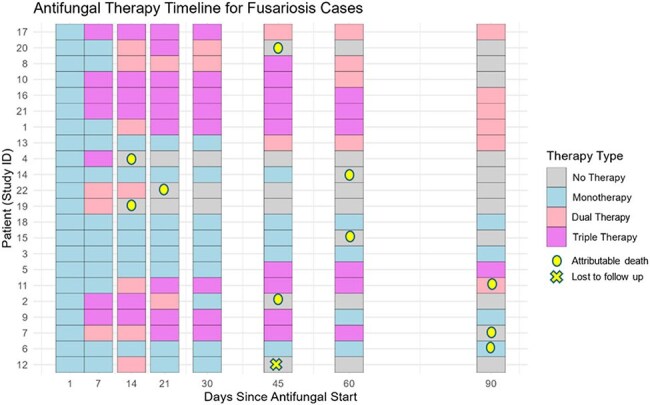 Figure 4
Peer Reviews
No public reviews on file for this paper yet. If you reviewed it on a platform where reviews are public (OpenReview, ICLR, NeurIPS, ICML), you can paste yours below so the community can read it here.
Videos
No videos yet. Explain this paper in a talk, walkthrough, or lecture? Add one.
Taxonomy
TopicsAntifungal resistance and susceptibility · Oral health in cancer treatment · Ocular Infections and Treatments