P-2140. Dalbavancin therapy failure in patients with Staphylococcus aureus infections despite sensitive MIC to Vancomycin: A retrospective Cohort
Kendymill Taveras, Margaret Cook, Stacy Harmon, Madeline Nowakowski, Mitchell Sorenson, Kans Lewis, Laura Mallinger, Megan Elmes, Rodolfo Alpizar-Rivas

TL;DR
This study examines why some patients with Staphylococcus aureus infections failed dalbavancin treatment even when their bacteria were sensitive to vancomycin.
Contribution
The study identifies treatment failures in dalbavancin therapy for S. aureus infections despite in vitro susceptibility to vancomycin.
Findings
19 out of 74 S. aureus cases treated with dalbavancin showed treatment failure despite vancomycin MIC < 0.5.
Treatment failures were more common in MSSA (13 cases) than MRSA (6 cases), though not statistically significant.
The study suggests further research is needed on dalbavancin's off-label use for Staphylococcus infections.
Abstract
Dalbavancin is a lipoglycopeptide antibiotic active against aerobic gram-positive organisms. It is approved to treat acute bacterial skin and skin structure infections (ABSSSI) with increasing interest in off-label use for blood stream infections (BSI), and osteomyelitis (OM). Its major benefit involves a long half-life. However, most clinical microbiology laboratories are unable to verify in vitro activity, resulting in limited real-time susceptibility testing. Therefore, the use of surrogate testing with susceptibility to other glycopeptide antibiotics test is used. This retrospective cohort evaluated the characteristics of treatment failures and re-occurrence of Staphlococcus aureus infections despite susceptibility to vancomycin. We retrospectively identified 203 cases between 2023-2024 . We extracted baseline characteristics of patients with S. aureus infections. Patient age,…
Genes, proteins, chemicals, diseases, species, mutations and cell lines named across the full text — each resolved to its canonical identifier and authoritative record.
Click any figure to enlarge with its caption.
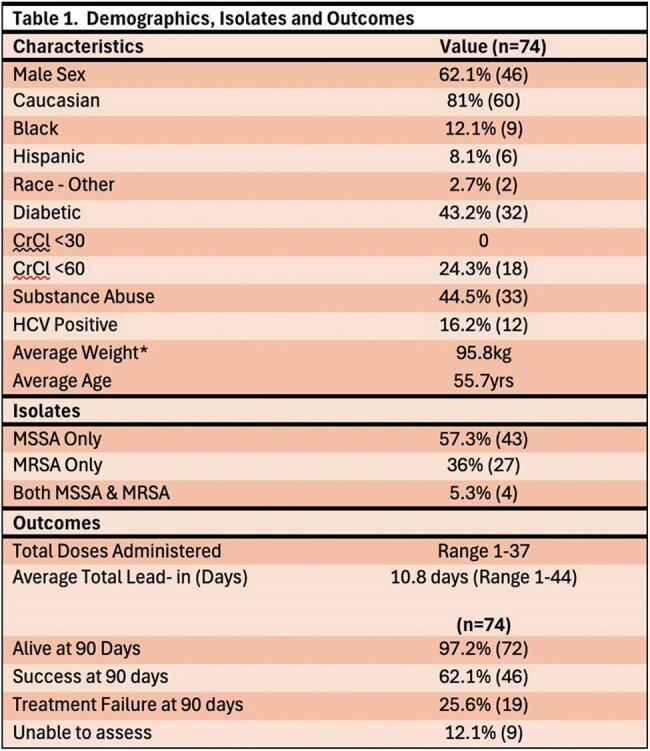 Figure 1
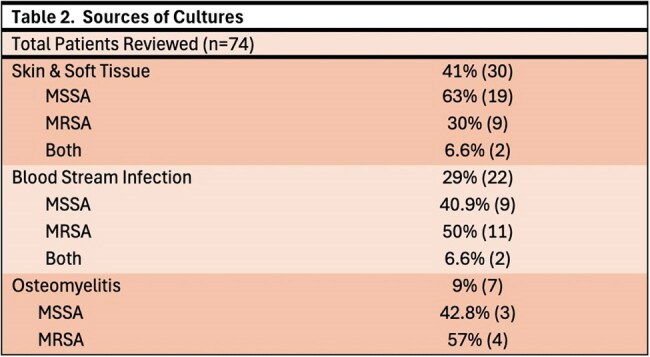 Figure 2
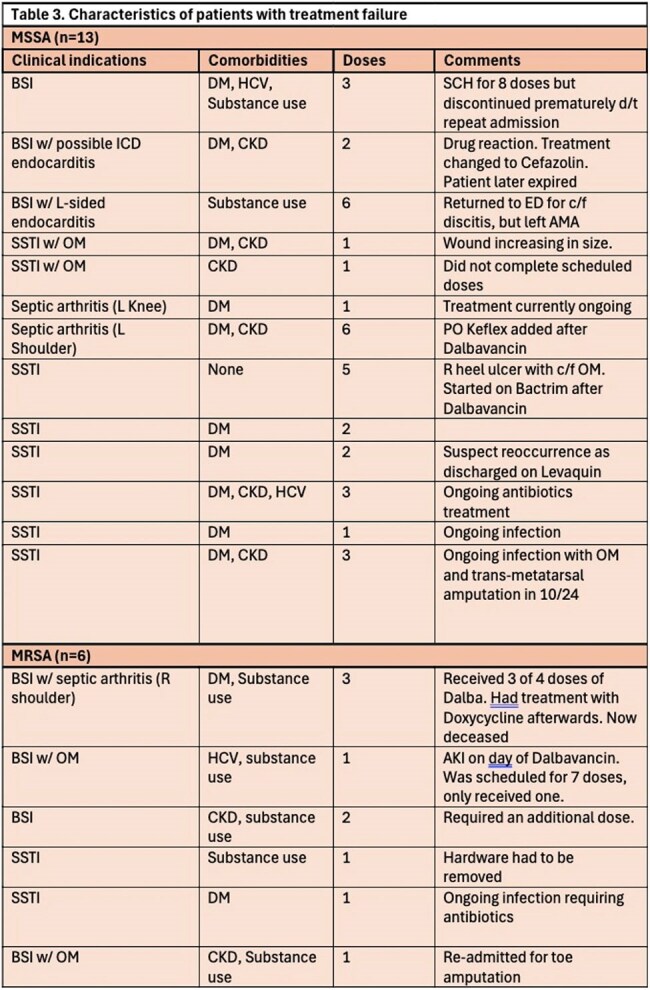 Figure 3
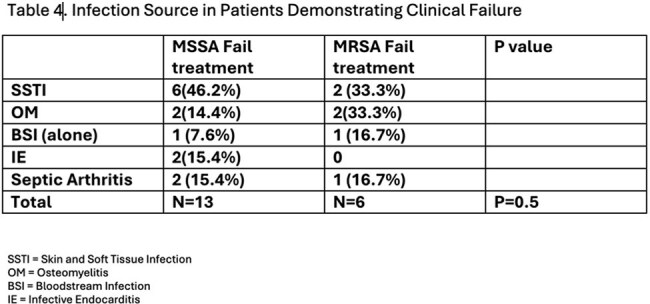 Figure 4
Peer Reviews
No public reviews on file for this paper yet. If you reviewed it on a platform where reviews are public (OpenReview, ICLR, NeurIPS, ICML), you can paste yours below so the community can read it here.
Videos
No videos yet. Explain this paper in a talk, walkthrough, or lecture? Add one.
Taxonomy
TopicsAntimicrobial Resistance in Staphylococcus · Orthopedic Infections and Treatments · Pneumonia and Respiratory Infections