P-2055. County-Level Social Vulnerability Index and Infectious Disease Mortality Among Adults in the United States
Birgit Agyeiwaah Baah, Kwabena Asante Asabere, Aimee Eyram Eklu, Una Kanor, George Akwetey Junior, Wendy Priya Miranda, Frederick Dapaah-Siakwan

TL;DR
Counties with higher social vulnerability in the US have higher infectious disease mortality rates, suggesting public health efforts should focus on vulnerable areas.
Contribution
This study demonstrates a strong association between county-level social vulnerability and increased infectious disease mortality rates in the US.
Findings
ID-related mortality rates increased stepwise with higher SVI quartiles, with a 2.8-fold increase in Q4 compared to Q1.
Higher SVI was linked to excess ID mortality across all racial/ethnic groups and geographic regions.
When ID was the underlying cause of death, mortality rates were 2.1 times higher in the most vulnerable counties.
Abstract
Social vulnerability index (SVI) measures social determinants of health in United States (US) counties and has been used to assess the impact of social vulnerability on health outcomes including COVID-19 mortality. It is unknown if county-level SVI negatively impacts mortality from all infectious diseases (ID). We assessed the relationship between the SVI and ID-related age adjusted mortality rates (ID-AAMR) across US counties from 2018 to 2023. We conducted a retrospective cross-sectional analysis of the multiple cause of death dataset from the CDC WONDER database. The ID-AAMR for all US residents aged ≥20 years who had any ID (ICD-10 codes A00-B99) listed on the death certificate were included. This was linked to the corresponding 2022 SVI score (range: 0 to 1; higher scores indicate greater vulnerability). The dataset was divided into quartiles based on SVI scores (0-0.25: 1st…
Genes, proteins, chemicals, diseases, species, mutations and cell lines named across the full text — each resolved to its canonical identifier and authoritative record.
Click any figure to enlarge with its caption.
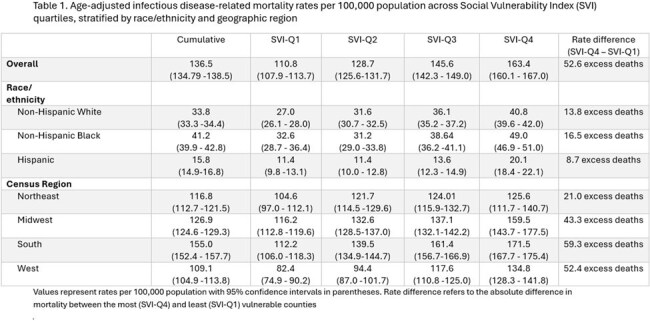 Figure 1
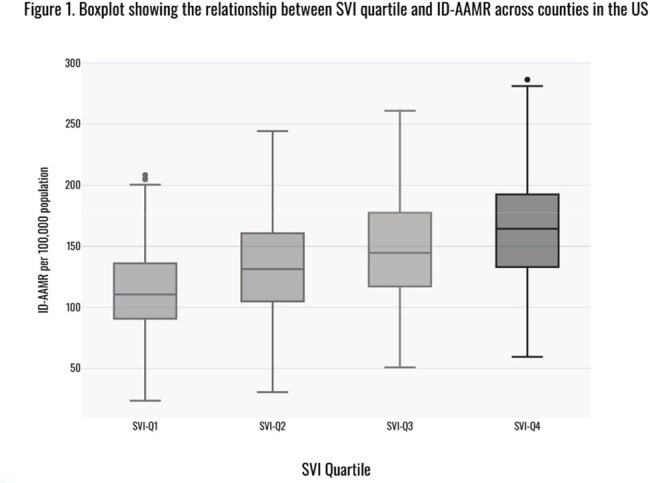 Figure 2
Peer Reviews
No public reviews on file for this paper yet. If you reviewed it on a platform where reviews are public (OpenReview, ICLR, NeurIPS, ICML), you can paste yours below so the community can read it here.
Videos
No videos yet. Explain this paper in a talk, walkthrough, or lecture? Add one.
Taxonomy
TopicsFood Security and Health in Diverse Populations · Health disparities and outcomes · Health, Environment, Cognitive Aging