P-2124. Retrospective Study to Determine the Predictive Factors for Invasive Fungal Infections in Patients who had undergone Bone Marrow Transplant
Haritha Subhagan, Dipu T Sathyapalan, Kiran G kulirankal, Neeraj Sidharthan, Nikhil Krishna Haridas, J S Gayathri, Jahnavi Mohandas, Georg Gutjahr, Merlin Moni

TL;DR
This study identifies risk factors for invasive fungal infections in bone marrow transplant patients in India, emphasizing the need for better antifungal strategies.
Contribution
The study provides insights into IFI risk factors specific to the Indian context and highlights the importance of tailored antifungal prophylaxis.
Findings
Invasive Aspergillosis was the most common IFI, followed by candidiasis and mucormycosis.
Allogeneic transplant recipients had a significantly higher IFI rate compared to autologous recipients.
MDS patients receiving micafungin prophylaxis had a high IFI incidence, suggesting a need for alternative strategies.
Abstract
Hematopoietic stem cell transplant (HSCT) recipients face a heightened risk for invasive fungal Infections (IFIs), which are a major cause of morbidity and mortality. Due to limited data from India, we investigated the prevalence and risk factors of IFIs following HSCT. The Sankey plot illustrates the treatment journey and the outcome of the patients who has undergone HSCT. It flows from left to right. Each colored stem represents a group of patients, and the width of each stream indicates the number of patients at each stage. Abbreviations: MM, Multiple Myloma; MDS, Myelodysplastic Syndrome; AML, Acute Myeloid Leukemia; ALL, Acute Lymphoblastic Leukemia; Auto MEL, Autologous transplant with Melphalan; Auto BEAM, Autologous transplant with BEAM protocol; Allo NMa, Allogenic transplant with non-myeloablative conditioning; Allo Ma, Allogenic transplant with myeloablative conditioning;…
Genes, proteins, chemicals, diseases, species, mutations and cell lines named across the full text — each resolved to its canonical identifier and authoritative record.
Click any figure to enlarge with its caption.
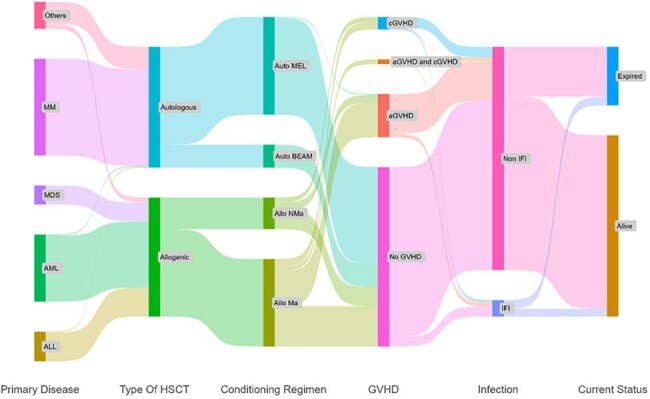 Figure 1
Peer Reviews
No public reviews on file for this paper yet. If you reviewed it on a platform where reviews are public (OpenReview, ICLR, NeurIPS, ICML), you can paste yours below so the community can read it here.
Videos
No videos yet. Explain this paper in a talk, walkthrough, or lecture? Add one.
Taxonomy
TopicsAntifungal resistance and susceptibility · Fungal Infections and Studies · Neutropenia and Cancer Infections