P-2050. Enhancing Patient Outcomes and System Efficiency Through Active Screening for Recurrent Clostridioides difficile and Specialty Treatment at an Infectious Diseases Clinic
Thomas Holowka, Trieu-Vi Khuu, Nikolaos Mavrogiorgos, Elizabeth C Arant, Michael Herce, Claire E Farel, Sarah McGill, Luther A Bartelt

TL;DR
A new approach to managing recurrent C. difficile infections by shifting care to infectious disease clinics and using active screening improves patient access and reduces wait times.
Contribution
The paper introduces an active screening process and a new clinical pathway for rCDI care in an infectious diseases clinic, leading to faster treatment access.
Findings
Active screening reduced time from diagnosis to referral by over three weeks and to clinic visit by nearly a month.
Transitioning referrals to infectious disease clinics cut wait times by about a month compared to gastroenterology clinics.
The new system improved patient access and satisfaction while lowering healthcare costs.
Abstract
Recurrent Clostridioides difficile infection (rCDI) increases healthcare costs and leads to poor patient outcomes. FDA-approved fecal microbiota transplant (FMT) therapies that are effective at breaking the cycle of recurrence are now available in the ambulatory setting without a need for colonoscopic delivery. To adapt to these changes, starting in 6/2024 we piloted routing of outpatient rCDI referrals to the Infectious Diseases (ID) clinic instead of Gastroenterology (GI). We coupled this shift in clinical care with an active rCDI screening process with the overall goal of improved access to care in a large academic medical system.Figure 1:Active Screening Process and Treatment Algorithm for rCDI clinic.Screening and referral process in orange, scheduling and triage in green, clinic evaluation and treatment in light blue, follow up in dark blue, with target timeline above. EMR =…
Genes, proteins, chemicals, diseases, species, mutations and cell lines named across the full text — each resolved to its canonical identifier and authoritative record.
Click any figure to enlarge with its caption.
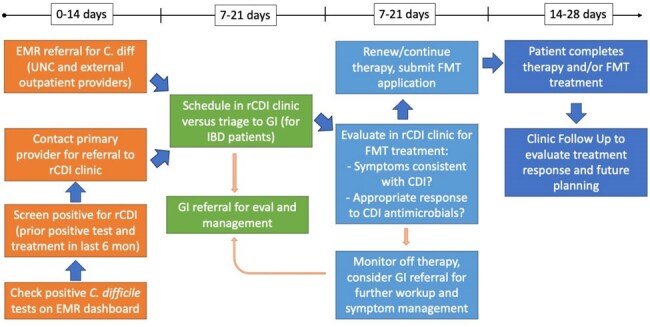 Figure 1
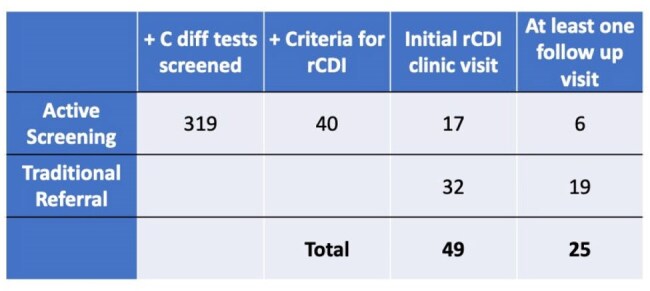 Figure 2
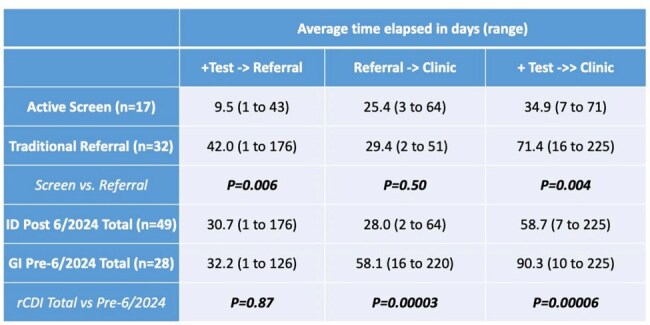 Figure 3
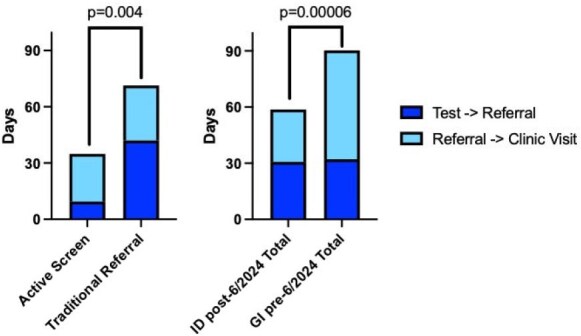 Figure 4
Peer Reviews
No public reviews on file for this paper yet. If you reviewed it on a platform where reviews are public (OpenReview, ICLR, NeurIPS, ICML), you can paste yours below so the community can read it here.
Videos
No videos yet. Explain this paper in a talk, walkthrough, or lecture? Add one.
Taxonomy
TopicsClostridium difficile and Clostridium perfringens research · Microscopic Colitis · Helicobacter pylori-related gastroenterology studies