P-2110. Strongyloides screening for heart transplant candidates in an endemic region: a single-center experience
Donna Dennis, Jessi Clark, Armaghan-e-Rehman Mansoor

TL;DR
This study reports on the screening of heart transplant candidates in an Appalachian region for Strongyloides infection, finding a 9.5% seroprevalence and successful treatment of all positive cases.
Contribution
The paper provides the first reported data on Strongyloides screening in heart transplant candidates in the Appalachian region of the U.S.
Findings
Strongyloides seroprevalence was 9.5% among heart transplant candidates in an Appalachian healthcare system.
All six transplanted patients with positive serology received ivermectin therapy and had no episodes of Strongyloidasis.
There was no statistically significant association between seropositivity and rural or Appalachian residence.
Abstract
Strongyloides stercoralis causes chronic intestinal infection and can reactivate in solid-organ transplant (SOT) recipients, leading to severe or fatal outcomes. The American Society of Transplantation (AST) guidelines recommends universal screening strategy in an endemic region. In the United States, the Appalachian region is endemic for Strongyloides, however screening data in SOT recipients has not been reported. We present data from patients undergoing evaluation for heart transplantation at a healthcare system serving a large portion of Appalachia.Table 1Demographics of prospective heart transplant recipients screened for StrongyloidesTable 2Association between residence and Strongyloides seropositivity Demographics of prospective heart transplant recipients screened for Strongyloides Association between residence and Strongyloides seropositivity Between January 2022 and…
Genes, proteins, chemicals, diseases, species, mutations and cell lines named across the full text — each resolved to its canonical identifier and authoritative record.
Click any figure to enlarge with its caption.
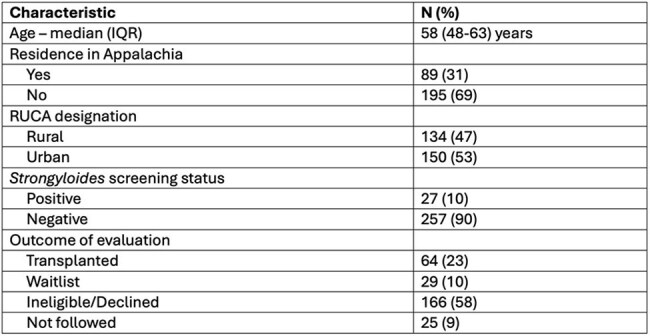 Figure 1
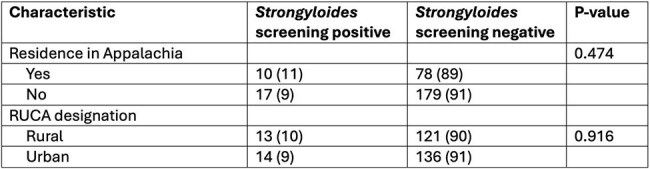 Figure 2
Peer Reviews
No public reviews on file for this paper yet. If you reviewed it on a platform where reviews are public (OpenReview, ICLR, NeurIPS, ICML), you can paste yours below so the community can read it here.
Videos
No videos yet. Explain this paper in a talk, walkthrough, or lecture? Add one.
Taxonomy
TopicsParasites and Host Interactions · Syphilis Diagnosis and Treatment · Amoebic Infections and Treatments