P-2162. Is complete avoidance to anti-anerobic therapy possible for empiric fever and neutropenia therapy?
Swarn V Arya, Mirae Baichoo, Amandeep Singh, Ravi Singh, Pamela Susman, Marcel van den Brink, Boglarka Gyurkocza, Jonathan Peled, Susan K Seo

TL;DR
This study explores whether avoiding anti-anaerobic antibiotics in treating fever and neutropenia in transplant patients can reduce gut microbiota disruption.
Contribution
The study evaluates antibiotic usage patterns in a clinical trial to assess the feasibility of avoiding anti-anaerobic drugs in febrile neutropenia treatment.
Findings
Antibiotic modifications were more common in the cefepime group compared to the piperacillin-tazobactam group.
Complete avoidance of anti-anaerobic drugs was not possible in the cefepime arm, but exposure duration was shorter compared to the piperacillin-tazobactam arm.
De-escalation strategies in the cefepime group likely reduced the duration of anti-anaerobic exposure.
Abstract
Use of anti-anaerobic antibiotics has been associated with disruptions of gut microbiota composition and adverse outcomes, including acute graft-vs-host disease in allogeneic hematopoietic cell transplant (allo-HCT) patients (pts). To test the hypothesis that sparing gut anaerobes would confer clinical benefit, we randomized pts undergoing allo-HCT to different regimens for treatment of fever and neutropenia (FN) (NCT03078010). Here we analyzed antibiotic utilization patterns in the trial to evaluate the feasibility of complete avoidance of anti-anaerobic agents. Pts were randomized to the institutional standard piperacillin-tazobactam (PTZ) or cefepime (CPM) for initial FN. Subsequent antibiotic changes for FN were left to provider discretion. Pts on the CPM arm could be de-escalated to aztreonam (or to a quinolone later in the trial) if clinically stable and afebrile x 72 hours,…
Genes, proteins, chemicals, diseases, species, mutations and cell lines named across the full text — each resolved to its canonical identifier and authoritative record.
Click any figure to enlarge with its caption.
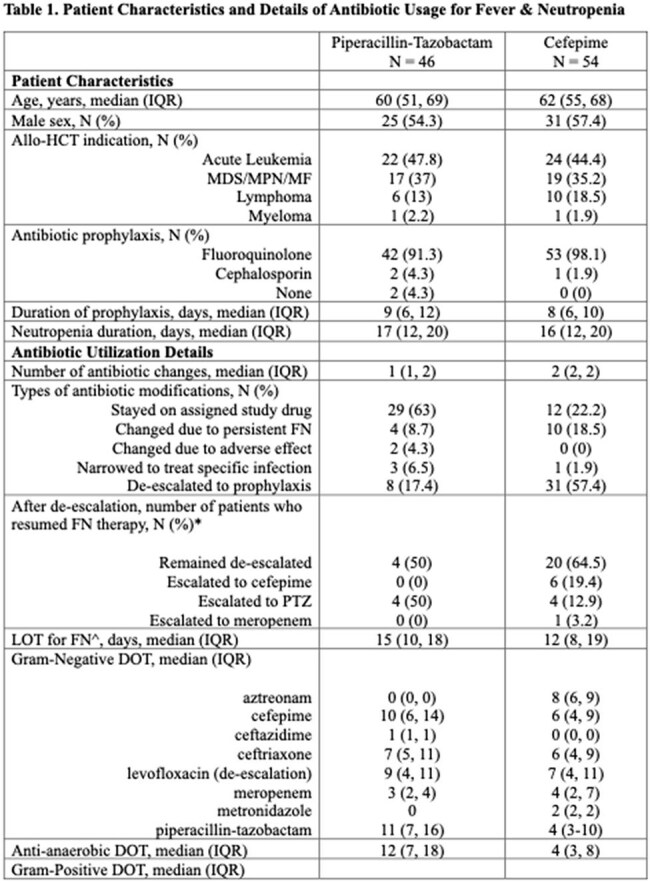 Figure 1
Peer Reviews
No public reviews on file for this paper yet. If you reviewed it on a platform where reviews are public (OpenReview, ICLR, NeurIPS, ICML), you can paste yours below so the community can read it here.
Videos
No videos yet. Explain this paper in a talk, walkthrough, or lecture? Add one.
Taxonomy
TopicsNeutropenia and Cancer Infections · Bacterial Identification and Susceptibility Testing · Blood disorders and treatments