P-1426. Serotype Distribution and Vaccine Coverage of Invasive Pneumococcal Disease in Mexico, Brazil, and Argentina, 2016-2023
Amanda M Martino, Juan Urrego-Reyes, Mohan Kumar Paluru, Jan Cervenka, Nicole Cossrow

TL;DR
This study examines the spread of pneumococcal disease in adults in three Latin American countries and finds that a new 21-valent vaccine could significantly reduce the disease burden.
Contribution
The study provides the first detailed analysis of serotype distribution and vaccine coverage of IPD in adults across Argentina, Brazil, and Mexico.
Findings
PCV21 covers a higher proportion of IPD cases in adults compared to other vaccines.
The unique 11 serotypes in PCV21 not found in PCV20 provide additional disease coverage of 16.46-30.37% in adults.
Inclusion of PCV21 in adult immunization programs may significantly reduce the residual IPD burden.
Abstract
Invasive pneumococcal disease (IPD) is a severe infection in which Streptococcus pneumoniae bacterium spreads to normally sterile sites in the body, resulting in meningitis (brain and/or spinal cord infection), bacteremia (bloodstream infection), and bacteremic pneumonia (lung infection). Despite availability of pneumococcal conjugate vaccines (PCV) to prevent IPD in Latin America, a significant burden of disease remains in adults. There is a scarcity of literature on the serotype distribution and vaccine coverage of IPD in this region, which this study aims to address.Table 1.IPD Disease Coverage (%) by Vaccine-Specific Serotypes in Argentina, Brazil, and Mexico by Age Group, 2016-2023Table 2.Serotype Distribution (%) of PCV21-non-PCV20 Serotypes vs. PCV20-non-PCV21 Serotypes in Argentina, Brazil, and Mexico by Age Group, 2016-2023 IPD Disease Coverage (%) by Vaccine-Specific…
Genes, proteins, chemicals, diseases, species, mutations and cell lines named across the full text — each resolved to its canonical identifier and authoritative record.
Click any figure to enlarge with its caption.
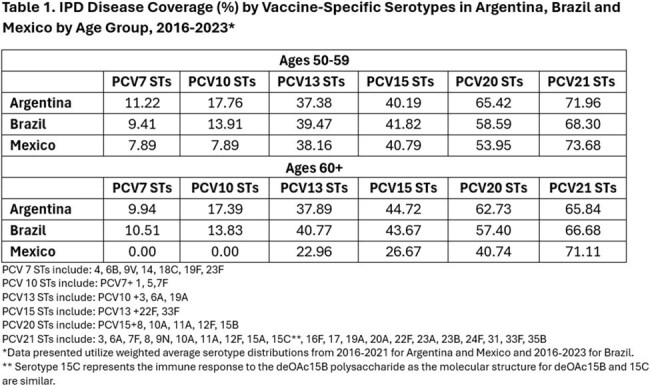 Figure 1
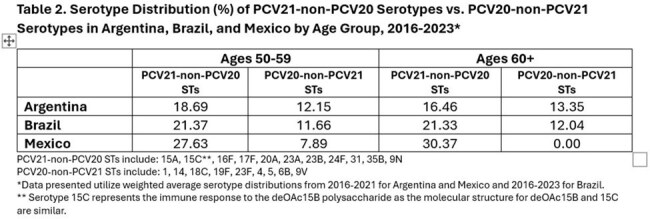 Figure 2
Peer Reviews
No public reviews on file for this paper yet. If you reviewed it on a platform where reviews are public (OpenReview, ICLR, NeurIPS, ICML), you can paste yours below so the community can read it here.
Videos
No videos yet. Explain this paper in a talk, walkthrough, or lecture? Add one.
Taxonomy
TopicsPneumonia and Respiratory Infections · vaccines and immunoinformatics approaches · Respiratory viral infections research