P-1521. Prophylactic Immunization with Nirsevimab Does Not Impair the Development of Natural Antibody Responses to the Pre-fusion Conformation of the Respiratory Syncytial Virus Fusion Protein
Ann Marie Stanley, Vancheswaran Gopalakrishnan, Carolina Caceres, Kevin M Tuffy, Beth Kelly, Mark T Esser, Tonya L Villafana, Anastasia A Aksyuk, Deidre Wilkins

TL;DR
A study shows that a monoclonal antibody called nirsevimab does not prevent infants from developing natural antibody responses to a key protein of respiratory syncytial virus.
Contribution
The study introduces a method to assess natural antibody responses in the presence of nirsevimab by depleting the antibody from serum samples.
Findings
Nirsevimab immunization does not impair natural pre-F binding antibody responses in infants with RSV exposure.
Neutralizing antibody responses in nirsevimab-immunized infants overlap with those of placebo participants with RSV exposure.
Pre-F antibody levels in nirsevimab-immunized infants are lower than placebo but higher than unexposed infants.
Abstract
Nirsevimab is an extended half-life (M252Y/S254T/T256E [YTE]-modified) monoclonal antibody that binds to the prefusion (pre-F) conformation of the respiratory syncytial virus (RSV) fusion (F) protein and is licensed for the prevention of RSV lower respiratory tract disease in neonates, infants and medically vulnerable children. Previous analyses have shown that nirsevimab immunization does not impair the development of antibody (Ab) responses to the G attachment, nucleocapsid or postfusion (post-F) conformation of the RSV F protein. Pre-F-specific Abs determine the magnitude of RSV neutralizing activity. However, the impact of nirsevimab immunization on pre-F responses has been difficult to assess due to shared epitopes. Here we describe a method of depleting YTE-modified Abs from serum, and its application in assessing natural pre-F binding and neutralizing Ab (nAb) responses following…
Genes, proteins, chemicals, diseases, species, mutations and cell lines named across the full text — each resolved to its canonical identifier and authoritative record.
Click any figure to enlarge with its caption.
 Figure 1
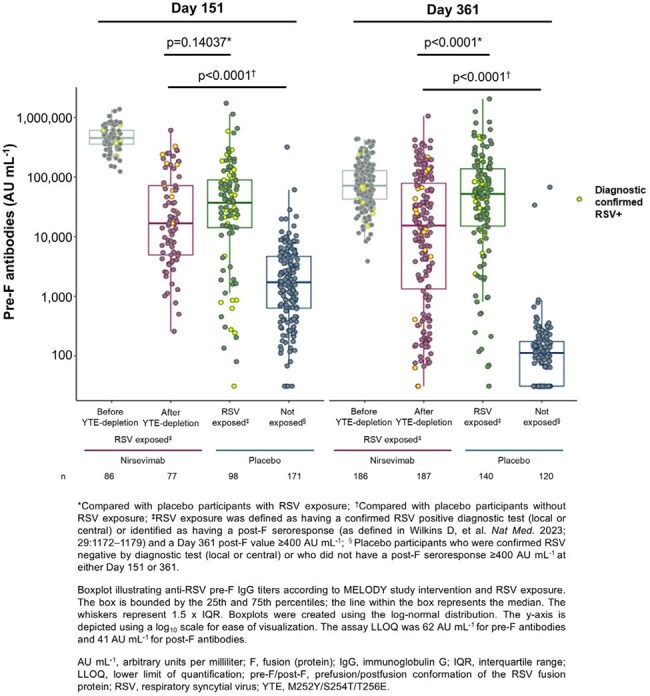 Figure 2
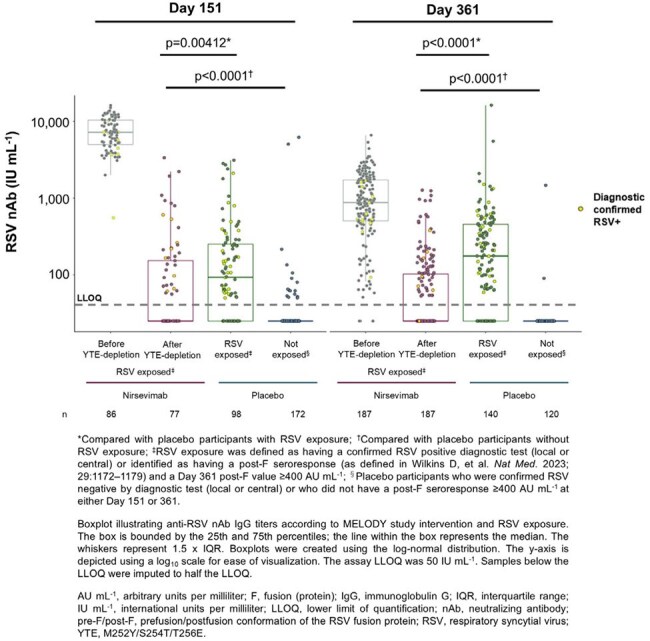 Figure 3
Peer Reviews
No public reviews on file for this paper yet. If you reviewed it on a platform where reviews are public (OpenReview, ICLR, NeurIPS, ICML), you can paste yours below so the community can read it here.
Videos
No videos yet. Explain this paper in a talk, walkthrough, or lecture? Add one.
Taxonomy
TopicsRespiratory viral infections research · Neonatal Respiratory Health Research · Virology and Viral Diseases