P-1713. Blood in Bronchoalveolar Lavage Samples can Produce False-Positive Aspergillus Galactomannan Antigen Test Results
Aditi S Iyer, D J Valint, Mabel Jimenez, Steven A Pergam, Guang-Shing Cheng, David Fredricks, Denise McCulloch

TL;DR
Blood contamination in bronchoalveolar lavage samples can lead to false-positive results in Aspergillus tests, especially in low-protein samples.
Contribution
This study identifies blood contamination as a novel cause of false-positive Aspergillus galactomannan test results in low-protein BAL samples.
Findings
Adding blood to BAL samples increases GM-ODI values in a dose-dependent manner.
Low-protein BAL samples are more susceptible to false positives from blood contamination.
Adding bovine serum albumin can mitigate the false-positive effect of blood in BAL samples.
Abstract
Invasive pulmonary aspergillosis (IPA) is the most common invasive fungal infection in immunocompromised patients. Bronchoalveolar lavage (BAL) fluid galactomannan assays are an important diagnostic tool, but can yield false positive results, leading to diagnostic errors and unnecessary treatment. We hypothesize that BAL fluid contaminated by blood contributes to false positive Galactomannan Optical Density Index (GM-ODI) results.Figure 1.Relationship between the volume of blood added to BAL samples and the Aspergillus galactomannan optical density index (GM-ODI)Figure 2.Addition of blood to GM-negative BAL samples resulted in false-positive Aspergillus GM results in low-protein samples, but no effect in high-protein samples Relationship between the volume of blood added to BAL samples and the Aspergillus galactomannan optical density index (GM-ODI) Addition of blood to GM-negative…
Genes, proteins, chemicals, diseases, species, mutations and cell lines named across the full text — each resolved to its canonical identifier and authoritative record.
Click any figure to enlarge with its caption.
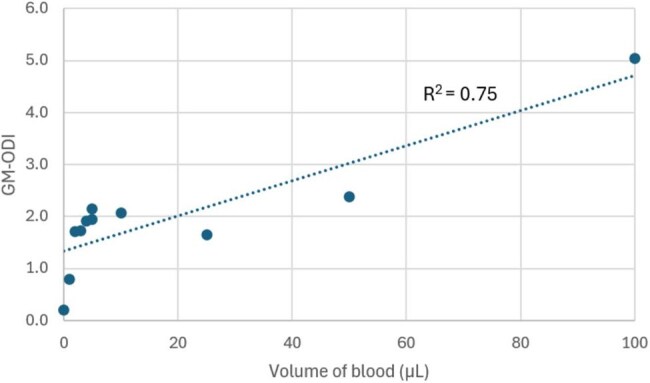 Figure 1
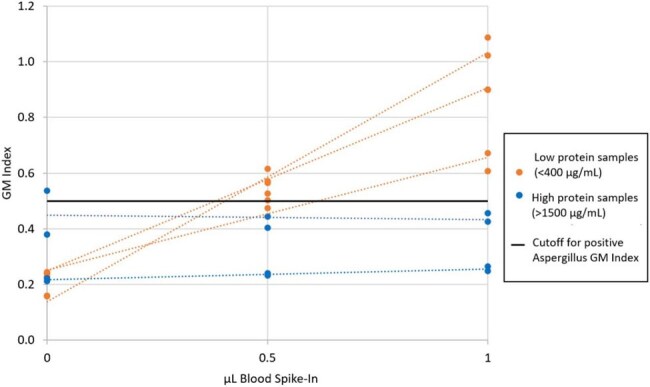 Figure 2
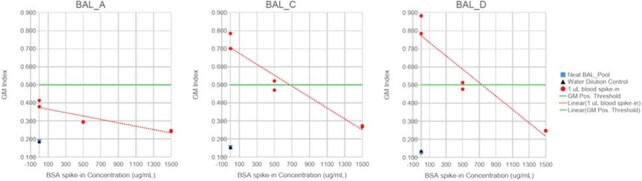 Figure 3
Peer Reviews
No public reviews on file for this paper yet. If you reviewed it on a platform where reviews are public (OpenReview, ICLR, NeurIPS, ICML), you can paste yours below so the community can read it here.
Videos
No videos yet. Explain this paper in a talk, walkthrough, or lecture? Add one.
Taxonomy
TopicsAntifungal resistance and susceptibility · Parasitic Diseases Research and Treatment · Ocular Infections and Treatments