560. Efficacy and Safety of Retavibart, a Long-acting Monoclonal Antibody, for the Prevention of Respiratory Syncytial Virus-Induced Lower Respiratory Tract Infection: A Phase 2b Trial in Infants Entering Their First Epidemic Season
Yanyan Li, Daiyin Tian, Lingli Pan, Hanmin Liu, Enmei Liu, Shiru Zhao, Haiyan An, Xin Zhou, Jiyuan Ding, Jianli Chu, Meizhuo Zhang, Ying Wang, Xiaohu Kuang, Xia Zhou, Zhenxing Jia, Hao Zhao, Huaxin Liao, Wanmei wang

TL;DR
A new long-acting antibody called Retavibart was tested in infants and found to significantly reduce RSV-related illnesses and hospitalizations, especially in high-risk infants.
Contribution
This is the first clinical trial to evaluate a long-acting anti-RSV monoclonal antibody in high-risk infants, showing strong efficacy and safety.
Findings
Retavibart reduced medically attended lower respiratory tract infections by 66.2% and RSV-related hospitalizations by 82.3%.
In high-risk infants, RSV-related infections and hospitalizations were reduced by 91.1% and 93.5%, respectively.
The safety profile of Retavibart was comparable to placebo, with no deaths or early withdrawals due to adverse events.
Abstract
Respiratory syncytial virus (RSV) is the most common cause of lower respiratory tract infection in young children. Retavibart (formerly known as TNM001) is a recombinant human monoclonal antibody (mAb) targeting the prefusion protein of RSV. This was a randomized, double-blind, placebo-controlled phase 2b trial. Eligible participants included term and preterm infants, with or without congenital heart disease (CHD) or chronic lung disease (CLD) of prematurity, who were entering their first RSV season. Participants were randomized in a 2:1 ratio to receive a single intramuscular injection of retavibart 120 mg or placebo. Efficacy endpoints included incidence of medically attended lower respiratory tract infection (MALRTI) and hospitalization due to RT-PCR confirmed RSV infection through Day 151. Safety assessments included the collection of adverse events (AEs) and serious adverse events…
Genes, proteins, chemicals, diseases, species, mutations and cell lines named across the full text — each resolved to its canonical identifier and authoritative record.
Click any figure to enlarge with its caption.
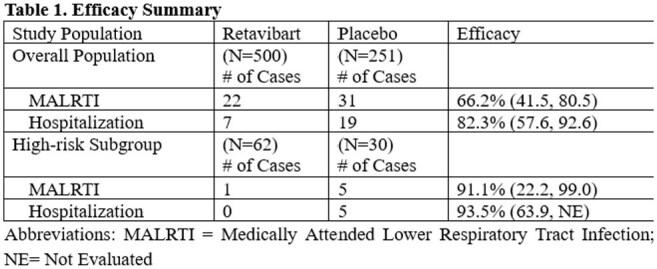 Figure 1
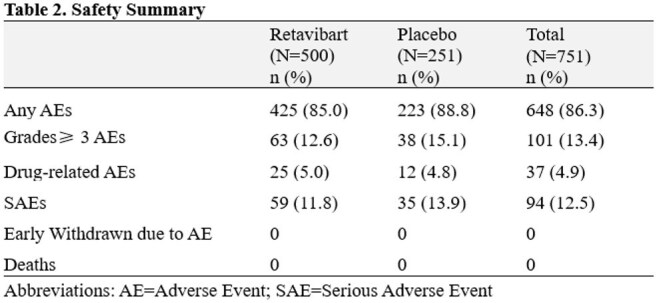 Figure 2
Peer Reviews
No public reviews on file for this paper yet. If you reviewed it on a platform where reviews are public (OpenReview, ICLR, NeurIPS, ICML), you can paste yours below so the community can read it here.
Videos
No videos yet. Explain this paper in a talk, walkthrough, or lecture? Add one.
Taxonomy
TopicsRespiratory viral infections research · Neonatal Respiratory Health Research · Cystic Fibrosis Research Advances