P-1655. Anti-Spike IgG4 and Fc Effector Responses: The Impact of SARS-CoV-2 Vaccine Platform–Specific Priming and Immune Imprinting
Raj Kalkeri, Mingzhu Zhu, Shane Cloney-Clark, Anand Parekh, Drew Gorinson, Zhaohui Cai, William Moffitt, Miranda R Cai, Gordon Chau, Tara M Babu, Anna Wald, Louis F Fries, Lisa M Dunkle, Amy W Chung, Joyce S Plested

TL;DR
This study shows that mRNA vaccines increase anti-spike IgG4 antibodies, which may reduce vaccine effectiveness, while protein-based vaccines can partially reverse this effect.
Contribution
The study is the first to show how vaccine platform-specific priming affects anti-S IgG4 and Fc effector functions, and how protein-based boosters can partially overcome mRNA vaccine imprinting.
Findings
mRNA vaccines increase anti-S IgG4, which correlates with reduced neutralizing antibodies and Fc effector functions.
Protein-based vaccines can partially overcome anti-S IgG4 and Fc effector function immune imprinting caused by mRNA vaccines.
Boosting with adjuvanted protein-based vaccines reduces the negative impact of anti-S IgG4 on Fc effector functions.
Abstract
Repeated mRNA SARS-CoV-2 (COVID) vaccination results in large increases in anti-spike (S)-specific IgG4, but this does not occur after repeat vaccination with Matrix-M®-adjuvanted recombinant SARS-CoV-2 S (rS) protein (NVX-CoV2373, Novavax). The clinical relevance of vaccine-induced anti-S IgG4 and its possible reversal remains poorly understood but may be pivotal for this and other future vaccine targets.Figure 1:Serum anti-Spike IgG4 concentrations (ng/mL) measured by ELISA. A. Comparison of mRNA vaccine primed 3x (gray) and protein vaccine primed 3x (dark blue) followed by protein vaccine boost subject sera. B. protein vaccine primed 2x subject sera followed by mRNA boost. ****p<0.0001 Serum anti-Spike IgG4 concentrations (ng/mL) measured by ELISA. A. Comparison of mRNA vaccine primed 3x (gray) and protein vaccine primed 3x (dark blue) followed by protein vaccine boost subject sera.…
Genes, proteins, chemicals, diseases, species, mutations and cell lines named across the full text — each resolved to its canonical identifier and authoritative record.
Click any figure to enlarge with its caption.
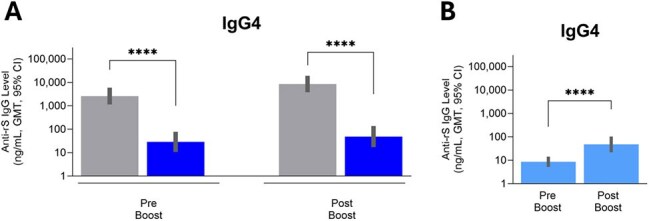 Figure 1
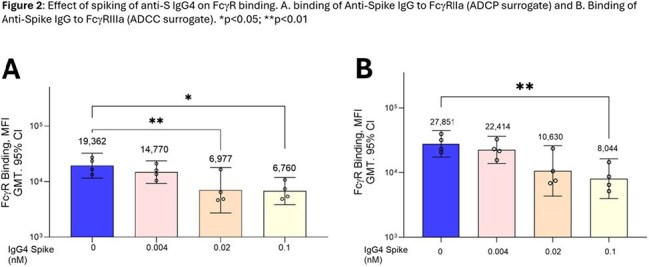 Figure 2
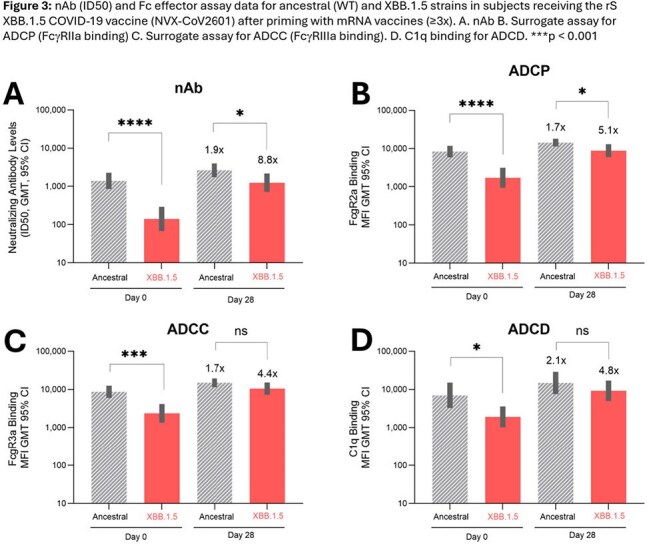 Figure 3
Peer Reviews
No public reviews on file for this paper yet. If you reviewed it on a platform where reviews are public (OpenReview, ICLR, NeurIPS, ICML), you can paste yours below so the community can read it here.
Videos
No videos yet. Explain this paper in a talk, walkthrough, or lecture? Add one.
Taxonomy
TopicsSARS-CoV-2 and COVID-19 Research · Heparin-Induced Thrombocytopenia and Thrombosis · Dermatological and COVID-19 studies