P-1249. Effect of Starting Inoculum and β-lactamase Retention on the Activity of Imipenem/Relebactam (I/R) and Aztreonam (ATM) plus I/R in Hollow Fiber Infection (HFIM) Studies of P. aeruginosa (PSA)
J Nicholas O’Donnell, Nicole L Shakerley, Kelly E Moolick, Avery I Nahorniak, Abimael Marrero, Katherine Young, Thomas Lodise

TL;DR
This study compares how different infection model cartridges affect antibiotic effectiveness against P. aeruginosa, focusing on imipenem/relebactam and aztreonam combinations.
Contribution
The study reveals how cartridge pore size influences β-lactamase retention and antibiotic efficacy in pre-clinical models.
Findings
C7011 cartridges showed better bacterial killing for CL 5701 at standard inocula compared to C2011.
High inocula reduced differences in killing between cartridge types for both isolates.
C2011 showed better short-term killing for MB 10480 at high inocula, but C7011 had better long-term results.
Abstract
HFIMs are the gold standard pre-clinical PK/PD model for studying humanized antibiotic exposure-response relationships. Standard HFIM cartridges (Fibercell C2011) use 20 kD MWCO fibers, which retain β-lactamases from lysed bacteria. Newer cartridges (Fibercell C7011) have larger 0.03 µm pores and are less prone to β-lactamase retention. We evaluated whether bacterial killing differs between I/R and I/R + ATM in PSA HFIM studies using C2011 vs. C7011 cartridges.Figure 1.Hollow fiber infection models evaluating bacterial killing against P. aeruginosa CL 5701 at standard (a) and high (b) starting inoculaI/R, imipenem/relebactamFigure 2.Hollow fiber infection models evaluating bacterial killing against P. aeruginosa MB 10480 at standard (a) and high (b) starting inoculaATM, aztreonam; I/R, imipenem/relebactam Hollow fiber infection models evaluating bacterial killing against P. aeruginosa…
Genes, proteins, chemicals, diseases, species, mutations and cell lines named across the full text — each resolved to its canonical identifier and authoritative record.
Click any figure to enlarge with its caption.
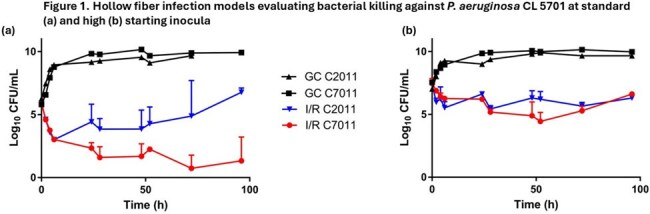 Figure 1
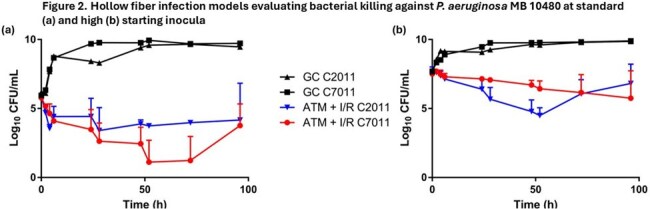 Figure 2
Peer Reviews
No public reviews on file for this paper yet. If you reviewed it on a platform where reviews are public (OpenReview, ICLR, NeurIPS, ICML), you can paste yours below so the community can read it here.
Videos
No videos yet. Explain this paper in a talk, walkthrough, or lecture? Add one.
Taxonomy
TopicsAntibiotics Pharmacokinetics and Efficacy · Antibiotic Resistance in Bacteria · Antimicrobial agents and applications