P-2156. Investigating the Relationship of Frailty and UTIs in Kidney Transplant Recipients
Rebecca Unterborn, Liza Creel, Kristine M Erlandson, Maheen Abidi

TL;DR
Frail kidney transplant recipients are at much higher risk of urinary tract infections than non-frail patients, with frail individuals being 8 times more likely to develop UTIs.
Contribution
First study to quantify the bidirectional relationship between frailty and UTIs specifically in kidney transplant recipients.
Findings
Frail KT recipients were 8 times more likely to develop UTIs compared to non-frail patients.
Frail patients developed UTIs sooner than non-frail patients, as shown by Kaplan-Meier curves.
45% of UTI patients were frail, compared to 25% of those without UTIs.
Abstract
Urinary tract infections (UTIs) are the most common infectious complication in kidney transplant (KT) recipients and are associated with high morbidity and mortality. Frailty, a vulnerability to stressors, has been associated with increased risk for UTIs in older adults, and UTIs may contribute to worsening frailty. Despite the significant burden of UTIs on KT recipients, the relationship between frailty and UTIs has not been described in this population. Our goal was to investigate the bidirectional relationship between UTIs and frailty.Table 1.Baseline Characteristics among KT recipients with and without UTIs.Table 2.Risk of Developing UTIs according to frailty, adjusting for age and sex. Baseline Characteristics among KT recipients with and without UTIs. Risk of Developing UTIs according to frailty, adjusting for age and sex. We conducted a retrospective chart review of 90 KT…
Click any figure to enlarge with its caption.
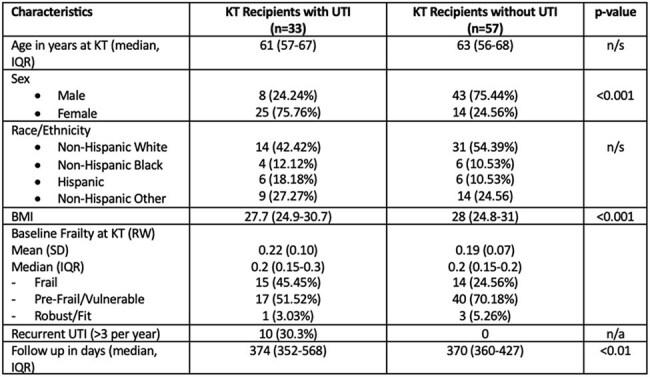 Figure 1
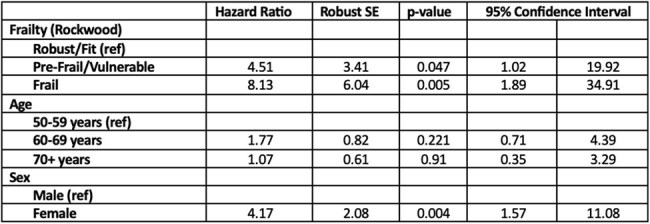 Figure 2
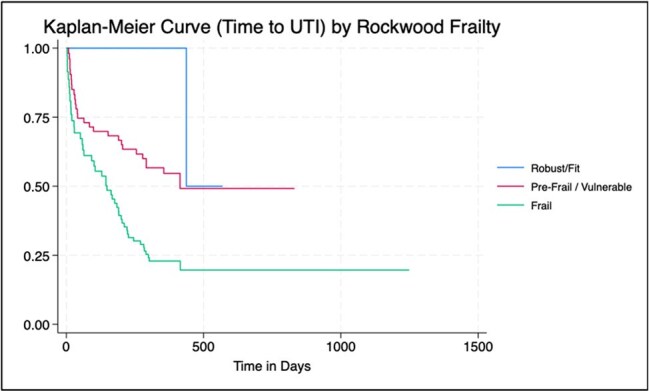 Figure 3
Peer Reviews
No public reviews on file for this paper yet. If you reviewed it on a platform where reviews are public (OpenReview, ICLR, NeurIPS, ICML), you can paste yours below so the community can read it here.
Videos
No videos yet. Explain this paper in a talk, walkthrough, or lecture? Add one.
Taxonomy
TopicsDialysis and Renal Disease Management · Cytomegalovirus and herpesvirus research · Renal Transplantation Outcomes and Treatments