P-1938. The Size of Pulmonary Invasive Mold Infection and Underlying Host Diseases
Hyeon Mu Jang

TL;DR
This study finds that larger pulmonary mold infections are more common in patients with blood cancers, while smaller ones are linked to transplants and lung diseases.
Contribution
The study introduces a size-based classification of pulmonary invasive mold infections and links lesion size to specific underlying host conditions.
Findings
Over 60% of proven pulmonary invasive mold infections were larger than 3cm.
Larger lesions were more common in patients with hematologic malignancies and mucormycosis.
Smaller lesions were more common in transplant recipients, patients with chronic lung diseases, and those with aspergillosis.
Abstract
Computed tomography (CT) is important to diagnose pulmonary invasive mold infection (PIMI). The radiologic criteria by the 2020 European Organization for Research and Treatment of Cancer (EORTC) include dense, well-circumscribed lesion, air crescent sign, cavity, and consolidation. The dense, well-circumscribed lesion(s) are classified into nodules or masses by the cut-off of 3cm, although there is no such cutoff for the other types of lung lesions. Moreover, there are limited data on the size of PIMI and its clinical characteristics. We thus evaluated the size of the representative lesion, dividing them into two groups (≤3cm, >3cm) and its clinical characteristics including underlying host diseases.Table 1.Clinical characteristics of invasive mold infection by the size (≤3cm, >3cm)Figure 1.The size of representative lesionIt was defined as the long diameter of the mass or consolidation…
Click any figure to enlarge with its caption.
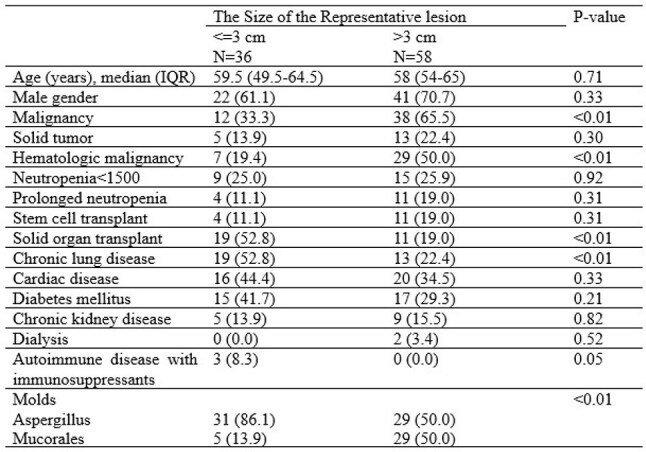 Figure 1
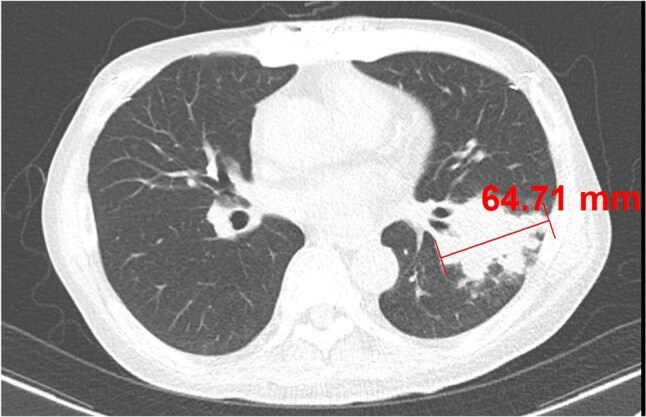 Figure 2
Peer Reviews
No public reviews on file for this paper yet. If you reviewed it on a platform where reviews are public (OpenReview, ICLR, NeurIPS, ICML), you can paste yours below so the community can read it here.
Videos
No videos yet. Explain this paper in a talk, walkthrough, or lecture? Add one.
Taxonomy
TopicsAntifungal resistance and susceptibility · Interstitial Lung Diseases and Idiopathic Pulmonary Fibrosis · Lung Cancer Diagnosis and Treatment