P-1415. Infectious Causes of Classical Fever of Unknown Origin: A Prospective Observational Study from a Tertiary Care Centre in North India
Md Tariq Maula, Sandeep Rao Kordcal, Piyush Ranjan, Ashutosh Biswas, Naveet Wig

TL;DR
This study finds that infections, especially tuberculosis, are the most common cause of undiagnosed fevers in North India, and advanced tests like PET-CT help identify these cases.
Contribution
The study provides updated insights into the infectious causes of fever of unknown origin in a resource-limited setting, emphasizing tuberculosis and the role of advanced diagnostics.
Findings
Infections accounted for 50.8% of classical fever of unknown origin cases, with tuberculosis being the most common cause.
PET-CT and bone marrow examination improved diagnostic yield in 42% of infectious cases.
Prior antibiotic use reduced microbiological output in infectious fever of unknown origin cases.
Abstract
Fever of unknown origin (FUO) is difficult to diagnose despite recent improvements, because of its nonspecific clinical characteristics and wide differential diagnosis. Although infections are the most common causes in underdeveloped nations, they are frequently overlooked in their early stages because of atypical presentations and empirical use of antibiotics. The purpose of this study was to describe the clinical characteristics, diagnostic methods, and infectious spectrum of patients with classical FUO.Figure 1Etiological distribution of FUO casesFigure 2Diagnostic yield of investigations in infectious FUO Etiological distribution of FUO cases Diagnostic yield of investigations in infectious FUO We prospectively enrolled 122 adult patients meeting classical FUO criteria at a tertiary care center in North India. Comprehensive data, including clinical, laboratory, imaging, course,…
Genes, proteins, chemicals, diseases, species, mutations and cell lines named across the full text — each resolved to its canonical identifier and authoritative record.
Click any figure to enlarge with its caption.
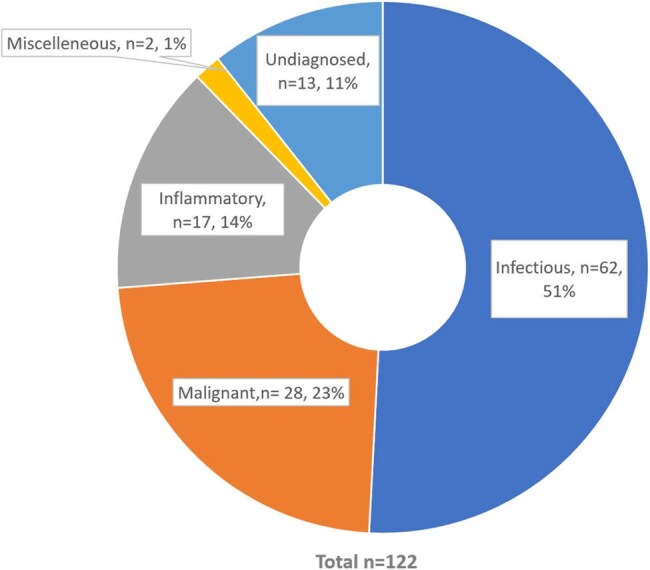 Figure 1
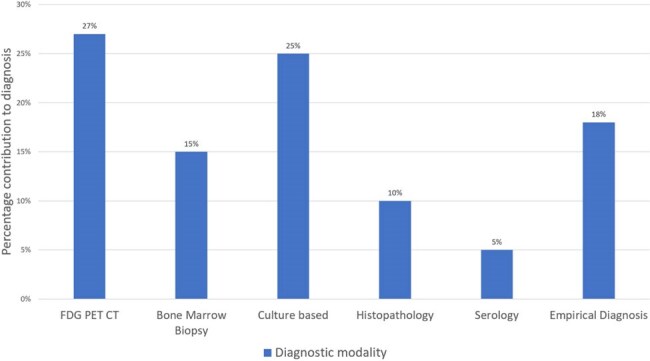 Figure 2
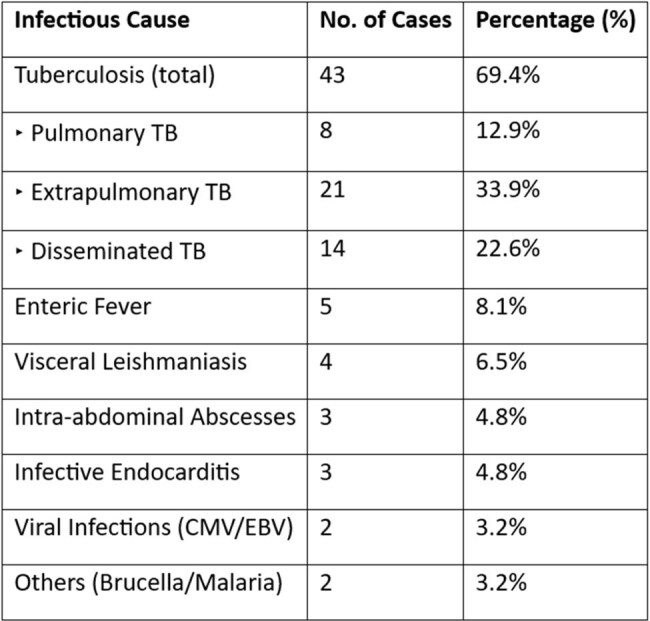 Figure 3
Peer Reviews
No public reviews on file for this paper yet. If you reviewed it on a platform where reviews are public (OpenReview, ICLR, NeurIPS, ICML), you can paste yours below so the community can read it here.
Videos
No videos yet. Explain this paper in a talk, walkthrough, or lecture? Add one.
Taxonomy
TopicsHematological disorders and diagnostics · Lymphadenopathy Diagnosis and Analysis · Orthopedic Infections and Treatments