P-1267. Neisseria gonorrhoeae in Ecuador: insights from whole-genome sequencing
Jeannete Zurita, Fernando Lara-Freire, Gabriela Sevillano, Gabriela Sevillano, Andrés Herrera-Yela, Heydi Tonguino, Ariane Paz y Miño, Camilo Zurita-Salinas

TL;DR
This study uses whole-genome sequencing to analyze Neisseria gonorrhoeae strains in Ecuador, revealing virulence and antibiotic resistance factors.
Contribution
The study provides the first genomic insights into N. gonorrhoeae in Ecuador, identifying specific plasmid types and resistance genes.
Findings
All isolates carried key virulence genes like pil, porB, and katA.
Five strains harbored the blaTEM gene associated with plasmid variants pbla.1 and pbla.3.
Ceftriaxone and cefixime remain effective, but other antibiotics require sensitivity testing.
Abstract
Neisseria gonorrhoeae causes over 80 million global gonorrhea cases annually and is increasingly resistant to first-line antibiotics. In Ecuador, genomic data is scarce due to empirical treatment practices and limited culture testing. This study aims to evaluate virulence and antimicrobial resistance (AMR) factors in N. gonorrhoeae strains from Quito, Ecuador.Antimicrobial resistance profiles in Neisseria gonorrhoeae strains.Schematic representation of the pbla.1 and pbla.3 associated to blaTEM.Grey line indicates aligned regions with arrows representing ORFs colored according to their gene products; grey, hypothetical proteins; yellow, mobilization proteins; red, Tn2-derived genes including blaTEM (NEIS2357); blue, replication initiation proteins. Antimicrobial resistance profiles in Neisseria gonorrhoeae strains. Schematic representation of the pbla.1 and pbla.3 associated to…
Genes, proteins, chemicals, diseases, species, mutations and cell lines named across the full text — each resolved to its canonical identifier and authoritative record.
Click any figure to enlarge with its caption.
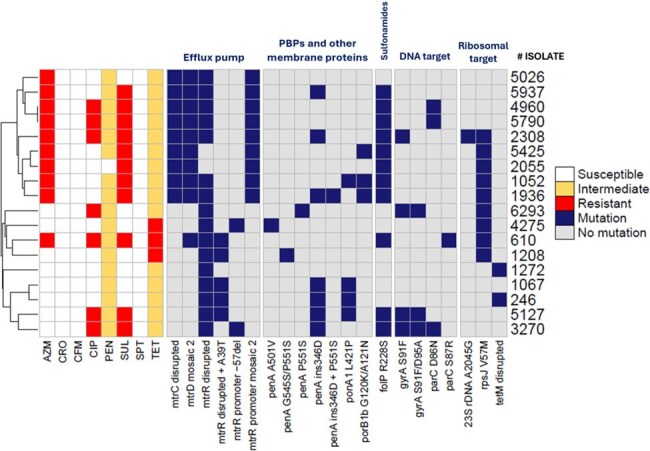 Figure 1
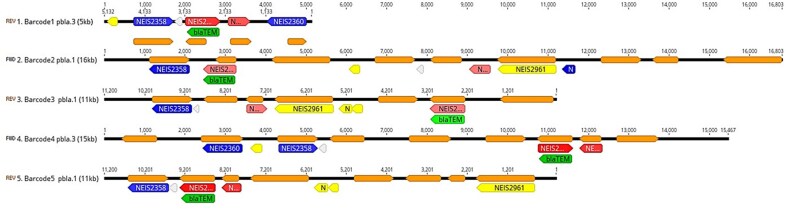 Figure 2
Peer Reviews
No public reviews on file for this paper yet. If you reviewed it on a platform where reviews are public (OpenReview, ICLR, NeurIPS, ICML), you can paste yours below so the community can read it here.
Videos
No videos yet. Explain this paper in a talk, walkthrough, or lecture? Add one.
Taxonomy
TopicsReproductive tract infections research · Bacterial Infections and Vaccines · Neonatal and Maternal Infections