222. Rabies Vaccination to Assess Vaccine Responsiveness after B Cell Targeted Chimeric Antigen Receptor (CAR)-T Cell Therapies: The RAVCAR Study
Patrick W Flaherty, Lauren Jatt, Elizabeth M Krantz, Anne Konchan, Lalita Priyamvada, Lauren A Greenberg, Karyn A Tindbaek, Molly Briggs, Julian Munoz, Clementine Chalal, Ajay K Gopal, Paul A Carpenter, Mazyar Shadman, Andrew J Cowan, Hans D Ochs, James G Kublin, William Hahn

TL;DR
This study tested how well people respond to a rabies vaccine after CAR-T therapy, finding that some patients can still mount an immune response, especially those treated with BCMA-targeted CAR-T.
Contribution
The study introduces the rabies vaccine as a tool to assess immune readiness for vaccination after B cell-targeted CAR-T therapies.
Findings
BCMA-CAR-T recipients had higher rabies vaccine response rates compared to CD19/CD20-CAR-T recipients.
Higher B cell and memory B cell counts were linked to better vaccine responses.
Rabies virus neutralizing antibody (RVNA) response predicted routine vaccine responses with moderate accuracy.
Abstract
We conducted an open-label trial using inactivated rabies vaccine (Imovax) as a neoantigen challenge after CAR-T therapy to assess predictors of vaccine response, the utility of a fractional escalating dose prime, and Imovax as a tool to assess ‘vaccine readiness’, even in patients receiving IVIG given that IVIG typically contains no rabies antibodies.Figure 1.Study design Study design Blood was collected prior to and at 1, 2, and 4 weeks after completion of primary immunization and boost, and 26 weeks post-primary immunization. Rabies virus neutralizing antibodies (RVNA) were measured at each timepoint. Seroprotective response was defined as RVNA ≥ 0.5 IU/mL at week 4 post-boost, as defined by the World Health Organization (WHO).Figure 2.Rabies virus neutralizing antibody (RVNA) kinetics stratified by cohortA-B. RVNA kinetics in 10 healthy volunteers compared to BCMA (panel A) and…
Genes, proteins, chemicals, diseases, species, mutations and cell lines named across the full text — each resolved to its canonical identifier and authoritative record.
Click any figure to enlarge with its caption.
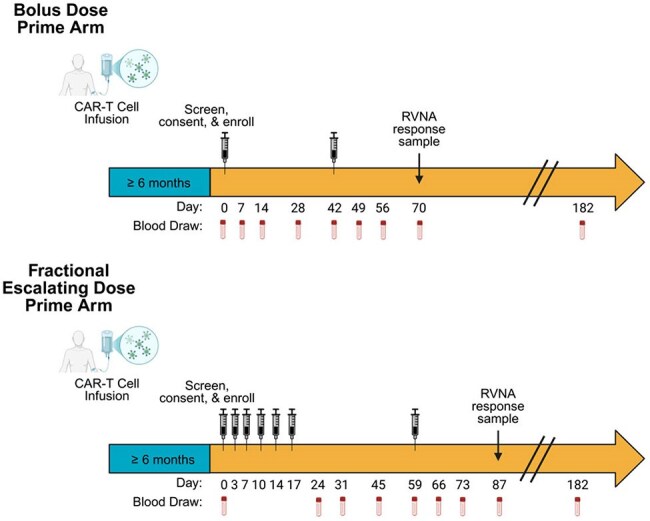 Figure 1
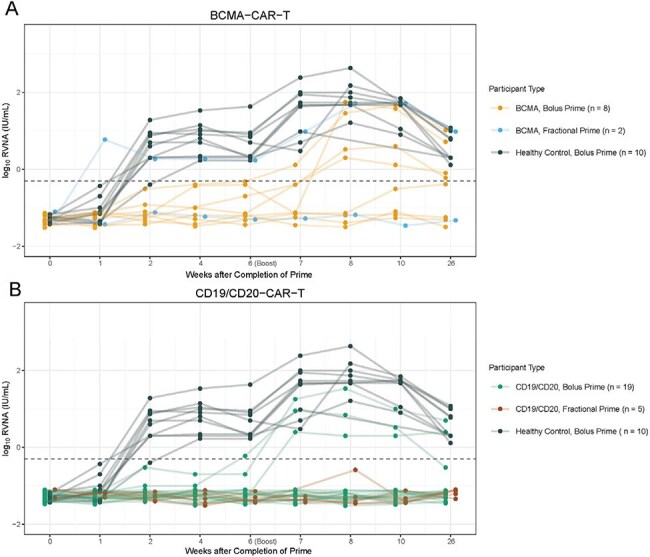 Figure 2
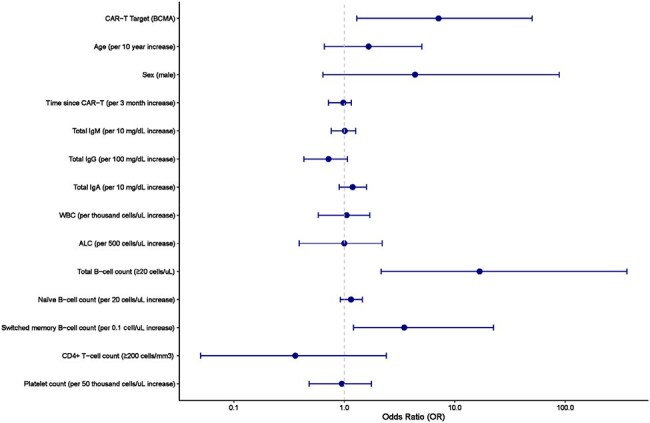 Figure 3
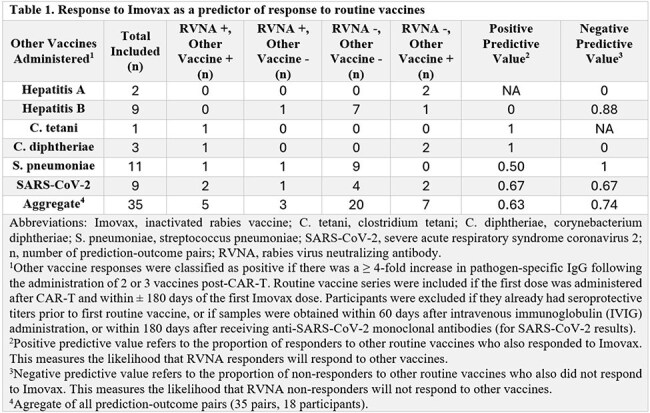 Figure 4
Peer Reviews
No public reviews on file for this paper yet. If you reviewed it on a platform where reviews are public (OpenReview, ICLR, NeurIPS, ICML), you can paste yours below so the community can read it here.
Videos
No videos yet. Explain this paper in a talk, walkthrough, or lecture? Add one.
Taxonomy
TopicsRabies epidemiology and control · CAR-T cell therapy research · Virus-based gene therapy research