P-142. Benefits and Pitfalls of Multiplex Gastrointestinal Polymerase Chain Reaction testing in a Veterans Affairs Hospital
Jessica Schildkraut, Claire Lewis, Monique Thorne, Debra Noland, Akif Acay, George Psevdos

TL;DR
This study evaluates the accuracy of a rapid PCR test for detecting gastrointestinal pathogens in veterans, finding it effective for some but with false positives for others.
Contribution
The study provides empirical evidence on the performance of GI PCR testing in a VA hospital, highlighting its benefits and limitations in clinical practice.
Findings
The Biofire GI PCR test showed high sensitivity for Campylobacter but had a significant rate of false positives for Norovirus and Vibrio.
Only 58% of Norovirus-positive samples were confirmed by LabCorp testing, indicating potential overdiagnosis.
Vibrio results were not confirmed by culture, suggesting limitations in the test's reliability for this pathogen.
Abstract
In the US infectious gastroenteritis remains a significant cause for morbidity and a public health concern. While stool culture had been the standard tool for microbiological diagnosis, known for its time consuming and often lower yields, rapid diagnostic tests have now been developed. Multiplex gastrointestinal (GI) polymerase chain reaction (PCR) testing is commercially available as a rapid, sensitive method for detecting GI pathogens, bacteria, viruses, and parasites in a single stool sample. Nevertheless, challenges in interpreting results can appear especially in mixed infections where detections may not be clinically significant. While high sensitivity of testing is desirable, false positive results require careful interpretation. We reviewed the performance of GI PCR tests in our facilityTable 1GI PCR resultsTable 2GI PCR COINFECTIONS GI PCR results GI PCR COINFECTIONS…
Genes, proteins, chemicals, diseases, species, mutations and cell lines named across the full text — each resolved to its canonical identifier and authoritative record.
Click any figure to enlarge with its caption.
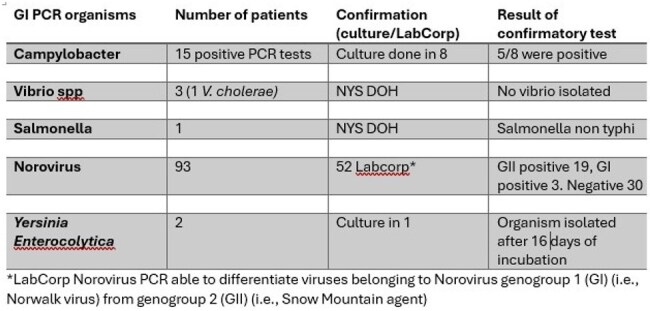 Figure 1
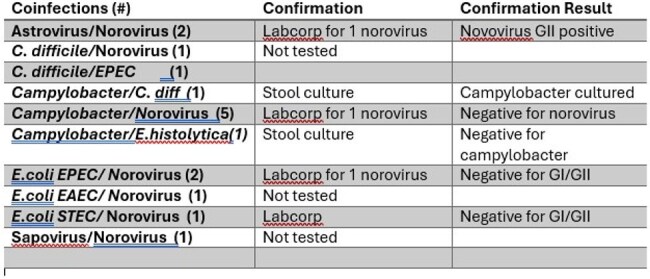 Figure 2
Peer Reviews
No public reviews on file for this paper yet. If you reviewed it on a platform where reviews are public (OpenReview, ICLR, NeurIPS, ICML), you can paste yours below so the community can read it here.
Videos
No videos yet. Explain this paper in a talk, walkthrough, or lecture? Add one.
Taxonomy
TopicsViral gastroenteritis research and epidemiology · SARS-CoV-2 detection and testing · Biosensors and Analytical Detection