P-380. The Clinical Development of VH3810109 (N6LS): Advancing Ultra-Long-Acting HIV Treatment into the Future
Peter Leone, Paul Wannamaker, Margaret Gartland, Michael Warwick-Sanders, Riccardo D’Agostino, Rulan Griesel, Chelsea Macfarlane, Viviana Wilches, Kathryn Brown, Yash Gandhi, David Dorey, Gabriela L Ghita, Christina Donatti, Babafemi Taiwo, Sherene Min, Jan Losos

TL;DR
This paper discusses the clinical development of N6LS, an ultra-long-acting HIV treatment, showing promising safety and efficacy in multiple trials.
Contribution
The paper presents new clinical data supporting the use of N6LS as a twice-yearly HIV treatment option.
Findings
N6LS has a long half-life of 40-44 days, supporting its ultra-long-acting potential.
Virologic suppression was maintained in 96% and 88% of participants receiving IV or SC N6LS Q4M + CAB LA.
N6LS monotherapy showed robust antiviral activity with ≥83% of participants achieving virologic response.
Abstract
Advancing novel ultra-long-acting (ULA; ≥ 4-month dosing interval) antiretroviral therapies is imperative to provide more options, enhancing quality of life and adherence. Broadly neutralizing antibodies, such as N6LS, have been engineered to have long half-lives and are currently being investigated to provide ULA antiretroviral options. N6LS binds to the CD4-binding site of the HIV-1 envelope and prevents entry into the host target cell. N6LS showed broad neutralization activity in vitro and potent antiviral activity in preclinical studies. Here, we summarize findings from N6LS clinical studies that informed the clinical development program. The phase 1 VRC 609 (first-time-in-human) and SPAN studies evaluated pharmacokinetics and safety of intravenous (IV) N6LS and subcutaneous (SC) N6LS with or without recombinant human hyaluronidase PH20 (rHuPH20) in adults without HIV (Table). The…
Genes, proteins, chemicals, diseases, species, mutations and cell lines named across the full text — each resolved to its canonical identifier and authoritative record.
Click any figure to enlarge with its caption.
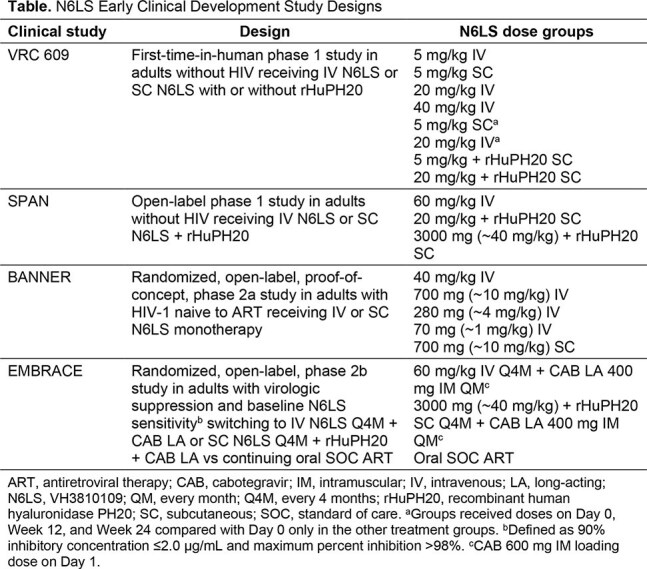 Figure 1
Peer Reviews
No public reviews on file for this paper yet. If you reviewed it on a platform where reviews are public (OpenReview, ICLR, NeurIPS, ICML), you can paste yours below so the community can read it here.
Videos
No videos yet. Explain this paper in a talk, walkthrough, or lecture? Add one.
Taxonomy
TopicsHIV/AIDS drug development and treatment · HIV Research and Treatment · Monoclonal and Polyclonal Antibodies Research