P-77. In vitro Activity of Phage and Vancomycin against Periprosthetic Joint Infection-Associated Staphylococcus aureus and Staphylococcus epidermidis on Orthopedic Kirschner Wires
Judith Alvarez Otero, Melissa J Karau, Jayawant Mandrekar, Krupa Parmar, Kerryl Greenwood-Quaintance, Robin Patel

TL;DR
This study tests phage and vancomycin against staphylococcal biofilms on orthopedic wires, showing some effectiveness but also bacterial regrowth.
Contribution
The study evaluates the in vitro activity of two specific phages, alone and in combination with vancomycin, against biofilms of PJI-associated staphylococci on orthopedic Kirschner wires.
Findings
Phage SaMD07FSphi1 alone showed higher log10 cfu/K-wire reduction than when combined with vancomycin for some S. aureus isolates.
Phage SaNSI1469phi1 combined with vancomycin showed better results than phage alone for certain S. epidermidis and S. aureus isolates.
Bacterial regrowth was observed at 24 hours for some isolates despite initial reductions.
Abstract
Staphylococci are the most frequent microorganisms in periprosthetic joint infection (PJI) and treatment remains challenging. Phage is being considered as a potential treatment. Here, the in vitro activity of phages SaMD07FSphi1or SaNSI1469phi1, alone and in combination with vancomycin against staphylococcal biofilms was evaluated. Figure 1In vitro activity of phage SaMD07FSphi1 against S. aureus and S. epidermidis biofilms In vitro activity of phage SaMD07FSphi1 against S. aureus and S. epidermidis biofilms Figure 2In vitro activity of phage SaNSI1469phi1 against S. aureus and S. epidermidis biofilms In vitro activity of phage SaNSI1469phi1 against S. aureus and S. epidermidis biofilms Biofilms were grown at 37°C on 4 cm stainless steel K-wires in tryptic soy broth (TSB) with 106 cfu/ml of S. epidermidis or S. aureus (8 PJI isolates with phage activity against planktonically-grown…
Genes, proteins, chemicals, diseases, species, mutations and cell lines named across the full text — each resolved to its canonical identifier and authoritative record.
Click any figure to enlarge with its caption.
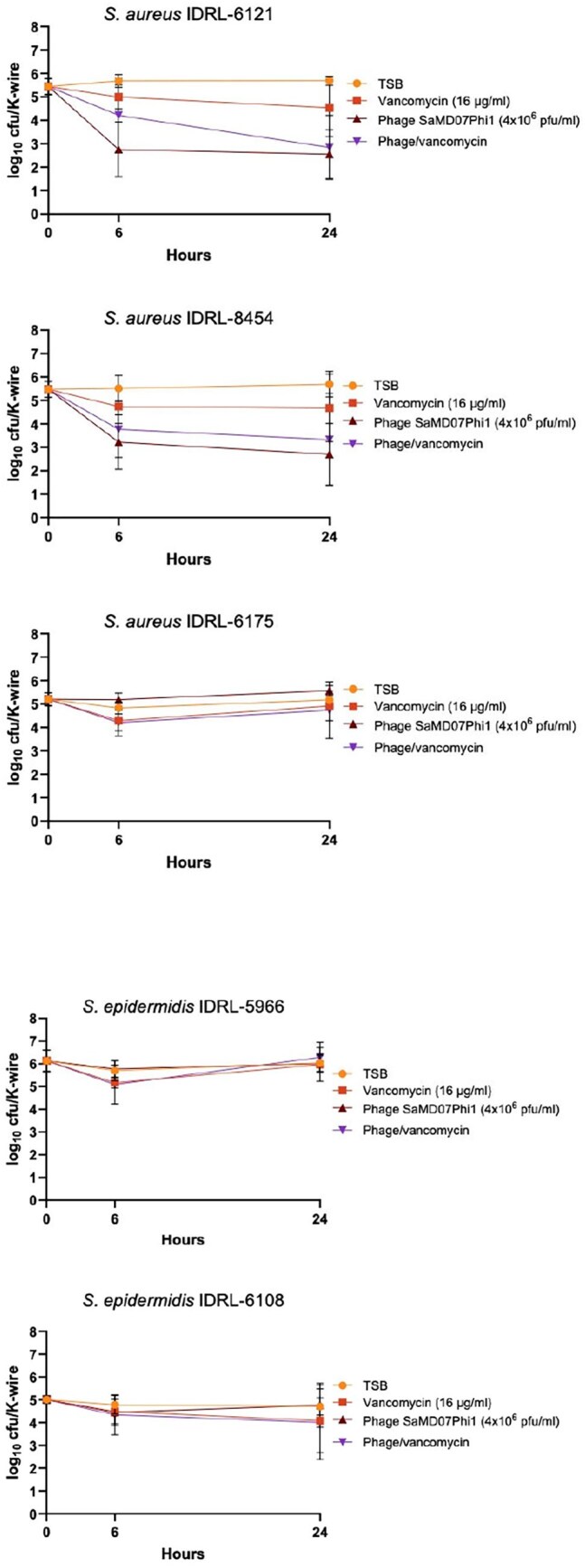 Figure 1
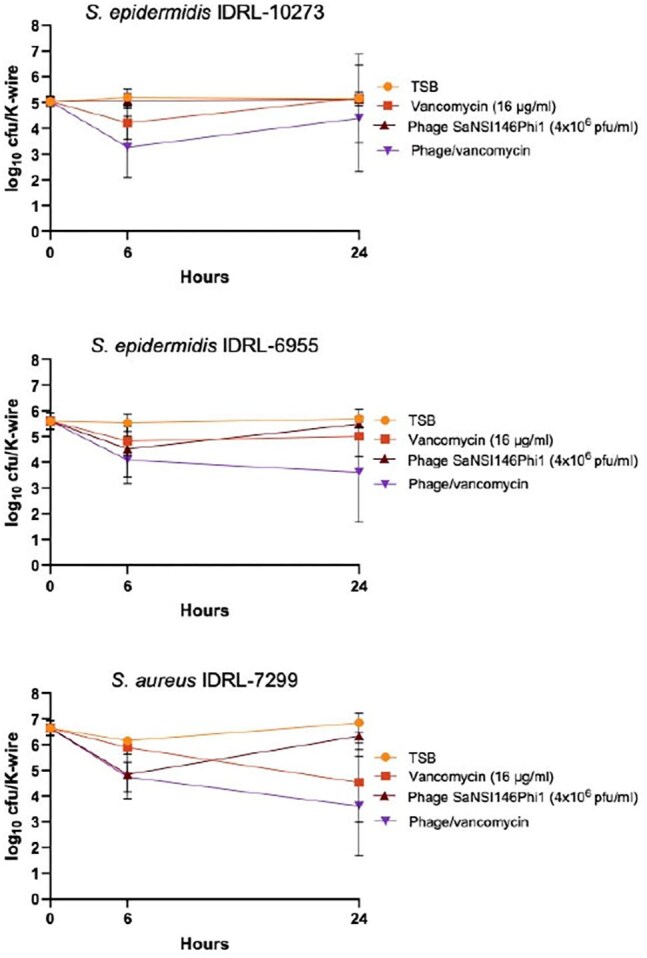 Figure 2
Peer Reviews
No public reviews on file for this paper yet. If you reviewed it on a platform where reviews are public (OpenReview, ICLR, NeurIPS, ICML), you can paste yours below so the community can read it here.
Videos
No videos yet. Explain this paper in a talk, walkthrough, or lecture? Add one.
Taxonomy
TopicsOrthopedic Infections and Treatments · Bacteriophages and microbial interactions · Musculoskeletal synovial abnormalities and treatments