P-1004. Vancomycin Susceptibility Determination for Clostridioides difficile Varies by Brucella Agar Brand and Composition
Giulia Orazi, Laurica A Petrella, Michelle Adamczyk, Davina Campbell, Megan Taylor, Jennifer Cadnum, Claire Kaple, Adam K Cheknis, Ashley Paulick, Stuart Johnson, Curtis Donskey, Maria Karlsson, Amy Gargis, Andrew M Skinner

TL;DR
This study shows that the brand and composition of Brucella agar used in testing can affect how resistant Clostridioides difficile is to vancomycin, highlighting the need for standardized testing methods.
Contribution
The study reveals that different Brucella agar formulations lead to variable vancomycin susceptibility results in C. difficile, emphasizing the importance of standardization.
Findings
Two pre-mixed agars (A3 and A6) produced 3-4-fold higher vancomycin MICs compared to CLSI-recommended agars.
Agar A5 showed significant variation in MICs between laboratories.
The proportion of non-wild type isolates varied widely depending on agar formulation.
Abstract
Agar dilution is the gold standard method for performing antimicrobial susceptibility testing for Clostridioides difficile. Ensuring the accuracy and interlaboratory reproducibility of this method is critical, particularly in light of recent reports of isolates with reduced susceptibility to vancomycin and fidaxomicin, the two primary treatments for C. difficile infection. The Clinical and Laboratory Standards Institute (CLSI) recommends using Brucella agar supplemented with hemin and vitamin K1. We performed a multi-laboratory evaluation to investigate whether using different commercially available Brucella agars influences vancomycin minimum inhibitory concentrations (MIC) obtained by agar dilution.Table 1.Reference agar dilution results obtained by three independent laboratoriesVancomycin minimum inhibitory concentrations (MICs) of 30 clinical isolates and one QC strain were…
Genes, proteins, chemicals, diseases, species, mutations and cell lines named across the full text — each resolved to its canonical identifier and authoritative record.
Click any figure to enlarge with its caption.
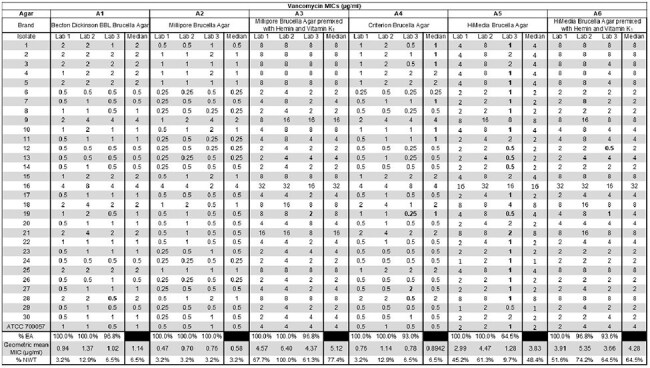 Figure 1
Peer Reviews
No public reviews on file for this paper yet. If you reviewed it on a platform where reviews are public (OpenReview, ICLR, NeurIPS, ICML), you can paste yours below so the community can read it here.
Videos
No videos yet. Explain this paper in a talk, walkthrough, or lecture? Add one.
Taxonomy
TopicsClostridium difficile and Clostridium perfringens research · Antimicrobial Resistance in Staphylococcus · Yersinia bacterium, plague, ectoparasites research