P-1085. An Opportunity for Stewardship: Idle Peripheral Venous Catheters
Heather Young, Himgauri Nikrad, Rosine Angbanzan, Sarah Gardiner, Kelly Medero

TL;DR
The study finds that many unused peripheral IV catheters in hospitals could be removed to reduce complications like bloodstream infections.
Contribution
This study quantifies idle peripheral IV catheter prevalence and links them to Staphylococcus aureus bacteremia cases in a single hospital.
Findings
Approximately 12.2% of peripheral IV catheter days were idle (unused for 24+ hours).
There were 0.4 cases of PIVC-related S. aureus bacteremia per 1000 PIVC days.
Removing idle PIVC could reduce avoidable morbidity and mortality from infections.
Abstract
Peripheral intravenous catheters (PIVC) are among the most common medical intervention for hospitalized patients. While PIVC can provide life-saving treatments, PIVC are also a major source of complications such as infiltration, occlusion, leaking, pain, dislodgement, and bacteremia, particularly due to Staphylococcus aureus. Both the Infusion Nurses Society (INS) and the Centers for Disease Control and Prevention state that PIVC that are no longer in use should be removed, with INS specifically stating that a catheter that has not used for more than 24 hours should be removed. Despite the guidance to remove PIVC that are unused, prevalence studies demonstrate that approximately 14% of all PIVC have not been used in the prior 24 hours. These “idle PIVC” contribute to avoidable morbidity and mortality. The goal of this study is to assess the opportunity for harm reduction at our…
Click any figure to enlarge with its caption.
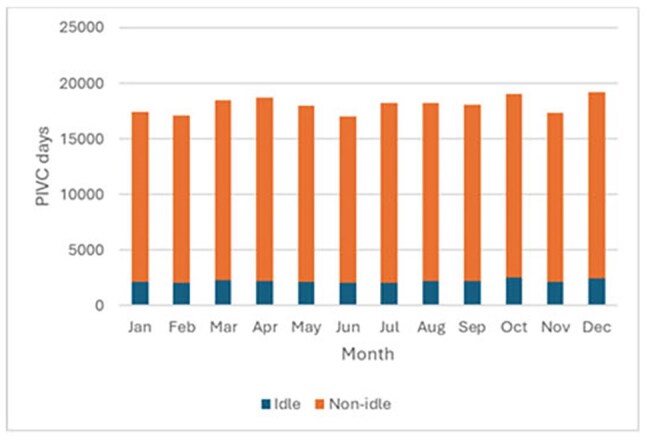 Figure 1
Peer Reviews
No public reviews on file for this paper yet. If you reviewed it on a platform where reviews are public (OpenReview, ICLR, NeurIPS, ICML), you can paste yours below so the community can read it here.
Videos
No videos yet. Explain this paper in a talk, walkthrough, or lecture? Add one.
Taxonomy
TopicsCentral Venous Catheters and Hemodialysis · Chemotherapy-related skin toxicity · Intravenous Infusion Technology and Safety