P-1686. Deep Learning Prediction Model for Staphylococcus aureus Positivity and Antibiotic Susceptibility Patterns Using A Large Longitudinal Electronic Health Record Dataset
Francis Ifiora, Laila Bekhet, Ziqian Xie, Marilyn Niravath, Stephen Jones, Cesar A Arias, Degui Zhi, Masayuki Nigo

TL;DR
This study uses deep learning to predict Staphylococcus aureus infection sources and antibiotic resistance patterns from electronic health records, improving clinical decision-making.
Contribution
A novel deep learning model that predicts both infection source and resistance patterns of S. aureus using longitudinal EHR data.
Findings
The model achieved an AUROC of 0.857 for predicting S. aureus presence across any culture source.
High resistance rates were observed for Erythromycin (63.9%), Oxacillin (51.8%), and Clindamycin (39.8%).
The model showed moderate accuracy in predicting antimicrobial resistance patterns with AUROCs up to 0.777 for rifampin.
Abstract
Staphylococcus aureus causes a range of infections, including bacteremia, pneumonia, and bone/joint infections, and exhibits variable antimicrobial resistance. Predicting both the infection source and resistance patterns is critical for clinical decision-making. However, existing models often focus solely on detecting resistant strains like MRSA, without addressing the infection source or broader resistance profiles. We developed a deep learning model to predict both the source and resistance patterns of S. aureus.Table 1:Patient characteristics of the study population stratified by Staphylococcus aureus status.Table 2:Summary of culture positivity and antibiotic resistance rates in cohort. Patient characteristics of the study population stratified by Staphylococcus aureus status. Summary of culture positivity and antibiotic resistance rates in cohort. We retrospectively collected…
Genes, proteins, chemicals, diseases, species, mutations and cell lines named across the full text — each resolved to its canonical identifier and authoritative record.
Click any figure to enlarge with its caption.
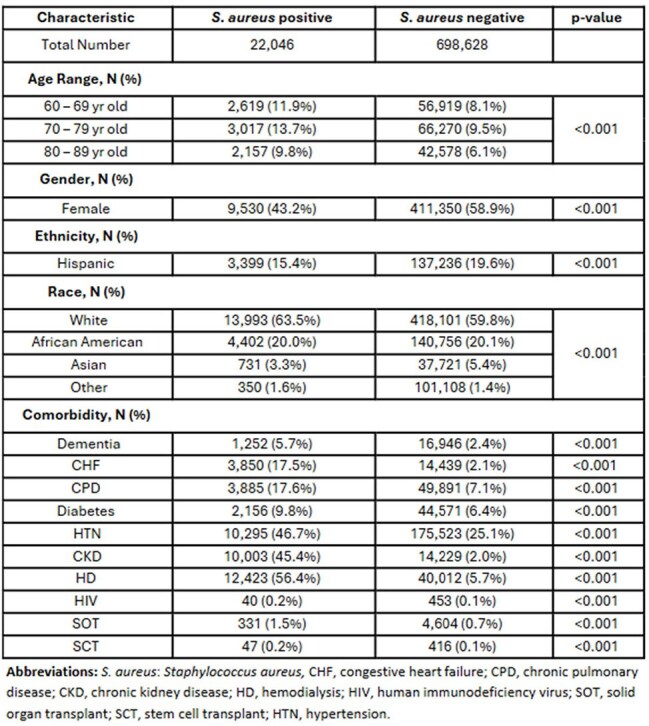 Figure 1
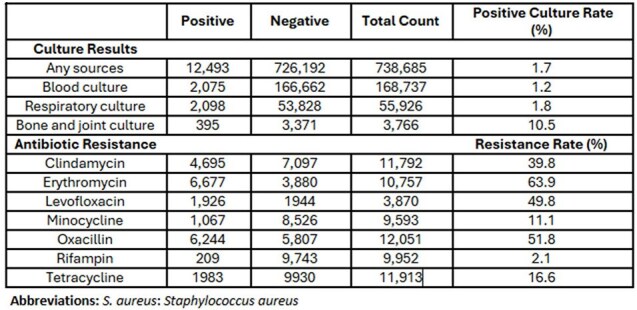 Figure 2
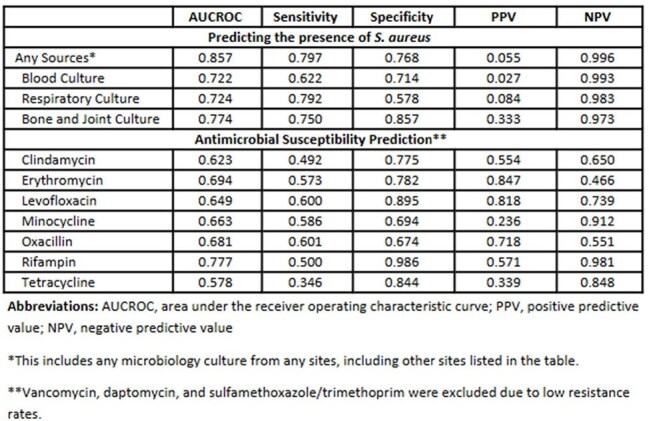 Figure 3
Peer Reviews
No public reviews on file for this paper yet. If you reviewed it on a platform where reviews are public (OpenReview, ICLR, NeurIPS, ICML), you can paste yours below so the community can read it here.
Videos
No videos yet. Explain this paper in a talk, walkthrough, or lecture? Add one.
Taxonomy
TopicsMachine Learning in Healthcare · Antimicrobial Resistance in Staphylococcus · Bacterial Identification and Susceptibility Testing