P-1425. Burden of pneumococcal disease associated with PCV21 non-PCV20 and PCV20 non-PCV21 serotypes among US adults
Amanda M Martino, Laura DeBenedetti, Maria Vutcovici Nicolae, Sheba Nellore, Nicole Cossrow, Henok Tadesse Ayele, Kenneth Klinker, Kelly Johnson

TL;DR
This study examines the remaining burden of pneumococcal disease in US adults caused by serotypes not covered by the latest vaccines and finds that some non-vaccine serotypes are more prevalent and antibiotic-resistant.
Contribution
The study quantifies residual pneumococcal disease burden in US adults caused by serotypes unique to PCV21 and PCV20 vaccines.
Findings
PCV21 non-PCV20 serotypes accounted for 34.8% of invasive pneumococcal disease in US adults (2015-2023).
PCV21 non-PCV20 serotypes showed higher resistance to antibiotics like penicillin and erythromycin compared to PCV20 non-PCV21 serotypes.
Multidrug resistance was highest in serotypes 19F and 23A.
Abstract
The introduction of pneumococcal conjugate vaccines (PCVs) into immunization schedules successfully reduced the burden of pneumococcal disease (PD) caused by vaccine serotypes in US adults. However, residual PD burden remains due to shifting serotype epidemiology from pediatric indirect protection and the emergence of non-vaccine serotypes. We aimed to quantify the residual PD burden in US adults addressable by PCV21 non-PCV20 and PCV20 non-PCV21 serotypes.Table 1.Serotype distribution among US adults with pneumococcal disease Serotype distribution among US adults with pneumococcal disease A systematic review of literature published from 2015 onwards was conducted to explore the epidemiology, antimicrobial resistance (AMR), and virulence associated with the PCV21 non-PCV20 serotypes (9N, 15A, 15C §, 16F, 17F, 20A, 23A, 23B, 24F, 31, 35B); and the PCV20 non-PCV21 serotypes (1, 4, 5,…
Genes, proteins, chemicals, diseases, species, mutations and cell lines named across the full text — each resolved to its canonical identifier and authoritative record.
Click any figure to enlarge with its caption.
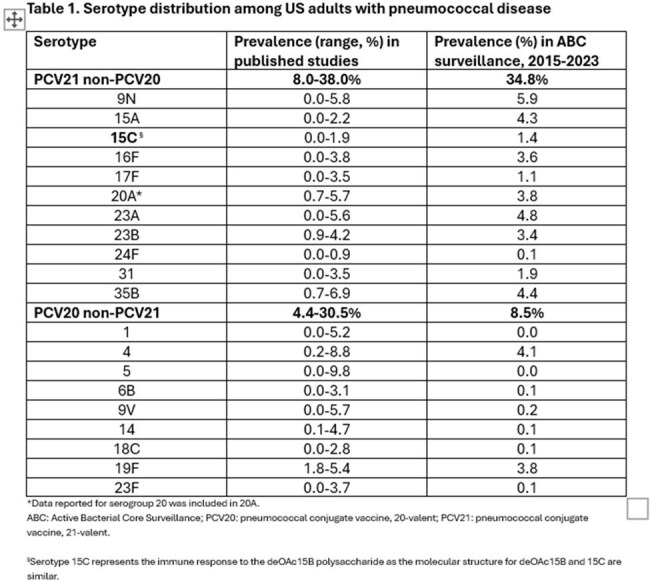 Figure 1
Peer Reviews
No public reviews on file for this paper yet. If you reviewed it on a platform where reviews are public (OpenReview, ICLR, NeurIPS, ICML), you can paste yours below so the community can read it here.
Videos
No videos yet. Explain this paper in a talk, walkthrough, or lecture? Add one.
Taxonomy
TopicsPneumonia and Respiratory Infections · Respiratory viral infections research · Immune responses and vaccinations