P-348. Real-world efficacy, safety and persistence of dolutegravir/lamivudine vs. bictegravir/emtricitabine/tenofovir alafenamide among virologically suppressed adults with HIV-results from the 96-week observational extension phase of the DYAD study
Charlotte-Paige M Rolle, Jamie Castano, Vu Nguyen, Federico Hinestrosa, Edwin DeJesus

TL;DR
A 96-week study found that switching to dolutegravir/lamivudine for HIV treatment was as effective as continuing bictegravir/emtricitabine/tenofovir alafenamide, with similar persistence but more side effects.
Contribution
The study provides real-world 96-week data on the efficacy and safety of switching to DTG/3TC in virologically suppressed HIV patients.
Findings
At week 96, 2% of DTG/3TC and 1% of B/F/TAF participants had HIV-1 RNA ≥50 copies/mL.
Drug-related adverse events were higher with DTG/3TC (28%) compared to B/F/TAF (5%).
Persistence on therapy was similar between the two groups at week 96.
Abstract
DYAD demonstrated noninferior efficacy of switching to dolutegravir/lamivudine (DTG/3TC) vs. continuing bictegravir/emtricitabine/tenofovir alafenamide (B/F/TAF) among virologically suppressed adults through Week (W) 48. Here, we present real-world efficacy, safety and persistence from the 96-week observational extension phase. DYAD (NCT04585737) was an open-label clinical trial that randomized adults with HIV-1 RNA<50 copies/mL and no prior virologic failure (2:1) to switch to DTG/3TC vs. continue B/F/TAF. Primary endpoint was the proportion with HIV-1 RNA≥50 copies/mL at W48. At study exit, consent was obtained from participants to collect and report virologic efficacy, safety and persistence on therapy from medical records through W96 and W144. Among 222 enrolled, DYAD randomized 149 to switch to DTG/3TC and 73 to continue B/F/TAF, 134 on DTG/3TC and 65 on B/F/TAF completed W48. At…
Genes, proteins, chemicals, diseases, species, mutations and cell lines named across the full text — each resolved to its canonical identifier and authoritative record.
Click any figure to enlarge with its caption.
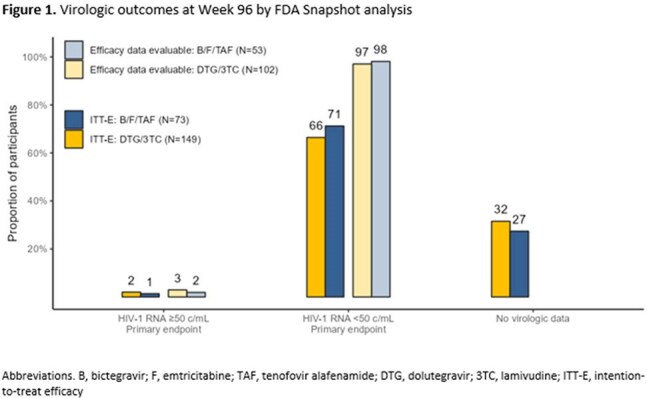 Figure 1
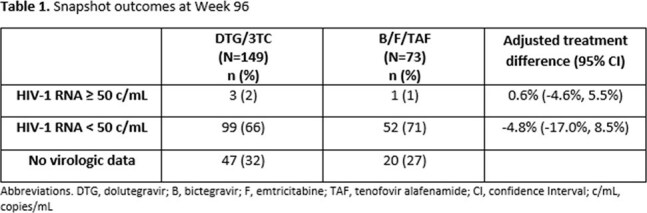 Figure 2
Peer Reviews
No public reviews on file for this paper yet. If you reviewed it on a platform where reviews are public (OpenReview, ICLR, NeurIPS, ICML), you can paste yours below so the community can read it here.
Videos
No videos yet. Explain this paper in a talk, walkthrough, or lecture? Add one.
Taxonomy
TopicsHIV/AIDS drug development and treatment · HIV Research and Treatment · Hepatitis C virus research