P-781. Evaluating UTI Management Using a Proposed Continuum of Diagnosis in an Academic Medical Center
Parker Kaleo, Alaina DeKerlegand, Dennis Marjoncu, Carolyn Cummings, Kerry O Cleveland

TL;DR
This study evaluates a new diagnostic category for urinary tract infections to improve treatment decisions and reduce unnecessary antibiotic use.
Contribution
The study introduces and evaluates a new diagnostic classification called bacteriuria of unclear significance (BUS) to guide UTI management.
Findings
Nearly half of patients were re-categorized as having BUS and treated more like those with asymptomatic bacteriuria.
Antibiotic duration was significantly shorter for ASB and BUS compared to UTIs.
De-escalation rates were higher for UTIs compared to ASB and BUS.
Abstract
Controversy remains when managing urinary tract infections (UTIs) for patients without urinary symptoms but with nonspecific clinical symptoms. A new diagnostic category was recently proposed termed bacteriuria of unclear significance (BUS) to acknowledge this gap and shine light on treatment decisions in these patients. We evaluated this classification in our academic medical center by retrospectively reviewing patients who were diagnosed and treated with a UTI as having asymptomatic bacteriuria (ASB), BUS, or a UTI.Figure 1.Primary ObjectiveTable 1.Primary and Secondary Outcomes Primary Objective Primary and Secondary Outcomes This retrospective study included adults (≥ 18 years) diagnosed with a UTI from July 1, 2023, to July 31, 2024. Patients had positive urinalysis, positive urine cultures, and received antibiotics for > 24 hours. Patients with complicating factors were…
Click any figure to enlarge with its caption.
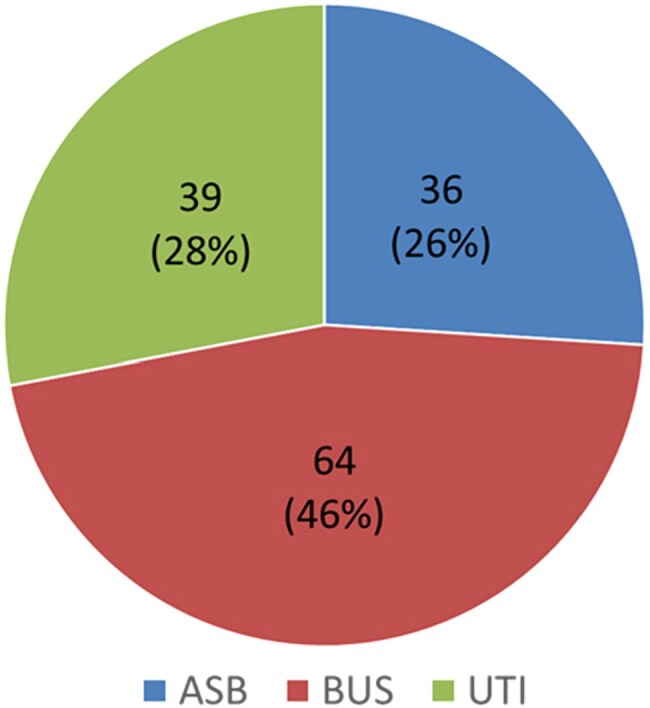 Figure 1
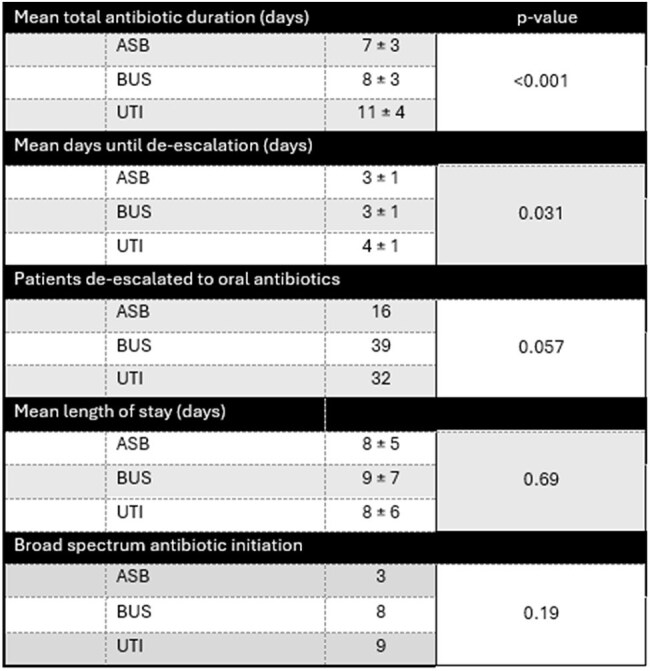 Figure 2
Peer Reviews
No public reviews on file for this paper yet. If you reviewed it on a platform where reviews are public (OpenReview, ICLR, NeurIPS, ICML), you can paste yours below so the community can read it here.
Videos
No videos yet. Explain this paper in a talk, walkthrough, or lecture? Add one.
Taxonomy
TopicsUrinary Tract Infections Management · Pediatric Urology and Nephrology Studies · Kidney Stones and Urolithiasis Treatments