403. Deep Learning–Based Prediction of Antimicrobial Resistance Using Multicenter Matrix-Assisted Laser Desorption/Ionization–Time-of-Flight (MALDI-TOF) Mass Spectrometry Data
Yu-Chun Pan, Shu-Yu Tsao, Yueh-Chen Hsieh, Chih-Hung Wang, Matthew Huei-Ming Ma, Wang-Huei Sheng, Po-Chun Liao, Chien-Chang Lee

TL;DR
This study uses deep learning on MALDI-TOF mass spectrometry data to predict antimicrobial resistance in bacteria, achieving high accuracy and potentially enabling faster, more effective antibiotic treatment.
Contribution
A novel TCN-Transformer deep learning model that significantly improves AMR prediction accuracy from MALDI-TOF spectra compared to prior methods.
Findings
22 out of 26 bacterial species achieved AUROCs ≥ 0.84 for antibiotic resistance prediction.
High-performing results include AUROCs of 0.95 for Staphylococcus aureus (oxacillin) and 0.92 for Klebsiella pneumoniae (cefepime).
The model's performance was consistent across institutions, supporting its generalizability.
Abstract
Sepsis is a leading cause of death, and early identification of pathogens with appropriate antibiotics improves survival. Antimicrobial resistance (AMR) complicates empirical therapy, while conventional diagnostics take 48–72 hours. Although MALDI-TOF mass spectrometry can identify pathogens within 24 hours, it cannot predict resistance. Prior machine learning models on spectra data showed only moderate performance (area under the receiver operating characteristic curve [AUROC] ≈ 0.70), limiting clinical utility. Representative Antibiotic-Resistance Predictions for 26 Bacterial Species This table summarizes the best-performing antibiotic-resistance predictions for each of the 26 bacterial species in our dataset. For each species, we selected the antibiotic that achieved the highest AUROC or held particular clinical relevance (e.g., widely used empirically or known to have critical…
Genes, proteins, chemicals, diseases, species, mutations and cell lines named across the full text — each resolved to its canonical identifier and authoritative record.
Click any figure to enlarge with its caption.
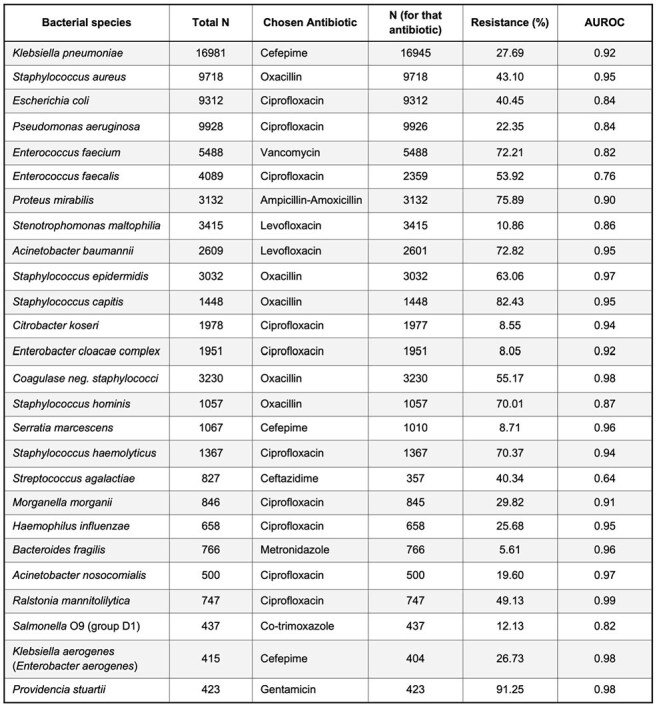 Figure 1
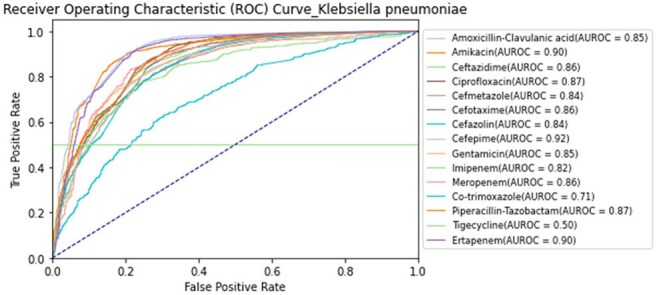 Figure 2
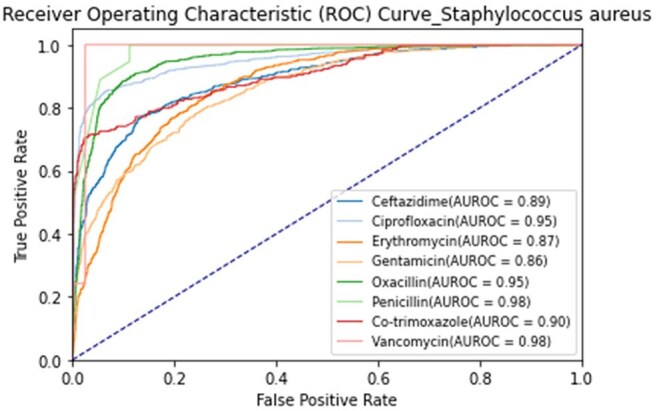 Figure 3
 Figure 4
Peer Reviews
No public reviews on file for this paper yet. If you reviewed it on a platform where reviews are public (OpenReview, ICLR, NeurIPS, ICML), you can paste yours below so the community can read it here.
Videos
No videos yet. Explain this paper in a talk, walkthrough, or lecture? Add one.
Taxonomy
TopicsBacterial Identification and Susceptibility Testing · Mass Spectrometry Techniques and Applications · Antibiotic Resistance in Bacteria