P-1771. Training and performance of Deep Learning algorithm in the detection of Plasmodium parasites using mobile devices in the Peruvian Amazon
Carlos Daniel D Ramírez Calderón, Bill Bardales Layche, Hugo Rodriguez Ferrucci, Jhosephi Jhampier Vasquez Ascate, Carlos Garcia Cortegano, Alejandro Reategui Pezo, Martin Casapia Morales, Cristiam Carey Angeles, Erwin Dianderas Caut, Rodolfo Cárdenas Vigo

TL;DR
A deep learning model was developed for mobile devices to detect malaria parasites in blood smears, achieving high precision and sensitivity in classifying Plasmodium species.
Contribution
A novel YOLOv11 nano model for mobile-based malaria parasite detection using thick blood smears is proposed and evaluated.
Findings
The YOLOv11 nano model achieved a precision weighted average of 94.5% in detecting Plasmodium parasites.
The model demonstrated a sensitivity of 82.3% and a classification error of 5.5%.
The model successfully classified different stages of Plasmodium vivax and Plasmodium falciparum.
Abstract
Malaria is a disease that represents a major public health problem with high morbidity and mortality caused by the Plasmodium parasite and transmitted by mosquitoes of the genus Anopheles sp. , which affects the entire world, with 263 million new cases of malaria and 597 thousand deaths in 2023.Figure 1Methodology flowchart for the training and implementation of YOLOv11 nano model for Plasmodium parasite detection in thick blood smears.Figure 2Normalized confusion matrix showing the classification performance of the YOLOv11 nano model Methodology flowchart for the training and implementation of YOLOv11 nano model for Plasmodium parasite detection in thick blood smears. Normalized confusion matrix showing the classification performance of the YOLOv11 nano model We propose the development of an artificial intelligence tool applied to mobile devices for the microscopic diagnosis of…
Genes, proteins, chemicals, diseases, species, mutations and cell lines named across the full text — each resolved to its canonical identifier and authoritative record.
Click any figure to enlarge with its caption.
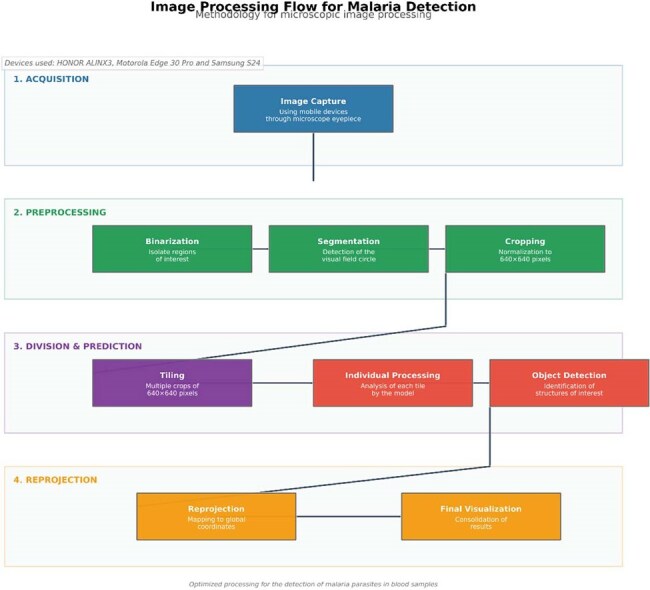 Figure 1
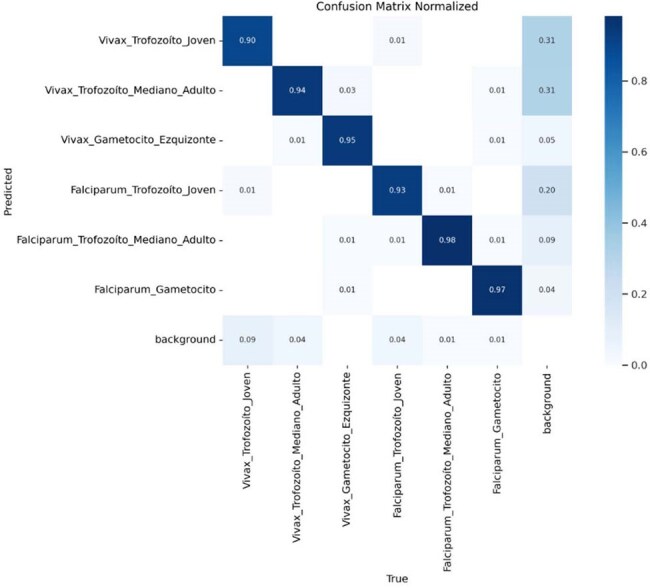 Figure 2
Peer Reviews
No public reviews on file for this paper yet. If you reviewed it on a platform where reviews are public (OpenReview, ICLR, NeurIPS, ICML), you can paste yours below so the community can read it here.
Videos
No videos yet. Explain this paper in a talk, walkthrough, or lecture? Add one.
Taxonomy
TopicsDigital Imaging for Blood Diseases · COVID-19 diagnosis using AI · Advanced Neural Network Applications