P-1180. Effects of a Novel Bacterial Topoisomerase Inhibitor on Type II Topoisomerases in Bacillus anthracis
Chelsea Mann, Jason West, J Matthew Meinig, Mark Mitton-Fry, Neil Osheroff

TL;DR
This study explores new bacterial drugs that could treat anthrax by targeting enzymes in the bacteria, even when the bacteria are resistant to other drugs.
Contribution
The study introduces OSUAB0284, a novel NBTI, and compares its efficacy against anthrax bacteria to existing drugs.
Findings
OSUAB0284 and gepotidacin showed potent antibacterial activity against Bacillus anthracis with low MIC90 values.
Both OSUAB0284 and gepotidacin induced DNA cleavage in anthrax enzymes, even in drug-resistant strains.
NBTIs like OSUAB0284 and gepotidacin inhibited anthrax enzymes' catalytic functions and maintained activity against resistant forms.
Abstract
The tier 1 agent, Bacillus anthracis (etiological cause of anthrax) is a highly transmissible pathogen that causes morbidity and mortality. The intentional release of anthrax spores from either wild-type or drug-resistant strains would constitute a severe threat to public and military health. Novel Bacterial Topoisomerase Inhibitors (NBTIs) are emerging antibacterials that target the type II topoisomerases, gyrase and topoisomerase IV. The NBTI pharmacophore promotes a binding mode that allows for the evasion of target-mediated fluoroquinolone (FQ) resistance. OSUAB0284 is a pre-clinical NBTI candidate that shows potent anti-staphylococcal activity in cultured cells and a neutropenic mouse model.1,2 Gepotidacin is an advanced NBTI-type first-in-class triazaacenapthylene. It has completed phase III clinical trials for the treatment of uncomplicated urogenital gonorrhea with positive…
Genes, proteins, chemicals, diseases, species, mutations and cell lines named across the full text — each resolved to its canonical identifier and authoritative record.
Click any figure to enlarge with its caption.
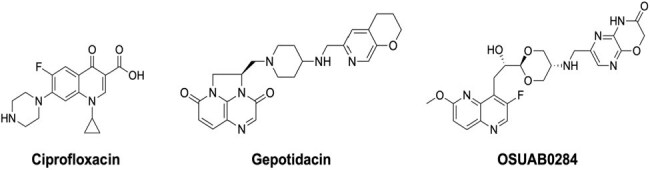 Figure 1
Peer Reviews
No public reviews on file for this paper yet. If you reviewed it on a platform where reviews are public (OpenReview, ICLR, NeurIPS, ICML), you can paste yours below so the community can read it here.
Videos
No videos yet. Explain this paper in a talk, walkthrough, or lecture? Add one.
Taxonomy
TopicsCancer therapeutics and mechanisms · Chemical Reactions and Isotopes · Microbial Natural Products and Biosynthesis