86. Frequency of Viral Monitoring to Detect Cytomegalovirus Infection and Prevent Disease in Solid Organ Transplant Recipients: An International Multicenter Study
Anja Lindis Dahl, Oriol Manuel, Kristian Schoenning, Helene Høgsbro Thygesen, Michael Perch, Søren Scwartz Sørensen, Nicolai Aagaard Schultz, Kasper Rossing, Jens Lundgren, Nicolas Johannes Müller, Marie Helleberg

TL;DR
Frequent CMV monitoring after transplant reduces disease risk, especially for D+/R- patients, suggesting close monitoring improves outcomes.
Contribution
This study identifies optimal CMV monitoring intervals for preventing disease in transplant recipients using a large multicenter dataset.
Findings
CMV disease risk is significantly lower with monitoring intervals of ≤7 days compared to >7 days in the first 3 months of PET/SAP.
The number needed to test (NNT) to prevent CMV disease is lower for D+/R- recipients compared to R+ recipients.
Frequent monitoring is more efficient in preventing CMV disease in D+/R- solid organ transplant recipients.
Abstract
Cytomegalovirus (CMV) is a major cause of morbidity among solid organ transplant recipients (SOTr). The risk of CMV disease during the first post-transplant year can be reduced by antiviral prophylaxis or pre-emptive therapy (PET), i.e. monitoring for early CMV replication in patients not receiving prophylaxis. For patients completing prophylaxis, surveillance after prophylaxis (SAP), may be used. However, the optimal frequency of CMV monitoring for PET/SAP remains unclear, and it is debated whether SAP is needed at all.Table 1:Interval between CMV PCR monitoring during PET/SAP follow-up and risk of CMV disease at time of diagnosis of CMV infection.Table 2:Incidence rates and adjusted hazard rates of CMV disease associated with CMV PCR monitoring of > 7 vs. ≤ 7 days for prevention of CMV disease during the first 3 months of PET/SAP. Interval between CMV PCR monitoring during PET/SAP…
Click any figure to enlarge with its caption.
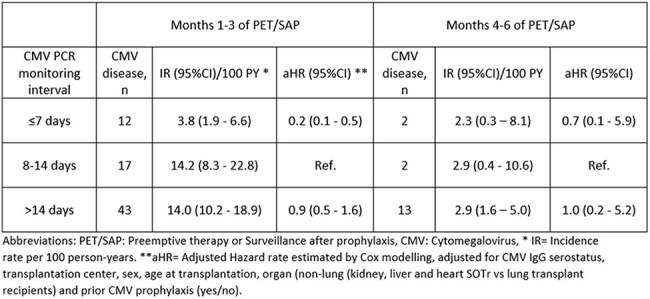 Figure 1
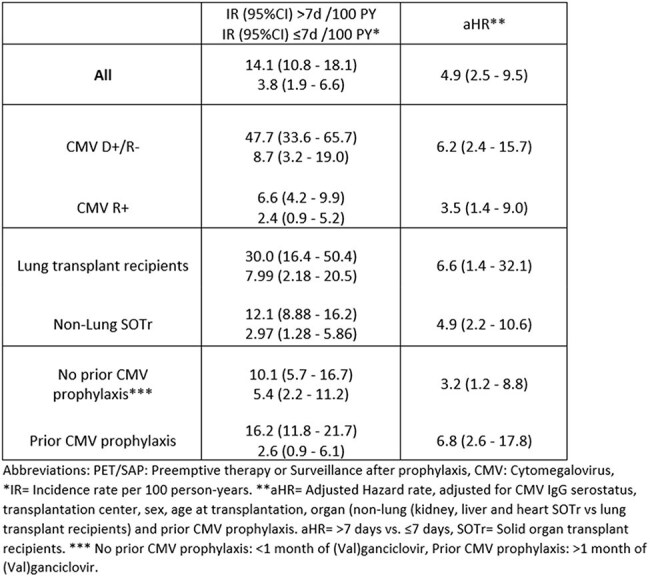 Figure 2
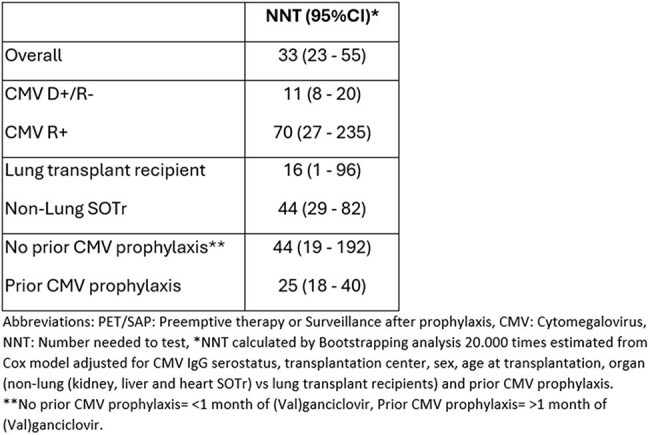 Figure 3
Peer Reviews
No public reviews on file for this paper yet. If you reviewed it on a platform where reviews are public (OpenReview, ICLR, NeurIPS, ICML), you can paste yours below so the community can read it here.
Videos
No videos yet. Explain this paper in a talk, walkthrough, or lecture? Add one.
Taxonomy
TopicsCytomegalovirus and herpesvirus research · Transplantation: Methods and Outcomes · Biosensors and Analytical Detection