P-216. US Health Care Spending on Septicemia
Yan Tian, Wenjun Wang

TL;DR
This study shows that healthcare spending on septicemia in the US increased from $34 billion in 2010 to $51 billion in 2019, with notable differences by age, sex, care type, and location.
Contribution
The study provides the first comprehensive analysis of septicemia-related healthcare spending trends in the US from 2010 to 2019, including demographic and geographic variations.
Findings
Healthcare spending on septicemia rose from $34 billion in 2010 to $51 billion in 2019.
Hospital inpatient care accounted for 94.1% of septicemia-related spending in 2019.
Age ≥65 years had the highest spending ($27 billion), and Alaska had the highest per capita spending ($218).
Abstract
Septicemia imposes a substantial and growing burden on the US health care system. This study aims to estimate health care spending on septicemia from 2010 to 2019, examining variation by sex, age, type of care, and geographic location to inform policy and resource allocation. Using data from the US Health Care Spending by Condition database, we analyzed inflation-adjusted (2019 USD) spending estimates for septicemia. Spendings were stratified by sex, age groups, care categories, and state-level distribution. Health care spending on septicemia increased from 32 billion–51 billion (95% CI, 53 billion) in 2019. The proportion of health care spending attributed to septicemia increased from 1.67% (95% CI, 1.59%–1.72%) in 2010 to 2.14% (95% CI, 2.05%–2.24%) in 2019. In 2019, males accounted for 27 billion–$29…
Click any figure to enlarge with its caption.
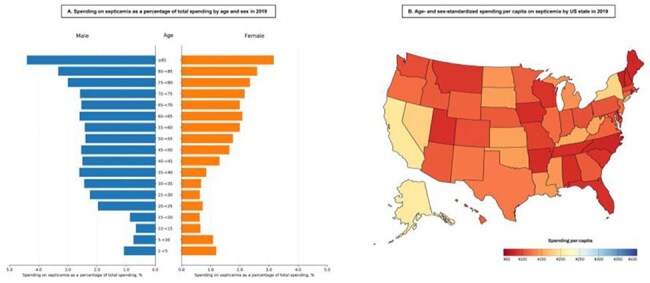 Figure 1
Peer Reviews
No public reviews on file for this paper yet. If you reviewed it on a platform where reviews are public (OpenReview, ICLR, NeurIPS, ICML), you can paste yours below so the community can read it here.
Videos
No videos yet. Explain this paper in a talk, walkthrough, or lecture? Add one.
Taxonomy
TopicsSepsis Diagnosis and Treatment · Bacterial Identification and Susceptibility Testing · Clostridium difficile and Clostridium perfringens research