P-610. Estimating Risk of Guillain-Barré Syndrome in US Medicare-Enrolled Older Adults Following Medically Attended Respiratory Syncytial Virus Disease: A Self-Controlled Case Series Analysis
Jennifer Judy, Caihua Liang, Erica Chilson, Scott P Kelly, Qing Liu, Jason D Maynard, Heidi De Souza, Bradford D Gessner, Elizabeth Begier

TL;DR
This study finds that older adults who have a respiratory syncytial virus (RSV) infection are at increased risk of developing Guillain-Barré syndrome (GBS), a rare neurological disorder.
Contribution
This is the first study to investigate the association between RSV infection and GBS risk in older adults using Medicare claims data.
Findings
The adjusted incidence rate ratio (IRR) for GBS after RSV was 2.11, indicating increased risk.
The risk remained significant even after restricting analysis to post-ICD-10 code implementation.
Fewer than 11 GBS cases were observed in the risk period compared to 34 in the control period.
Abstract
Guillain-Barré syndrome (GBS) may be preceded by viral respiratory infections (e.g., influenza and SARS-CoV-2) and is considered a rare complication of such infections. However, the association between GBS and RSV infection has not been described. We performed a self-controlled case series analysis to estimate GBS risk associated with medically attended RSV disease among older adults. Adults aged ≥65 years who had both RSV infection and incident GBS were identified from US Medicare Part A, B, and C claims data (2010–2024). RSV disease was identified via outpatient or inpatient visits’ ICD codes (J12.1, J20.5, J21.0, B97.4, 079.6, 480.1, 466.11, or 466.1 as primary or secondary diagnosis). GBS events had a primary ICD code of G61.0 or 357.0 in an inpatient setting or any setting if hospitalized in following 7 days. Patients with GBS ICD codes during year preceding RSV disease were…
Genes, proteins, chemicals, diseases, species, mutations and cell lines named across the full text — each resolved to its canonical identifier and authoritative record.
Click any figure to enlarge with its caption.
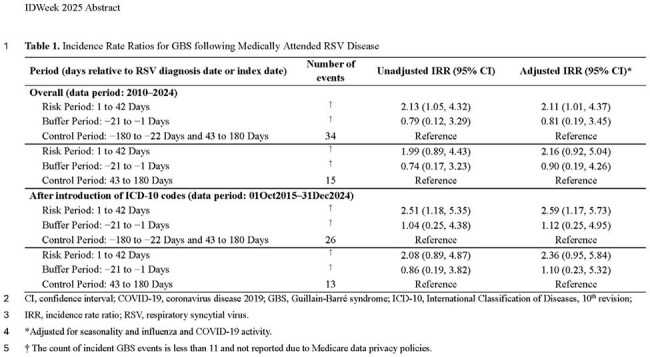 Figure 1
Peer Reviews
No public reviews on file for this paper yet. If you reviewed it on a platform where reviews are public (OpenReview, ICLR, NeurIPS, ICML), you can paste yours below so the community can read it here.
Videos
No videos yet. Explain this paper in a talk, walkthrough, or lecture? Add one.
Taxonomy
TopicsPeripheral Neuropathies and Disorders · Long-Term Effects of COVID-19 · Respiratory viral infections research