P-1491. Invasive Meningococcal Disease Incidence and Risk Among Commercially- and Medicaid-Insured Infants in the United States
Oscar Herrera-Restrepo, Elizabeth Packnett, Megan Richards, Elise Kuylen, Tosin Olaiya, Thatiana Pinto, Lindsay Landgrave, Andrew G Allmon

TL;DR
This study found that invasive meningococcal disease rates are higher in Medicaid-insured infants and those with certain health conditions, especially in the first few months of life.
Contribution
The study provides new insights into the incidence and risk factors of invasive meningococcal disease in U.S. infants based on insurance type and clinical conditions.
Findings
The incidence rate of invasive meningococcal disease was higher in Medicaid-insured infants (1.97) compared to commercially-insured infants (0.45).
Infants aged 0–<4 months had the highest incidence rates in the Medicaid cohort.
Clinical conditions like preterm delivery, renal disease, and complement component deficiency were associated with significantly higher incidence rates.
Abstract
Invasive meningococcal disease (IMD), caused by Neisseria meningitidis, is an uncommon but serious disease. The highest incidence rates (IRs) in the United States (US) are reported among infants (< 1 year). In this study, we estimated IMD IRs by patient characteristics (month [m] of age and clinical conditions) among commercially- and Medicaid-insured US infants. Claims data of commercially- and Medicaid-insured infants from 01/2005–12/2022 were analyzed. Eligibility was based on birth dates (index date: first date patient met the age and enrollment criteria). Conditions known to increase IMD risk (eculizumab use, asplenia, human immunodeficiency virus, complement component deficiency [CCD], sickle cell disease) and those hypothesized to increase IMD risk (asthma, autoimmune disease, type 1 diabetes, corticosteroid use, immunocompromised status, malignancy, preterm delivery, renal…
Genes, proteins, chemicals, diseases, species, mutations and cell lines named across the full text — each resolved to its canonical identifier and authoritative record.
Click any figure to enlarge with its caption.
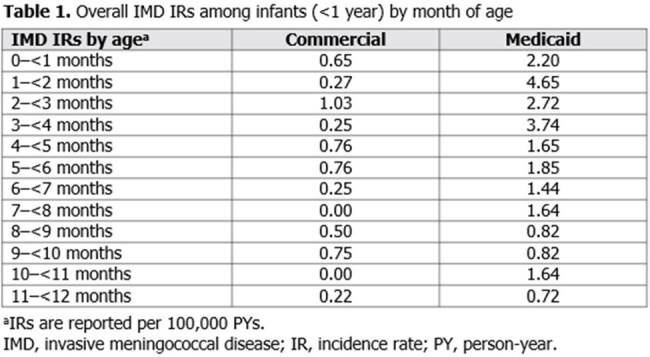 Figure 1
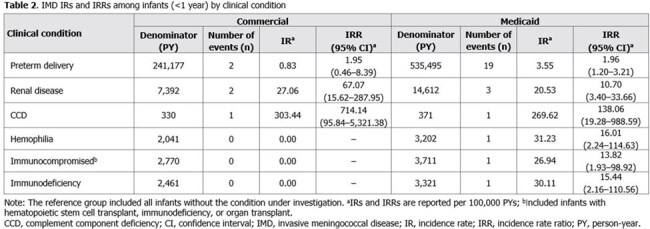 Figure 2
Peer Reviews
No public reviews on file for this paper yet. If you reviewed it on a platform where reviews are public (OpenReview, ICLR, NeurIPS, ICML), you can paste yours below so the community can read it here.
Videos
No videos yet. Explain this paper in a talk, walkthrough, or lecture? Add one.
Taxonomy
TopicsBacterial Infections and Vaccines · Migraine and Headache Studies · Nicotinic Acetylcholine Receptors Study